

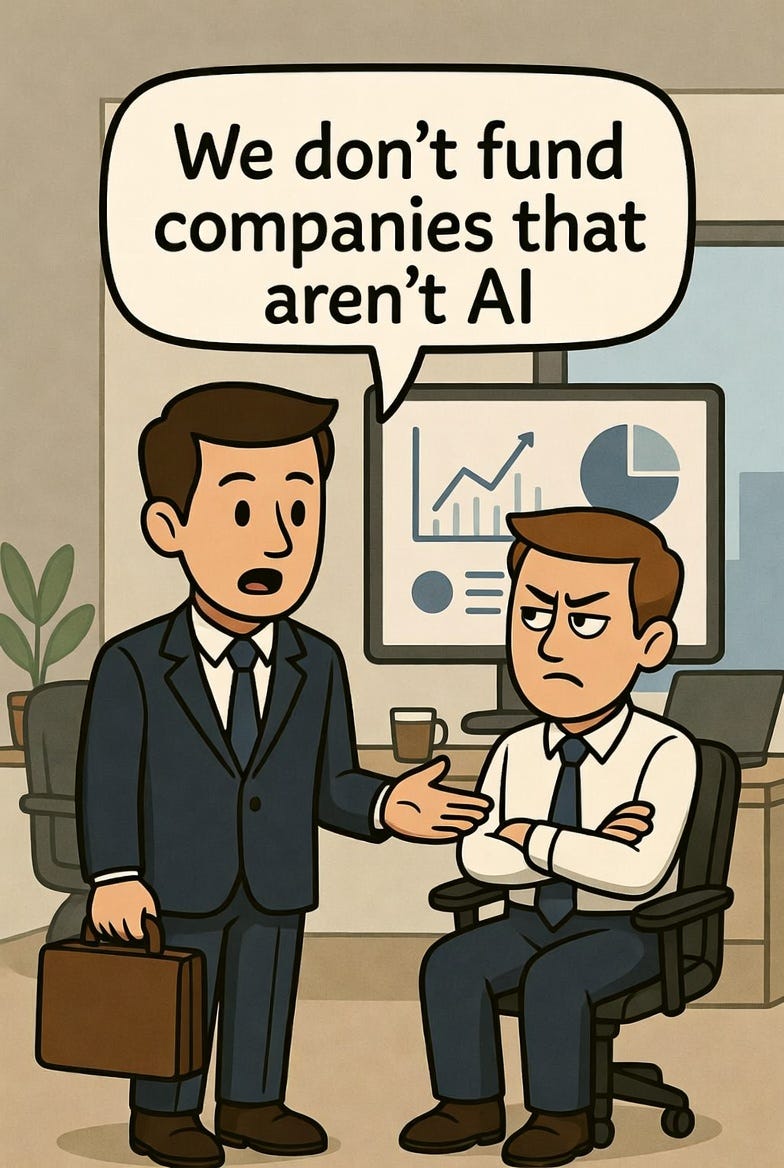
The venture capital party is over for most founders. As AI startups vacuum up 50% of available capital, non-AI businesses face a brutal reality: only companies with exceptional fundamentals, proven traction, and defensible moats will survive the 2026 funding gauntlet. The middle market has evaporated. Here’s why.
10 KEY TAKEAWAYS - THE 2026 VC FUNDING LANDSCAPE
1. AI captured 50% of global VC funding: Over $200 billion in 2025, up from 34% in 2024, capital concentration is accelerating.
2. Non-AI startups face capital scarcity: Only the strongest survive, middle-market deals have evaporated, ghosting is common.
3. The Series A bottleneck is real: 60% of pre-seed companies fail to reach Series A; 35% of Series A fail to reach B.
4. Capital efficiency matters more than ever: Bootstrapping, grants, and IP-backed debt are becoming survival strategies.
5. AI startups face sustainability risks: High burn rates, ROI scrutiny, and 90% failure rate for undifferentiated plays.
6. Defensible moats are non-negotiable: VCs demand clear competitive advantages, tech alone isn’t enough anymore.
7. Mega-rounds dominate AI funding: $500M+ deals concentrate capital among few leaders, leaving scraps for others.
8. 75%+ of non-AI startups won’t return capital: Exit paths narrow to M&A and PE rollups for most companies.
9. Proven traction beats potential: VCs now demand measurable revenue, growth metrics, and unit economics upfront.
10. The funding bar keeps rising: AI’s influence on investor expectations affects ALL sectors, even non-tech businesses.
📚 READING PREREQUISITES
This analysis builds on fundamental business valuation an venture capital principles covered in previous YBAWS! posts. Understanding how investors think about value, risk, and exit multiples will help you grasp why these funding shifts matter, even if you’re not raising VC money. The same metrics VCs use to evaluate startups apply when you’re trying to sell your mature business.
You learn from every YBAWS! Post, these are facts not opinions.
Recommended Prior Reading:
• Understanding Enterprise Value vs. Equity Value
• Why Your Business Isn’t Worth What You Think
• The Series A Crunch: Why 90% of Funded Startups Fail
The Capital Concentration Crisis
Let’s cut through the noise: the venture capital market in 2026 isn’t just selective, it’s bifurcated. If you’re building an AI company with the right pedigree, capital is abundant. If you’re building anything else, you’re fighting for scraps at a table where the feast has already been served.
The numbers tell the story. Artificial intelligence companies captured approximately $200 billion in funding during 2025, representing 50% of all global VC investment. That’s up from 34% just one year earlier. In the US, the concentration is even more extreme, with some quarters seeing AI grab 65-70% of available capital.
What does this mean for everyone else? Simple: you’re competing for half the capital with twice the scrutiny. The middle-market deals that used to get done on potential and vision now require bulletproof metrics. VCs are ghosting founders they would have taken meetings with 18 months ago.
This isn’t temporary market noise. It’s a structural shift in how capital gets allocated. And if you’re a business owner thinking about your own company’s value or exit strategy, pay attention, because the same forces reshaping startup funding are coming for your industry too.
The Funding Landscape in Numbers:
• Global VC investment hit $97B in Q3 2025, up 38% year-over-year
• Market projected to reach $758B by 2029, but distribution will be highly uneven
• Seed-stage deals remain active ($9B across thousands of companies in late 2025)
• Series A progression bottlenecked—extended timelines and capital rationing the new norm
Why Non-AI Founders Are Getting Crushed
Here’s what nobody wants to admit: if you’re not building AI infrastructure, AI applications, or AI-enabled services, you’re playing a different game entirely. And that game has fundamentally different rules.
The challenge isn’t just capital scarcity, it’s capital scarcity combined with elevated expectations. VCs who used to fund promising teams and interesting ideas now demand:
• Proven product-market fit with measurable traction
• Strong unit economics and a clear path to profitability
• Defensible competitive moats beyond just “good execution”
• Elite founding teams with track records or deep domain expertise
The data is brutal. 60% of pre-seed companies fail to reach Series A. Another 35% of Series A companies fail to reach Series B. This isn’t because good companies are failing, it’s because the capital simply isn’t there for everyone who deserves it.
The AI Hype Cycle: Winners and Losers
Don’t think AI companies have it easy either. Yes, capital is abundant, if you’re building the right thing. But the failure rate for undifferentiated AI plays is approaching 90%.
The market is bifurcating within AI itself. Vertical AI companies with strong annual recurring revenue and proven ROI are scaling rapidly to unicorn status. Meanwhile, generic AI wrappers and feature-level products are watching pilot programs dry up and revenue stall.
The sustainability risks are real: high burn rates, intense competition from Big Tech, and increasing pressure to demonstrate actual productivity gains, not just novelty. VCs are starting to ask harder questions about moats and defensibility in AI, just like they should have all along.
What This Means for Your Business
If you’re not raising venture capital, you might think this doesn’t affect you. You’d be wrong.
The same metrics VCs use to evaluate startups, capital efficiency, proven traction, defensible moats, and measured ROI, are exactly what strategic acquirers and private equity buyers will demand when you try to exit. The bar isn’t just rising for startups. It’s rising for everyone.
More importantly, this funding environment tells you where capital is flowing and what investors value. If you’re planning your business strategy for the next 3-5 years, understanding these trends isn’t optional, it’s essential for survival.
Whether you’re a founder, business owner, or advisor, the message is clear: fundamentals matter more than ever. The days of raising capital on potential or selling businesses on multiples of revenue are over. Buyers, whether VCs or strategic acquirers, want to see proof.
Strategic Survival Tactics
So what do you do in this environment? The answer depends on where you sit.
For Non-AI Founders
11. Focus on capital efficiency ruthlessly: Bootstrapping isn’t failure, it’s survival strategy in this market.
12. Target underserved verticals: Climate tech, biotech, defense, and energy still attract capital outside AI.
13. Explore alternative funding: the VC Risk Swap, Grants, IP-backed debt, government partnerships, and strategic revenue deals.
14. Plan for M&A exits: 75%+ of non-AI startups won’t return traditional VC multiples, PE rollups are more realistic.
For AI Founders
15. Build vertical-specific solutions: Generic wrappers are dying, deep domain expertise wins.
16. Demonstrate real ROI: Pilot fatigue is setting in, customers want measurable productivity gains.
17. Control burn rates: Even in AI, the free money era is ending, path to profitability matters.
18. Build defensible moats: Network effects, proprietary data, or deep customer integration, pick one.
For Business Owners and Advisors
19. Understand the metrics: ARR, CAC, LTV, churn, these aren’t just startup jargon, they’re valuation drivers.
20. Focus on fundamentals: Strong unit economics and proven traction will matter more in M&A too.
21. Watch market signals: VC trends today predict buyer behavior tomorrow, pay attention.
💡 KEY TAKEAWAYS
Remember These Core Principles:
• Capital is concentrating, not disappearing: AI captures 50% of VC funding, leaving non-AI founders fighting for the rest.
• Fundamentals beat potential: Proven traction, unit economics, and defensible moats are non-negotiable now.
• The bar is rising everywhere: VC expectations today predict M&A buyer expectations tomorrow—get ready.
• Alternative paths exist: Bootstrapping, grants, IP-debt, and strategic M&A are viable—plan accordingly.
• Execution matters more than ever: The 2026 market rewards proof over promise—deliver results first, raise money second.
❓ FREQUENTLY ASKED QUESTIONS
Q: Does this mean non-AI startups should give up on raising VC?
A: No, but expectations need to be realistic. Focus on underserved verticals, prove exceptional fundamentals, and explore alternative funding. Capital exists for truly differentiated companies—just less of it.
Q: Is AI funding sustainable at these levels?
A: Unlikely. Expect consolidation as ROI pressure mounts and undifferentiated plays flame out. Vertical AI with proven value will survive; generic wrappers won’t. Capital will moderate but remain elevated compared to non-AI sectors.
Q: How does this affect mature business valuations?
A: The same metrics VCs demand—ARR growth, unit economics, competitive moats—are increasingly what strategic buyers want. The discipline forced on startups by tight capital is spreading to traditional M&A. Expect more scrutiny.
Q: What sectors outside AI are still attracting capital?
A: Climate tech, biotech, defense tech, energy innovation, fintech infrastructure, and cybersecurity continue attracting investment. Key is defensible differentiation and clear value propositions—not just interesting technology.
Q: Should business owners care about VC trends if they’re not raising money?
A: Absolutely. VC trends today predict buyer behavior tomorrow. Understanding what investors value helps you build a more valuable, marketable business—whether you exit to PE, strategics, or family succession.
🎯 READY TO BUILD A MORE VALUABLE BUSINESS?
Understanding venture capital trends is just one piece of building a valuable, marketable business. Whether you’re a founder fighting for funding or a business owner planning your exit, the same principles apply: fundamentals matter, moats are essential, and buyers want proof.
Subscribe to YBAWS! for weekly insights on business valuation, M&A strategy, and maximizing your company’s worth. Join business owners who are building more valuable, marketable businesses through unvarnished truth about business exits.
Have questions about your specific situation? Drop a comment below or reach out directly—I respond to every message.
📖 RELATED READING
Continue Your Learning:
• Crunchbase - 2025 Global Venture Capital Report: Comprehensive data on funding trends, deal flow, and sector analysis across global markets.
• PitchBook - Q3 2025 US Venture Monitor: Detailed breakdowns of US venture activity including AI concentration and exit trends.
• Harvard Corporate Governance - The Series A Crunch: Academic analysis of declining graduation rates from seed to Series A and implications for startup ecosystems.
CONNECT WITH SAFERWEALTH
Expand Your Learning Beyond This Post:
22. Web: SaferWealth.com - Alternative Startup Funding Structures
23. Video: SaferWealth Posts - VC Risk Swap Educational Content
24. LinkedIn: @SaferWealth - Startup Finance Innovation
25. Rumble: @saferwealth - Educational video content on business valuation
26. Instagram: @saferwealth - Quick insights and updates
👤 ABOUT THE AUTHOR
Sean Cavanagh, BAS, CPA, CA, CF, CBV
With over three decades negotiating business sales and conducting valuations, Sean delivers unvarnished truth about business exits. Starting at Deloitte and Canada Revenue Agency, he now advises business owners through SaferWealth.ca and his M&A practice. YBAWS! reflects his frustration with owners who consistently overvalue their companies.
Connect with Sean:
• 📧 Email Contact
• 🌐 YBAWS! Website
📚 DO YOUR OWN RESEARCH
The concepts discussed in this article are grounded in current market data and industry analysis. Below are authoritative sources for readers who want to dive deeper:
Market Data & Reports:
• Crunchbase Global Venture Report - Q3 2025 funding data and trends
• PitchBook Venture Monitor - US market analysis and sector breakdowns
• Silicon Valley Bank - State of the Markets Report 2025
Academic & Industry Analysis:
• Harvard Corporate Governance - Series A graduation rate studies
• National Venture Capital Association - Industry statistics and benchmarks
This section empowers readers to verify information, explore topics deeper, and develop their own informed perspectives on venture capital and business valuation principles.
⚖️ EDUCATIONAL DISCLAIMER
This guide provides information only, not professional advice. Consult qualified advisors for your specific situation. All cases are fictional, created for educational purposes from collective industry experience. Neither the author nor YBAWS! accepts liability for actions based on this content. This material supplements but never replaces proper professional consultation and judgment.
YBAWS! (Your Business Ain’t Worth Sh*t!) is a trademark and educational platform dedicated to helping business owners understand corporate value and marketability.
© 2025 YBAWS! All rights reserved.