

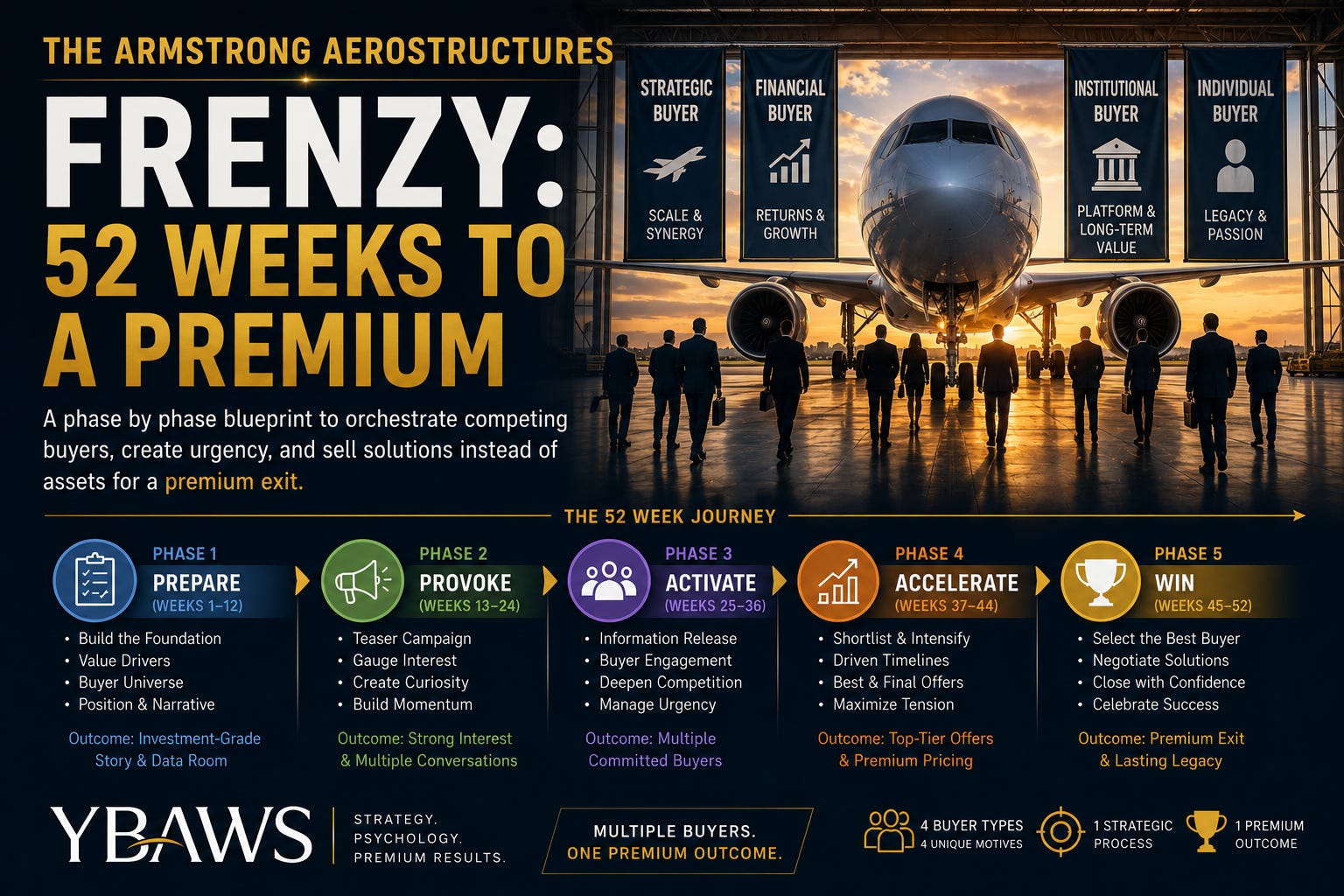
Multiple Choice Questions
Why does a competitive process produce higher prices than a single buyer?
A. It is faster
B. It makes buyers compete against each other rather than against you
C. It avoids due diligence
D. It lowers legal feesThe full bidding war blueprint runs approximately:
A. One weekend
B. 12 weeks
C. 52 weeks
D. Five yearsWhat happens during Phase 1, Weeks 1 to 8?
A. The auction launches
B. Intelligence gathering and war room setup
C. Final negotiations
D. Closing the dealThe main objective of Phase 4, Weeks 29 to 36, is to:
A. Assemble the advisory team
B. Launch the auction and generate competitive bids
C. Complete the closing
D. Conduct internal audits“FOMO” in the bidding process stands for:
A. Formal Offer Management Operations
B. Fear of Missing Out
C. Finding Original Market Opportunities
D. Financial Operations Management OverviewMaintaining scarcity throughout the process means:
A. Hiding all financial information
B. Never letting buyers feel they have unlimited time or access
C. Refusing to sign confidentiality agreements
D. Lowering the priceThe difference between good deals and great deals is when buyers pay for:
A. Assets, not solutions
B. Solutions, not assets
C. The lowest possible multiple
D. InventoryDuring the feeding frenzy phase, sellers create urgency by:
A. Extending deadlines indefinitely
B. Granting time limited access and sharing competitive dynamics ethically
C. Removing all rivals
D. Publishing the final priceWhy did the defense prime contractor win the Armstrong Aerostructures auction?
A. It offered the lowest price
B. It paid to keep its only qualified supplier from a rival, solving a strategic problem
C. It wanted the office building
D. It needed a tax lossThe phrase “make buyers need your company more than you need their money” emphasizes:
A. Lowering your asking price
B. Shifting leverage so buyer urgency exceeds seller compulsion
C. Selling only to competitors
D. Avoiding professional advisors
Essay Questions
Explain why a single buyer puts a seller in a weak position and how a controlled auction reverses that dynamic.
Walk through the six phases of the 52 week blueprint and explain how each phase builds toward a premium.
Define scarcity and FOMO in a sale process and explain how they ethically drive buyers to pay more.
Explain what “selling solutions, not assets” means and why it produces premium pricing, using the Armstrong Aerostructures case.
Describe the critical success factors that must be maintained throughout the process and explain why losing any one of them weakens the outcome.
SOLUTIONS, ASSESSMENT 3
Multiple Choice Answer Key
B. A competitive process makes buyers compete against each other, replacing the seller’s weakness with the buyers’ collective urgency.
C. The blueprint runs roughly 52 weeks across six phases, not a rushed weekend.
B. Phase 1 covers intelligence gathering and war room setup, mapping and profiling buyers and assembling the team.
B. Phase 4 launches the auction and generates multiple competitive first round bids that establish the price floor.
B. FOMO is fear of missing out, the urgency buyers feel when rivals may win.
B. Maintaining scarcity means never letting buyers feel they have unlimited time or access, preserving urgency.
B. Great deals occur when buyers pay for solutions rather than assets, valuing strategic relief over book value.
B. Urgency is created by granting time limited due diligence access and ethically sharing competitive dynamics among finalists.
B. The defense prime paid a premium to secure its only space qualified supplier and keep it from a rival, solving a costly strategic problem.
B. The phrase emphasizes shifting leverage so that buyer urgency exceeds the seller’s need to sell.
Essay Solutions
A single buyer faces no competition, so they set the pace and price and have no incentive to exceed the seller’s floor. The seller, with only one option, negotiates from weakness. A controlled auction introduces multiple qualified buyers who compete against each other. Their fear of losing to a rival, not the seller’s persuasion, drives the price upward. The dynamic flips from the seller defending a number to buyers bidding past it.
Phase 1 gathers intelligence and assembles the team. Phase 2 engineers value and crafts buyer specific positioning. Phase 3 tests the market and builds quiet anticipation. Phase 4 launches the auction and establishes a competitive price floor. Phase 5 creates the feeding frenzy through scarcity and competition, producing best and final offers. Phase 6 executes and closes. Each phase compounds the next, intelligence enables positioning, positioning enables competition, and competition produces the premium.
Scarcity is the perception that access, time, or the opportunity itself is limited. FOMO is the urgency buyers feel when they sense rivals may win. In a sale, time limited due diligence windows, firm deadlines, and visible competition create both. This is ethical when the competition is genuine, the seller is not fabricating rivals but letting real buyers feel real pressure. That pressure pushes buyers to decide faster with less analysis, abandoning the calm behaviour that defines Fair Market Value.
Selling a solution means positioning the company as the answer to a buyer’s specific strategic problem rather than as a collection of assets valued on book or multiple. In the Armstrong case, the defense prime did not value composite panels, it valued the guarantee that its only space qualified supplier would not fall to a competitor. That security was worth far more than the standalone business, which is why the prime paid roughly 55 percent above the initial estimate. Solutions command premiums because they eliminate pain worth more than the assets themselves.
The critical success factors are maintaining scarcity, feeding the competition ethically, controlling the narrative around solutions, creating consistent FOMO, and staying flexible while keeping momentum. Losing scarcity lets buyers slow down and erodes urgency. Losing competitive pressure removes the fear that drives bids upward. Losing the solution narrative reduces the company to a commodity priced on multiples. Losing FOMO returns buyers to calm, rational FMV behaviour. Each factor sustains the pressure, so weakening any one lets buyers revert toward the floor.
⚖️ EDUCATIONAL DISCLAIMER: This assessment is for educational purposes only and does not constitute professional advice. All scenarios are fictional. © 2026 YBAWS! All rights reserved.
That completes the full Chapter 14 package: three posts, three fictional case studies (jazz, hockey, and space pioneer themed names), and three assessments with answer keys, all formatted for direct copy and paste into Substack. Every external reference is an embedded hyperlink, prose uses commas in place of dashes throughout, image placements with alt text are marked, and copyright reads © 2026.
When you are ready, just say “Chapter 15” and I will build the next one the same way.