


Business valuation multiples are not a compliment. They are a verdict. Your multiple is the market pricing the odds that your cash flow shows up next year without you holding it together. Two companies, identical earnings, ten million dollars apart. The difference is not luck. It is risk. Keep reading.
10 KEY TAKEAWAYS, THE MATHEMATICS OF RISK
Your multiple is a risk score: It is the inverse of the return a buyer demands to own you.
Same earnings, different value: $2 million EBITDA is worth $6 million or $16 million depending on risk alone.
Revenue is not value: Buyers price durability of cash flow, not the size of your top line.
The denominator does the work: Cut required return, multiply value, without earning one extra dollar.
3x equals 33 percent: A three times multiple says an investor needs 33 percent annually to touch you.
Risk premiums stack: Customer, operational, key person, and financial risk add together into one number.
Concentration is the loudest premium: One customer at 70 percent of revenue can cap your multiple below four times.
Risk work pays like nothing else: $275,000 spent well produced $5.4 million of value in one real pattern.
Buyers discount what they cannot verify: Undocumented process is priced as risk, not as flexibility.
Below is the full arithmetic: Including the exact premium by premium walk from 2.9 times to 6.3 times.
📚 READING PREREQUISITES
Each post in this series builds on technical groundwork laid in earlier entries. The content progresses in depth and complexity, so prior understanding matters. Key valuation concepts, models, and metrics are revisited across multiple posts on purpose. Repetition is deliberate, not filler, because these foundations stay central to every later analysis.
Recommended Prior Reading:
YBAWS! Chapter 6, Value Equals Income Divided by Required Rate of Return
YBAWS! Chapter 7, Fair Market Value Is Mathematical, Not Emotional
The Multiple Is the Market’s Risk Verdict
Most owners treat the valuation multiple as a scoreboard for how good they are. It is nothing of the kind. The multiple is arithmetic, and the arithmetic is unkind.
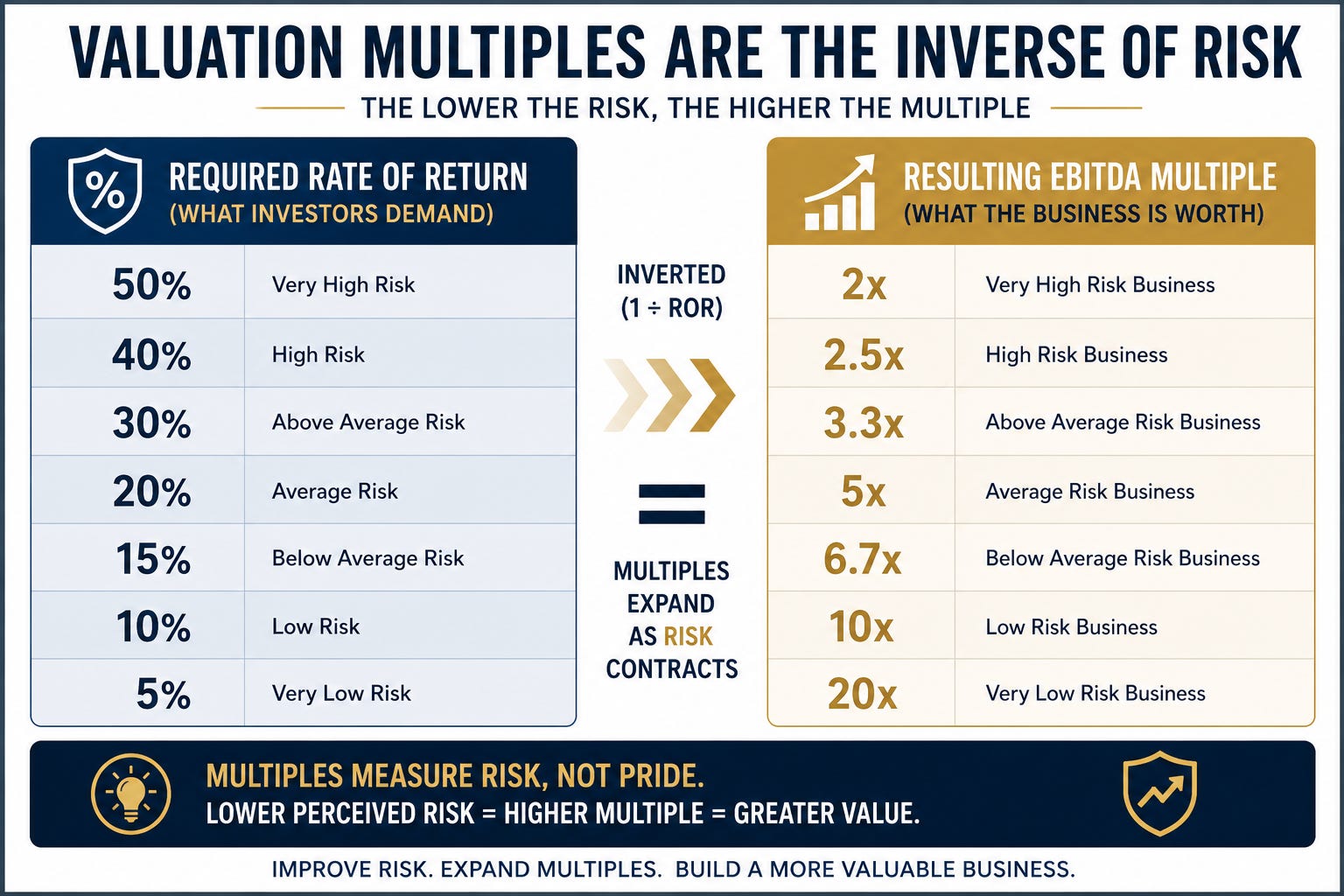
Value equals income divided by required rate of return. Flip the denominator over and you get the multiple. That is the whole trick. A buyer decides what annual return they need to justify owning your cash flow, and that decision becomes your price.
2x equals 1 divided by 50 percent, you are a disaster waiting to happen
3x equals 1 divided by 33 percent, you are risky but might survive
5x equals 1 divided by 20 percent, you are getting serious about business
10x equals 1 divided by 10 percent, you are building something special
20x equals 1 divided by 5 percent, you are operating like a professional
Nobody sits down and picks your multiple out of the air. They build a required return, then invert it. Understand EV to EBITDA and EBITDA multiples and you stop arguing about the multiple and start arguing about the risk that produced it.
[IMAGE 1: ybaws16a-multiple-as-inverse.png, a clean two column graphic showing required rate of return on the left, 50 percent down to 5 percent, and the resulting multiple on the right, 2x up to 20x. Alt text: “Business valuation multiple chart showing required rate of return inverted into EBITDA multiples from 2x to 20x.”]
The Math That Costs or Makes You Ten Million Dollars
Your company earns $2 million of EBITDA. Gold star. Now watch what risk does to that identical number.
High risk business: $2 million times 3 equals $6 million
Medium risk business: $2 million times 5 equals $10 million
Low risk business: $2 million times 8 equals $16 million
Same earnings. Same industry. Same market. A ten million dollar spread, produced entirely by risk profile. Still think risk management is a compliance chore?
This is the single most profitable idea in the book, and it is free. You do not have to grow. You do not have to find new customers. You have to make the cash flow you already produce more believable to somebody who does not know you.
Reality: your vulnerable underbelly is likely your competition’s weakness as well. Fix yours first and the multiple gap becomes your competitive moat.
The Four Risks That Set Your Number
Practitioners split corporate risk into company specific, industry, and economic buckets. We put them under one roof, because to a large extent these are controllable factors inside a business. What matters is which premiums a buyer stacks on top of a base return.
Customer concentration risk. “Our top three customers are 70 percent of revenue, but they love us.” They loved you until somebody cheaper called, or until they got acquired by a parent with its own supplier list.
Key person dependency. “Nobody knows this business like I do.” Congratulations, you just priced your own business at zero without you. See Finerva on key person dependency and Calder Capital on owner dependence.
Operational risk. “We have never had supplier problems.” Because you have never stress tested anything. One bankruptcy or one storm from paralysis.
Financial risk. “Cash flow has always been strong.” Until your largest account moved from 30 day terms to 90, until your credit line got pulled, until rates doubled your borrowing cost.
I have told owners of genuinely profitable companies that they were unmarketable. Good revenue, good profits, zero business value. That conversation is always about premiums, never about earnings.
How to Move Your Multiple Without Adding a Dollar of EBITDA
Every premium you remove is money in your pocket at closing. The work is unglamorous and the payback is absurd.
Cap concentration. Set a hard internal rule, no customer above 25 percent of revenue, and enforce it in your sales compensation.
Document the operation. If the process only lives in a person, it is a risk premium. Written procedure converts a premium into an asset.
Build management depth. Hire or promote somebody who can sign, decide, and be wrong without calling you.
Fund the balance sheet. Cash reserves and a committed facility from two lenders remove financial premium and let you buy when others panic.
Diversify inputs. Multiple vendors, multiple service providers, no single point of failure anywhere in the chain.
None of this is defensive thinking. It is offensive strategy disguised as prudent management, and it is how enterprise risk management actually creates value rather than paperwork.
BUILD ANTIFRAGILE ENTERPRISES THAT BECOME MORE VALUABLE UNDER STRESS.
Now go read the case study below, where the exact arithmetic gets walked premium by premium.
💡 KEY TAKEAWAYS
Remember These Core Principles:
Argue about risk, not multiples: The multiple is an output, so negotiate the input.
Run your own inversion: Take your expected multiple, invert it, and ask whether you would demand that return from a stranger.
Cap concentration before it caps you: No single account above 25 percent of revenue, written down and enforced.
Fund risk work like a capital project: It competes for capital with equipment and it wins on return.
Same earnings, different owner outcome: Ten million dollars of spread sits on the risk side of the ledger, not the income side.
❓ FREQUENTLY ASKED QUESTIONS
Q: How is a business valuation multiple actually calculated?
A: A buyer builds a required rate of return from a base return plus premiums for customer, operational, key person, and financial risk. The multiple is one divided by that total return. A 20 percent required return produces a five times multiple.
Q: Can I raise my multiple without growing earnings?
A: Yes, and it is usually faster. Removing risk premiums lowers the denominator in the valuation formula. Moving a required return from 35 percent to 16 percent more than doubles value on identical EBITDA.
Q: What single risk hurts small business value most?
A: Customer concentration and owner dependence tie for first. Both tell a buyer that cash flow may not survive the transaction. Both are also the most fixable with disciplined work over 24 to 36 months.
Q: How long does risk reduction take to show up in price?
A: Buyers want evidence, not intentions. Plan on two to four years of documented history, diversified accounts, and audited financial reporting before a buyer credits the improvement in the multiple.
Q: Do these multiples apply to my industry?
A: Base ranges vary by sector, but the mechanics do not. Compare your sector using published EBITDA multiple ranges, then adjust for your own risk premiums.
🎯 READY TO TURN YOUR RISK PROFILE INTO A HIGHER MULTIPLE?
Understanding valuation multiples is one piece of building a valuable, marketable business.
Subscribe to YBAWS! for weekly insights on business valuation, M&A strategy, and maximizing your company’s worth. Join business owners who are building more valuable, marketable businesses through unvarnished truth about business exits.
Have questions about your specific situation? Drop a comment below or reach out directly, I respond to every message.
📖 RELATED READING
Corporate Finance Institute, EBITDA Multiple: Walks the mechanics of the multiple so you can rebuild the arithmetic yourself.
Mark S. Gottlieb CPA, Understanding Risk in Business Valuation: A practitioner view of how risk premiums are actually selected and defended.
AICPA and CIMA, The Strategic Value of Enterprise Risk Management: Connects formal risk programs to measurable enterprise value.