

Multiple Choice Questions
1. A five times EBITDA multiple corresponds to what required rate of return?
a) 10 percent b) 15 percent c) 20 percent d) 25 percent
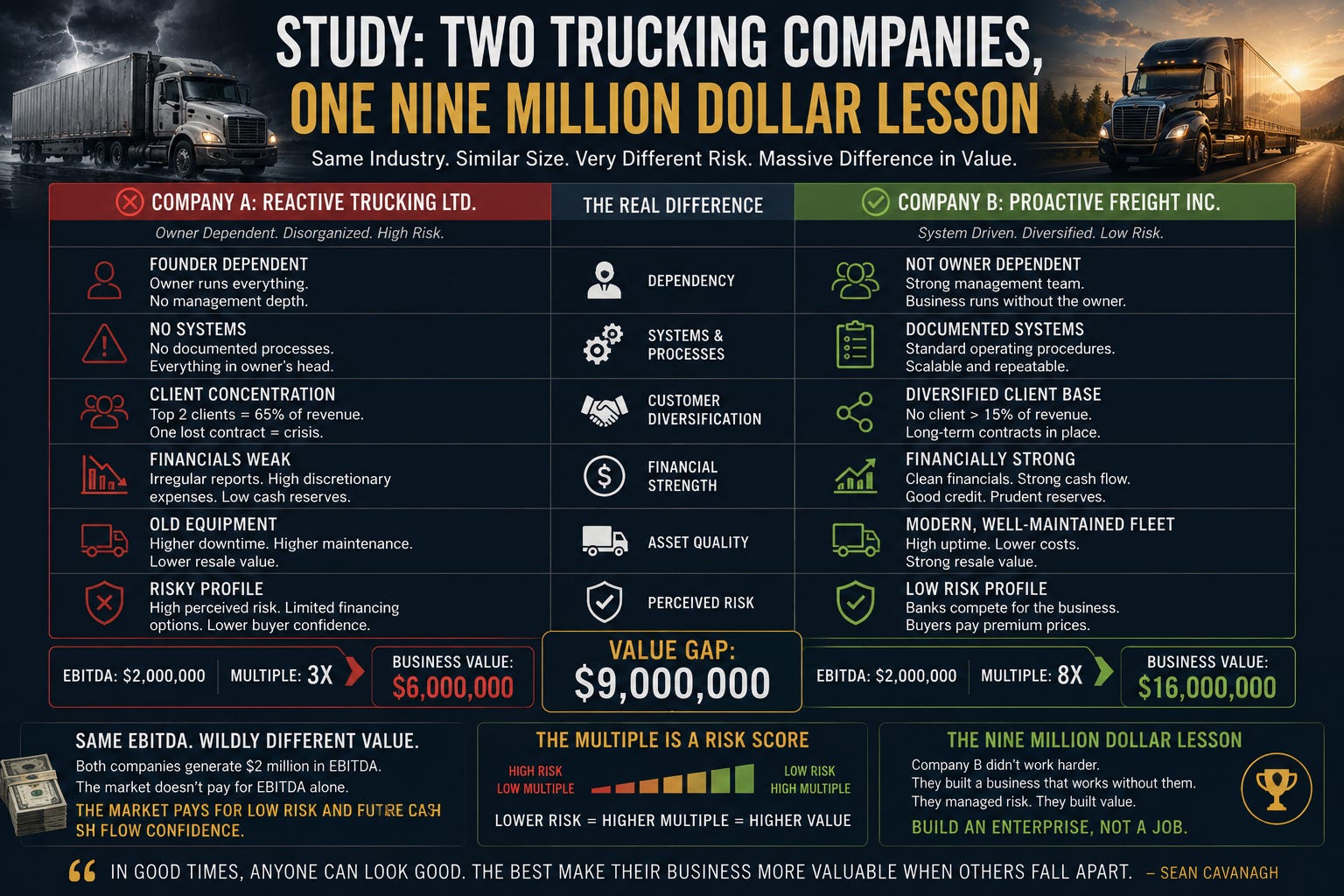
2. On $2 million of EBITDA, moving from a high risk to a low risk profile changes value by how much?
a) $4 million b) $6 million c) $10 million d) $16 million
3. What was Superior Logistics’ hard internal ceiling for any single customer?
a) 20 percent of revenue b) 25 percent of revenue c) 30 percent of revenue d) 35 percent of revenue
4. Superior Logistics’ total company specific risk premium moved from 25 percent to what level?
a) 2 percent b) 6 percent c) 10 percent d) 14 percent
5. What return on investment did Bessie Smith earn on her $275,000 of risk work?
a) 964 percent b) 1,464 percent c) 1,964 percent d) 2,464 percent
6. By the year before its collapse, what share of Metro Freight’s revenue came from its largest customer?
a) 60 percent b) 70 percent c) 78 percent d) 85 percent
7. Metro Freight’s cash reserves at the time of the crisis were approximately:
a) $45,000 b) $145,000 c) $450,000 d) $800,000
8. Which statement about the valuation formula is correct?
a) The multiple sets the required return
b) The required return is the inverse of the multiple
c) Revenue growth is the only path to a higher multiple
d) Multiples are set by industry alone
9. Which of the following is not one of the four risk premiums discussed?
a) Customer concentration b) Operational c) Trademark d) Financial
10. The total value difference between the two trucking companies was:
a) $5.9 million b) $6.2 million c) $9.0 million d) $10.8 million
Essay Questions
1. Explain the mathematical relationship between required rate of return and valuation multiple. Use the $2 million EBITDA example to show why identical earnings produce a ten million dollar spread in enterprise value.
2. Bessie Smith invested $275,000 and created $5.4 million of value without increasing EBITDA. Walk through the premium by premium arithmetic and explain what accountants would call the denominator effect.
3. Stevie Ray Vaughan described his 78 percent customer concentration as growth. Explain why a buyer reads the same fact as a risk premium, and quantify the likely impact on his multiple.
4. Argue the case that risk reduction spending should compete for capital against equipment purchases inside a business. Use return on investment figures from the case study, and identify where the argument is weakest.
5. Metro Freight had higher revenue and higher EBITDA than Superior Logistics and still sold for one sixth of the price. Explain what this reveals about the difference between profitability and marketability, and describe three specific actions Stevie Ray could have taken in year one.
🔑 SOLUTIONS
Multiple Choice Answers
1. c) 20 percent. One divided by 0.20 equals 5. The multiple is always the inverse of required return.
2. c) $10 million. High risk at three times gives $6 million. Low risk at eight times gives $16 million. The spread is $10 million on identical earnings.
3. b) 25 percent of revenue. Bessie set the ceiling as a written policy and enforced it through her sales process, reaching 22 percent across 47 accounts.
4. b) 6 percent. Customer risk fell from 8 to 2, operational from 6 to 1, management from 7 to 2, and financial from 4 to 1, totalling 6 percent.
5. c) 1,964 percent. $5.4 million divided by $275,000 equals 19.6 times, or 1,964 percent.
6. c) 78 percent. Concentration grew from 60 percent to 78 percent while Stevie Ray described it as growth.
7. a) $45,000. Minimal reserves in a business checking account, with no committed credit facility behind them.
8. b) The required return is the inverse of the multiple. Value equals income divided by required return, so the multiple is one divided by that return.
9. c) Trademark. The four premiums are customer concentration, operational, key person or management, and financial.
10. c) $9.0 million. A $10.8 million exit against a $1.8 million distressed sale.
Essay Answer Guidance
1. A complete answer states value equals income divided by required rate of return, and that the multiple is the reciprocal of that return. It applies the figures, $2 million times 3 equals $6 million at a 33 percent required return, times 5 equals $10 million at 20 percent, times 8 equals $16 million at 12.5 percent. The key insight is that industry, earnings, and market conditions are held constant, so the entire $10 million spread is produced by risk perception. Strong answers note that the relationship is non linear, so early premium reductions at high required returns move value far more than later ones.
2. Expected content: the four premiums and their movements, customer 8 to 2, operational 6 to 1, management 7 to 2, financial 4 to 1, giving a total company specific premium falling from 25 percent to 6 percent and a total required return falling from 35 percent to 16 percent. Then $1.6 million divided by 0.35 equals $4.6 million at 2.9 times, and $1.6 million divided by 0.16 equals $10.1 million at 6.3 times, a $5.4 million increase on a $275,000 investment, or 1,964 percent. The denominator effect is the observation that reducing the divisor multiplies value, which is why risk work outperforms growth work at high starting risk levels.
3. Strong answers separate the seller view from the buyer view. Stevie Ray saw an expanding partner and rising revenue. A buyer sees that 78 percent of future cash flow depends on a contract they do not control, held by a counterparty who can leave on notice. The buyer prices the probability weighted loss, which shows up as an elevated customer concentration premium, plausibly 8 to 12 percent added to required return. On a 16 percent otherwise clean return, adding 10 points moves the multiple from roughly 6.3 times to roughly 3.8 times, cutting value by about 40 percent. Best answers note the acquisition of his customer proved the buyer right.
4. The affirmative case: risk spending at Superior Logistics returned 1,964 percent over four years, far above any realistic return on a truck or a machine, and the gain is realized at exit as a permanent revaluation rather than as incremental margin. Risk spending also compounds, because documented process and management depth make later growth cheaper. The weaknesses to identify: the return is only realized on a sale or financing event, so an owner who never transacts captures less of it. The premium reductions used are judgment based, not observable market prices. The case study is a single fictional illustration, and survivorship bias means we rarely see the risk programs that did not move a multiple. A strong answer concludes that risk spending belongs in the capital budget but should be staged and evidence tested.
5. Profitability measures what the business earned last year under current ownership. Marketability measures whether a stranger can buy that earnings stream and keep it. Metro Freight’s $1.7 million of EBITDA was real and was also entirely contingent on one contract and one man, so a buyer could not underwrite it. Three year one actions: first, set and enforce a concentration ceiling and fund a dedicated business development role to build accounts below the top customer. Second, document the customer relationships and operating procedures so knowledge sits in the company rather than in the owner, and cross train staff against those documents. Third, build a cash reserve of at least three to six months of operating expenses and establish a committed credit facility with a second lender, so a revenue shock becomes a bad quarter rather than an insolvency. Strong answers add that each action maps directly to a named risk premium and can be measured
.
Have questions about your specific situation? Drop a comment below or reach out directly, I respond to every message.
📖 RELATED READING
AICPA and CIMA, Strategic Value of Risk Management: How structured risk management creates measurable firm value.
Investopedia, Enterprise Risk Management: The framework connecting preparation to protected and created value.
Calder Capital, Effects of Owner Dependence: Why systems dependent businesses command premium multiples.
CONNECT WITH SAFERWEALTH
Web: SaferWealth.com, Alternative Startup Funding Structures
YouTube: @CapitalToolKit, Business valuation and M&A education
LinkedIn: LinkedIn @SaferWealth, Startup Finance Innovation
Rumble: @saferwealth, Educational video content
Instagram: @saferwealth, Quick insights and updates
👤 ABOUT THE AUTHOR
Sean Cavanagh, BAS, CPA, CA, CF, CBV
With over three decades negotiating business sales and conducting valuations, Sean delivers unvarnished truth about business exits. Starting at Deloitte and Canada Revenue Agency, he now advises business owners through his M&A practice. YBAWS! reflects his frustration with owners who consistently overvalue their companies.
Connect with Sean:
📚 DO YOUR OWN RESEARCH
Professional Standards & Organizations:
Risk Management Frameworks:
Key Terms & Definitions:
This section empowers readers to verify information, explore topics deeper, and develop their own informed perspectives on business valuation principles.
⚖️ EDUCATIONAL DISCLAIMER
This guide provides information only, not professional advice. Consult qualified advisors for your specific situation. All cases are fictional, created for educational purposes from collective industry experience. Neither the author nor YBAWS! accepts liability for actions based on this content. This material supplements but never replaces proper professional consultation and judgment.
YBAWS! (Your Business Ain’t Worth Sh*t!) is a trademark and educational platform dedicated to helping business owners understand corporate value and marketability.
© 2026 YBAWS! All rights reserved.