

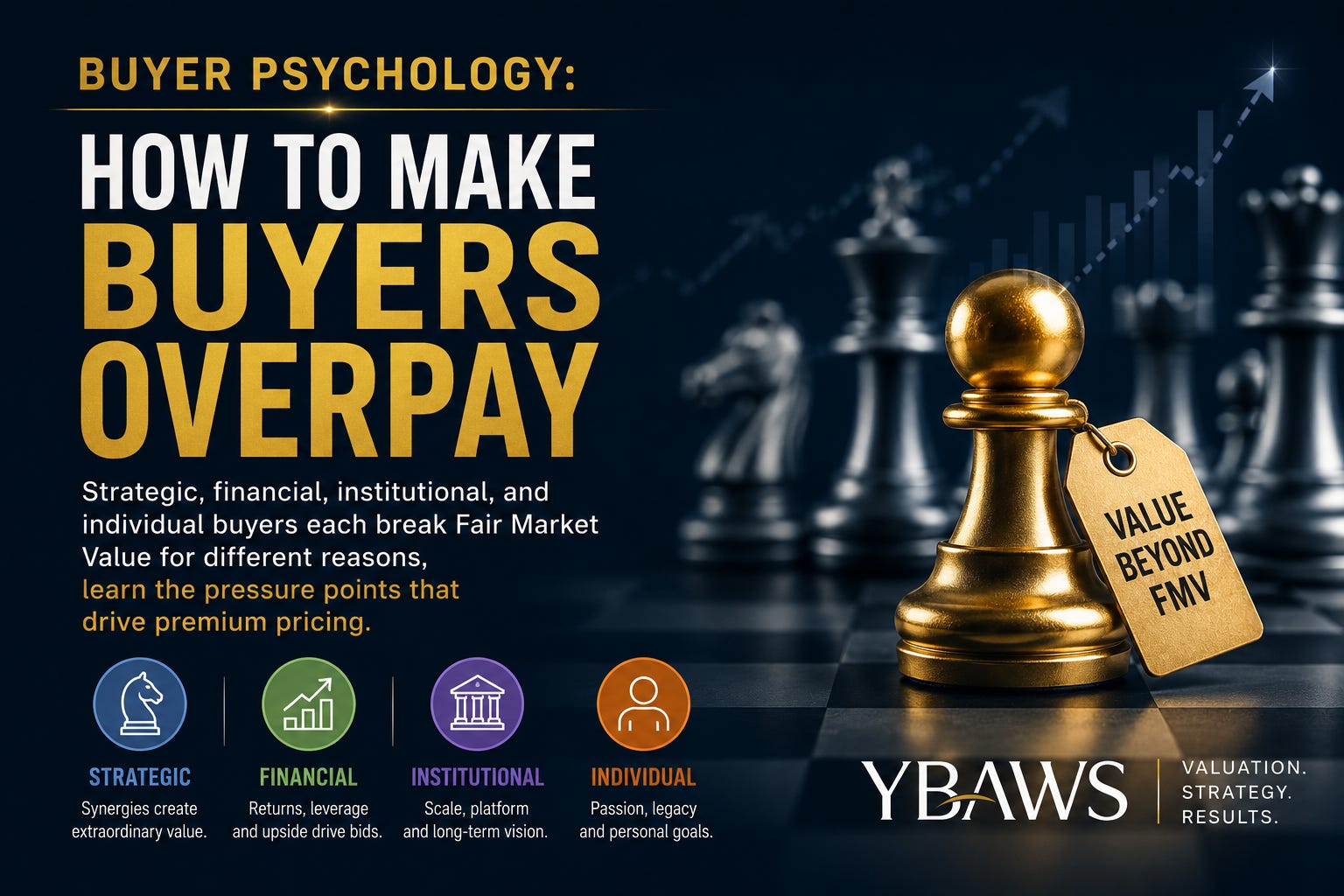
Every buyer who overpays does it for a reason, and the reasons differ wildly. The competitor fears your rival. The private equity firm fears a ticking clock. The entrepreneur wants purpose. Master buyer psychology and you stop selling a business, you start selling a solution they cannot refuse.
10 KEY TAKEAWAYS, BUYER PSYCHOLOGY AND PREMIUM PRICING
Buyers buy solutions: Strategic acquirers purchase relief from problems, not your widgets.
Competitors fear loss: They pay premiums to keep rivals from getting stronger.
Synergies justify madness: A deal that cuts a buyer’s costs is worth more than its price tag.
Time compression sells: Buyers pay to skip years of building from scratch.
PE has a clock: Deployment pressure pushes premiums in a fund’s final year.
Leverage changes the math: Debt turns a modest asset return into a large equity return.
Roll ups pay for completion: The final piece of a platform commands extra.
Institutions chase mandates: Allocation deadlines create artificial demand.
Individuals buy emotion: Purpose, lifestyle, and legacy override the spreadsheet.
Know the pressure point: Find what each buyer fears or needs, then position to it.
📚 READING PREREQUISITES
This post builds on the foundations laid earlier in the series. Concepts are revisited deliberately to reinforce how they interconnect. Understanding Fair Market Value and risk reduction will make the buyer strategies below far more powerful.
Recommended Prior Reading:
Strategic Buyers: The Panic Premium
Strategic buyers are your goldmine. They are not buying your widgets or digits, they are buying competitive advantage, market position, and sleep at night security. They include competitors, suppliers, customers, and companies desperate for market entry. As the saying goes, strategic buyers buy solutions to the problems that keep them awake at night.
The Competitor Buyer
Your competitor is not just buying your business, they are buying the elimination of a threat. When two rivals bid for the same target, both understand a simple truth: the winner gains share while the loser watches an opponent grow stronger. That dynamic creates beautiful desperation. Competitors have paid 40 percent premiums purely to keep a rival from winning. That is not stupidity, it is strategic necessity.
The Supplier or Customer Buyer
Vertical integration buyers chase margin capture and supply chain control. A supplier buying your operation eliminates a margin it was paying and locks in volume. A customer acquiring you removes your profit and guarantees supply. These buyers calculate synergies that justify prices that look insane on a standalone basis. A 10 million dollar acquisition that removes 3 million in annual costs is worth far more than 10 million to the right buyer.

The Market Entry Buyer
Companies wanting geographic or product expansion face a brutal choice: build from scratch over years or buy immediate presence. Building demands regulatory approvals, customer acquisition, and operational development. Buying delivers instant results. The time value of accelerated entry justifies large premiums. Why spend three years and 20 million building when you can spend 15 million and own the market tomorrow?
Strategic buyers pay premiums because they value:
Elimination of a competitive threat
Synergies that cut their own costs or boost revenue
Compressed time to market versus building internally
Strategic positioning that is hard or slow to replicate
Financial Buyers: The Leverage and Deployment Game
Private equity and financial buyers operate under pressures that make them abandon FMV in predictable ways. They are playing with other people’s money under time constraints that create their own urgency.
The Deployment Pressure
PE firms with committed capital face a ticking clock. Limited partners expect that dry powder to be deployed within a defined window. Fund managers approaching investment deadlines will pay premiums rather than return capital and look incompetent. Firms have paid 15 to 20 percent premiums in their final investment year, because returning capital signals failure to their investors. That is survival instinct, not poor judgment.
The Leverage Mathematics
When a buyer finances 70 percent of an acquisition with cheap debt, they are not buying a business, they are buying equity returns. A company generating 15 percent returns on assets can generate roughly 35 percent returns on equity once properly leveraged. This is the engine behind every leveraged buyout. It explains premiums that look excessive on an enterprise value basis but make perfect sense on an equity return basis.
The Roll Up Strategy
Financial buyers building platforms through multiple acquisitions value each deal for its contribution to the whole. In a roll up, the fifth acquisition might command a premium because it completes the market coverage needed for a strategic exit. Your company might be worth 10 million standalone but 15 million as the final piece of a 100 million dollar exit story.
Institutional Buyers: The Mandate Machine
Pension funds, insurers, and institutional investors face asset allocation mandates that create artificial demand. A pension fund needing 50 million dollars of alternative investments this quarter will pay premiums for quality opportunities, because the mandate is to deploy capital efficiently, not to find the cheapest deal.
Institutional pressure points include:
Allocation deadlines that must be met within policy constraints
Liability matching, where steady, predictable earnings command a premium
Diversification benefits, where currency and geographic exposure justify higher prices
Individual Buyers: The Emotional Goldmine
Individual buyers decide on factors far beyond financial returns, and emotion produces the most dramatic departures from FMV. The successful entrepreneur often pays a premium for intellectual stimulation, industry status, and personal fulfillment, sometimes 30 percent above rational value, because they are buying purpose and identity. The lifestyle buyer pays extra for a business in a desired location, valuing balance as much as return. The legacy builder pays for community ties, reputation, and family heritage that no spreadsheet captures.
When you understand which buyer sits across the table, you can position your company as the precise solution to what they fear or crave. That is the heart of premium pricing.
