

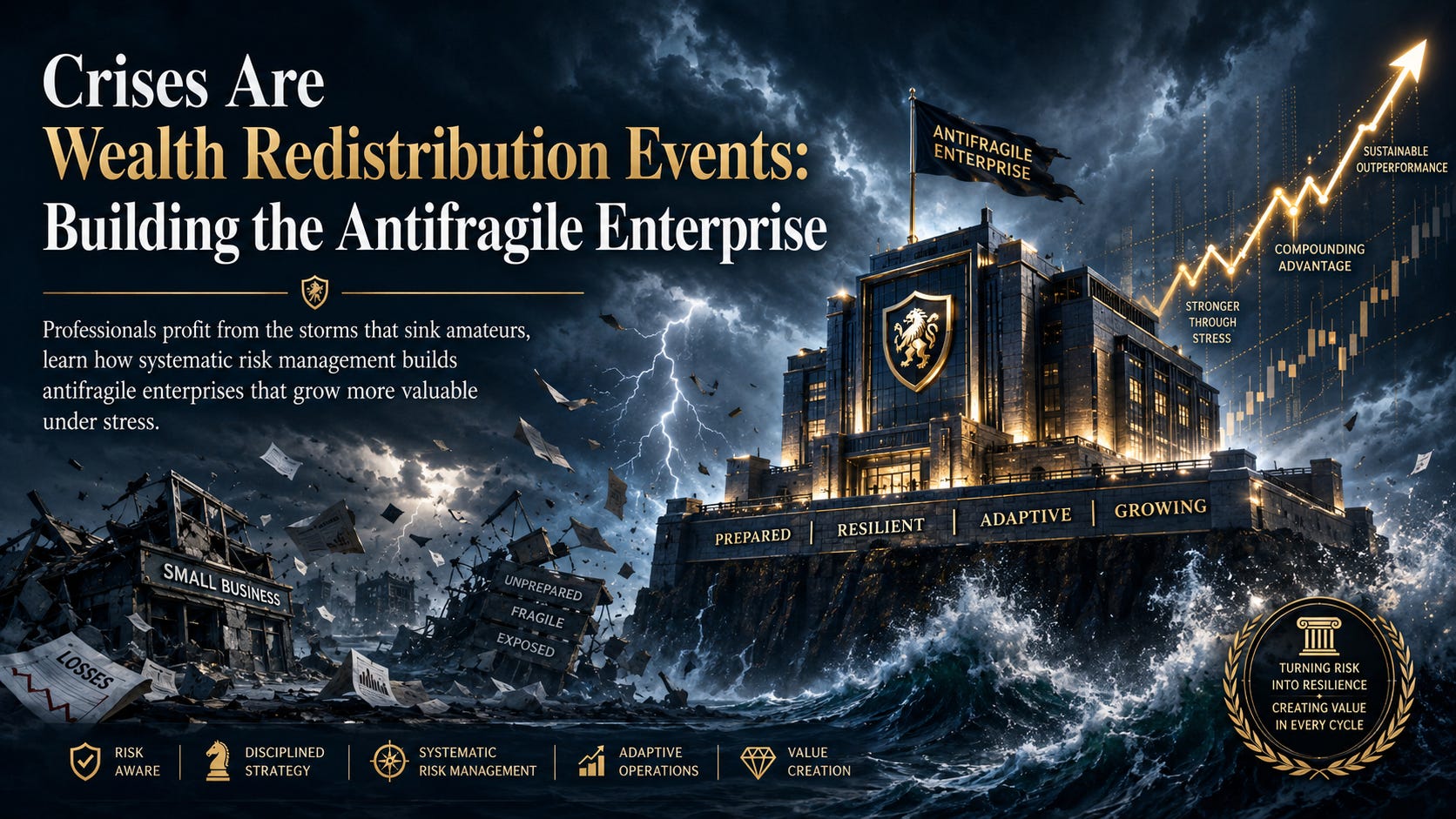
Money does not disappear in a crisis, it changes hands. Market share does not vanish, it transfers. Amateurs panic and retreat while professionals execute predetermined strategies to acquire distressed assets and market share. The difference is preparation. Ready to build an enterprise that becomes more valuable under stress, not less?
10 KEY TAKEAWAYS, THE ANTIFRAGILE ENTERPRISE
Amateurs versus professionals: One sees risk as fate, the other as a manageable advantage.
Crises redistribute wealth: Money and market share change hands, they do not vanish.
Preparation enables offense: You cannot acquire assets without capital and capability.
Document to de risk: Every process you document reduces operational risk.
Diversify to survive: No single customer defection should be able to destroy you.
Cross train your people: Key departures should never paralyze operations.
Build cash reserves: Reserves let you survive downturns and seize opportunities.
Redundancy beats fragility: Multiple vendors and systems remove single points of failure.
Risk management is offense: It is offensive strategy disguised as prudent management.
Antifragile enterprises win: They do not just survive stress, they grow more valuable in it.
📚 READING PREREQUISITES
This post applies the risk multiplier and preparation principles from the first two posts to crisis strategy. You should understand that reducing the required return multiplies enterprise value.
Recommended Prior Reading:
What Separates Professionals From Amateurs
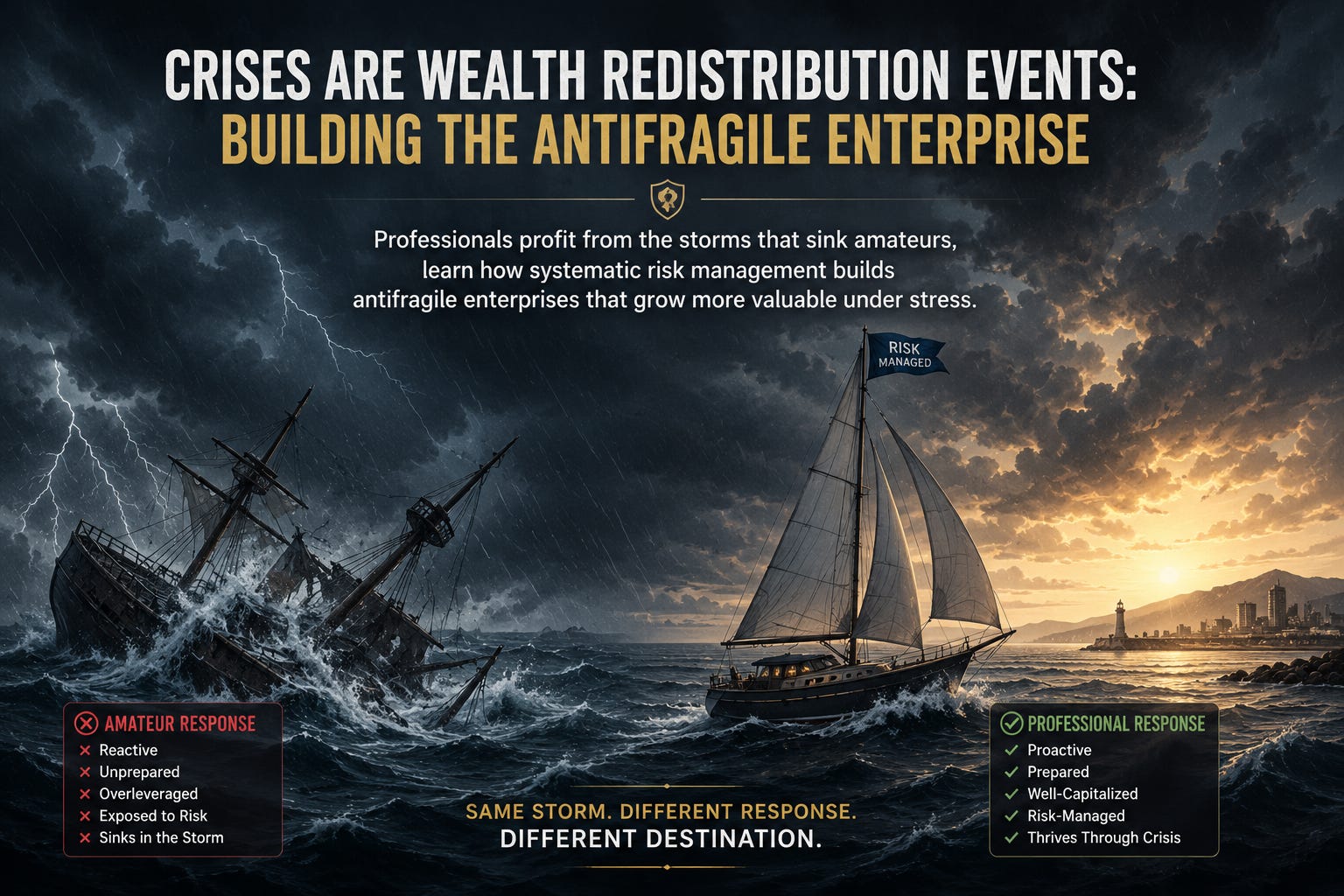
The amateur owner sees risk as something that happens to them. The professional sees risk as something they can manage and leverage for competitive advantage. That single difference in mindset shows up in dollars every time a crisis hits.
How the two respond when crisis strikes:
When recessions hit, amateurs panic and retreat, professionals execute predetermined strategies to acquire market share and distressed assets.
When key employees leave, amateurs scramble to replace them, professionals rely on documented processes and cross trained teams.
When customers defect, amateurs chase them desperately, professionals lean on diversified revenue and acquisition systems.
When suppliers fail, amateurs face operational paralysis, professionals switch to redundant supply chains.
Professionals understand that crises are wealth redistribution events. Money does not disappear, it changes hands. Market share does not vanish, it gets transferred. But you cannot be opportunistic if you are not prepared. You cannot acquire assets if you have no capital, and you cannot capture market share if your business model is fragile. For the professional framing, Investopedia on enterprise risk management explains how structured preparation protects and creates value.
The Preparation That Creates Exponential Value
Risk management is not about eliminating every risk. It is about systematically preparing for predictable challenges while positioning for opportunities. The good news is that each element is concrete and buildable.
The preparation playbook:
Document your processes so the business operates without your constant intervention.
Diversify your customer base so no single defection can destroy you.
Cross train your people so key departures do not paralyze operations.
Build cash reserves so you can survive downturns and acquire opportunities.
Then add redundancy. Create backup systems so single points of failure do not bring down the enterprise. Establish multiple vendor relationships so supply disruptions do not halt production. Develop scenario plans so you can execute strategies instead of reacting to crises. This is not defensive thinking, it is offensive strategy disguised as prudent management. Every dollar spent on systematic risk management should generate multiple dollars in enterprise value, exactly the denominator reduction that the valuation formula rewards.
Build the Antifragile Enterprise
The businesses that master this understanding do not just survive crises, they profit from them by capitalizing on competitors’ weaknesses. They do not just weather storms, they emerge stronger while others struggle. Do not merely build a business, build an antifragile enterprise that becomes more valuable under stress.
This connects directly to the valuation math. Remember that value equals income divided by the required rate of return. Risk management is how you systematically reduce that denominator to multiply enterprise value. The buyer who pays you the premium multiple is the one who sees a low risk, systems dependent operation. The buyer who structures a deal that hurts you is the one who sees a high risk, founder dependent business.
What antifragility looks like in practice:
Diversified revenue that absorbs the loss of any single account
Documented systems that run without heroic individual effort
Cash and credit that fund survival and opportunistic acquisition
Scenario plans that turn shocks into rehearsed strategies
Risk management is not paranoia, it is mathematics. Every risk you ignore becomes a value destroyer, and every risk you systematically address becomes a competitive advantage. Which owner are you going to be? For deeper grounding, AICPA and CIMA on the strategic value of risk management and Calder Capital on owner dependence reinforce the connection between preparation and value.
💡 KEY TAKEAWAYS
Remember These Core Principles:
Mindset is the divide: Professionals manage and leverage risk, amateurs are managed by it.
Crises transfer wealth: Preparation puts you on the receiving end of that transfer.
Risk management is offense: It is strategy disguised as prudence, and it compounds value.
Reduce the denominator: Systematic preparation lowers the required return and multiplies value.
Build antifragile: Aim for an enterprise that grows more valuable under stress.
❓ FREQUENTLY ASKED QUESTIONS
Q: What does “crises are wealth redistribution events” mean?
A: It means that in a downturn, money and market share do not disappear, they change hands. Prepared businesses with capital and capability acquire distressed assets and customers from failing competitors, so a crisis transfers wealth toward the prepared and away from the fragile.
Q: How is risk management an offensive strategy?
A: Because preparation does more than protect you. Documented systems, diversified revenue, and cash reserves let you go on offense during a crisis, acquiring assets and share when competitors retreat. It is strategy disguised as prudent management, and it compounds enterprise value.
Q: What is an antifragile enterprise?
A: It is a business that does not merely survive stress but becomes more valuable under it. Through diversification, documentation, reserves, and scenario planning, it turns shocks into opportunities, gaining share and capacity while fragile competitors collapse.
Q: How does risk management connect to valuation math?
A: Value equals income divided by the required rate of return. Systematic risk management reduces that required return, the denominator, which raises the multiple and multiplies enterprise value on the same earnings. Preparation is therefore a direct value creation activity.
🎯 READY TO BUILD AN ANTIFRAGILE ENTERPRISE?
Understanding crisis strategy is just one piece of building a valuable, marketable business.
Subscribe to YBAWS! for weekly insights on business valuation, M&A strategy, and maximizing your company’s worth. Join business owners building more valuable, marketable businesses through unvarnished truth about exits.
Have questions about your specific situation? Drop a comment below or reach out directly, I respond to every message.
📖 RELATED READING
AICPA and CIMA, Strategic Value of Risk Management: How structured risk management creates measurable firm value.
Investopedia, Enterprise Risk Management: The framework connecting preparation to protected and created value.
Calder Capital, Effects of Owner Dependence: Why systems dependent businesses command premium multiples.
CONNECT WITH SAFERWEALTH
Web: SaferWealth.com, Alternative Startup Funding Structures
YouTube: @CapitalToolKit, Business valuation and M&A education
LinkedIn: LinkedIn @SaferWealth, Startup Finance Innovation
Rumble: @saferwealth, Educational video content
Instagram: @saferwealth, Quick insights and updates
👤 ABOUT THE AUTHOR
Sean Cavanagh, BAS, CPA, CA, CF, CBV
With over three decades negotiating business sales and conducting valuations, Sean delivers unvarnished truth about business exits. Starting at Deloitte and Canada Revenue Agency, he now advises business owners through his M&A practice. YBAWS! reflects his frustration with owners who consistently overvalue their companies.
Connect with Sean:
📚 DO YOUR OWN RESEARCH
Professional Standards & Organizations:
Risk Management Frameworks:
Key Terms & Definitions:
This section empowers readers to verify information, explore topics deeper, and develop their own informed perspectives on business valuation principles.
⚖️ EDUCATIONAL DISCLAIMER
This guide provides information only, not professional advice. Consult qualified advisors for your specific situation. All cases are fictional, created for educational purposes from collective industry experience. Neither the author nor YBAWS! accepts liability for actions based on this content. This material supplements but never replaces proper professional consultation and judgment.
YBAWS! (Your Business Ain’t Worth Sh*t!) is a trademark and educational platform dedicated to helping business owners understand corporate value and marketability.
© 2026 YBAWS! All rights reserved.