


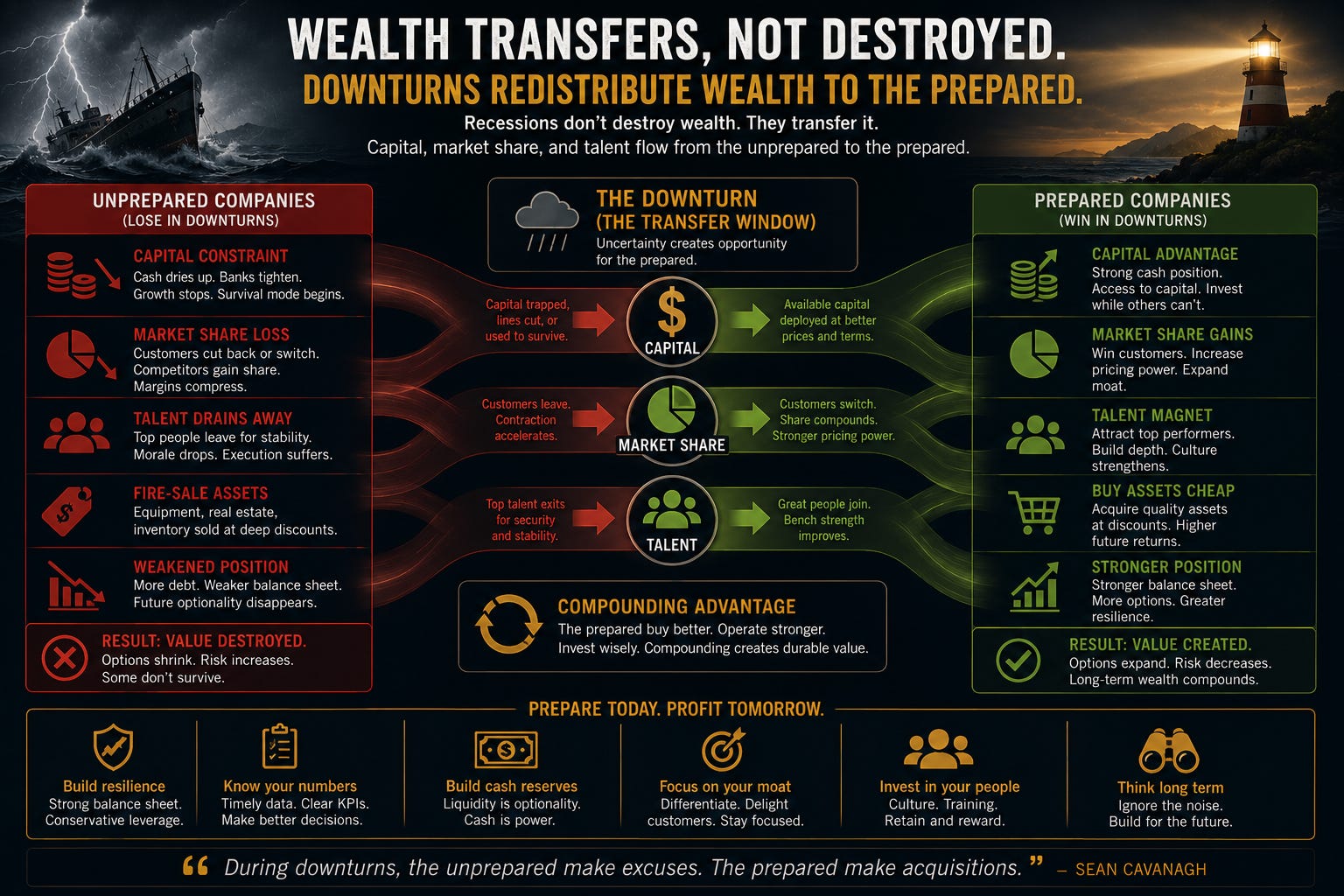
Crises are wealth redistribution events. Money does not disappear in a downturn, it changes hands. Market share does not vanish, it transfers. The only question is which side of the transfer you are standing on, and that is decided years before the storm arrives. Yours is being decided right now.
10 KEY TAKEAWAYS, ANTIFRAGILE ENTERPRISE VALUE
Money changes hands, it does not vanish: Every crisis has buyers, and preparation decides who they are.
The cycle is not a surprise: Expansion to recession to expansion is the one certainty in business.
Amateurs react, professionals execute: One invents a plan under stress, the other runs a written one.
Preparedness itself lowers risk: A documented contingency plan reduces the premium before the event occurs.
Cash is optionality: Reserves are not lazy money, they are the price of being a buyer instead of seller.
Your underbelly is theirs too: Fix your weakness first and it becomes an offensive weapon.
Distressed assets are the payoff: Equipment at thirty cents and talent that was unreachable last year.
Antifragile means gaining from stress: Not merely surviving the shock, becoming more valuable because of it.
Baby boomer supply is coming: A fifteen year wave of sellers, and most of them will be disappointed.
Below, a full cycle case study: Two distributors, one interest rate shock, a completely different ending.
📚 READING PREREQUISITES
Each post in this series builds on technical groundwork laid in earlier entries. The content progresses in depth and complexity, so prior understanding matters. Key valuation concepts, models, and metrics are revisited across multiple posts on purpose. Repetition is deliberate, not filler, because these foundations stay central to every later analysis.
Recommended Prior Reading:
YBAWS! Chapter 4, The Multiplier Is the Market’s Trust in Your Cash Flow
YBAWS! Chapter 16 Part One, Business Valuation Multiples Are Really Risk Scores
You Do Not Control the Storm, You Control the Sail
The economy has business cycles. Expansion to recession to expansion and back again. YOU KNOW THIS IS GOING TO HAPPEN.
So what are your indicators for the turn, and what is your strategy to grow value on the way down as well as on the way up? Never thought about it? You are a sheep ready for slaughter.
Successful companies take advantage of adverse situations. By preparing for worst case scenarios in your business ecosystem, you actually surface opportunities, because you have already worked through the challenges before they arrive. That state of pre thought preparedness lowers your risk profile in the meantime, which is a free gift the market hands you for doing the work early.
Reality: your vulnerable underbelly is likely your competition’s weakness as well.
ALTHOUGH YOU DO NOT CONTROL THE STORM, YOU CAN SET SAIL TO BEST NAVIGATE IT. WHEN THERE ARE SHOCKS TO THE SYSTEM, ECONOMY, INDUSTRY OR CORPORATE, THE GREATEST OPPORTUNITIES PRESENT THEMSELVES.
What Separates Professionals from Amateurs
The amateur sees risk as something that happens to them. The professional sees risk as something to manage and leverage for competitive advantage. Watch how the same four events split them.
When recessions hit, amateurs panic and retreat. Professionals execute predetermined strategies to acquire market share and distressed assets.
When key employees leave, amateurs scramble to replace them. Professionals have documented processes and cross trained teams already in place.
When customers defect, amateurs chase them desperately. Professionals have diversified revenue and a repeatable acquisition system.
When suppliers fail, amateurs face operational paralysis. Professionals have redundant supply chains and alternate vendors on file.
THE PROFESSIONALS UNDERSTAND THAT CRISES ARE WEALTH REDISTRIBUTION EVENTS. MONEY DOES NOT DISAPPEAR, IT CHANGES HANDS. MARKET SHARE DOES NOT VANISH, IT GETS TRANSFERRED.
But you cannot be opportunistic if you are not prepared. You cannot acquire assets if you have no capital. You cannot capture share if your own business model is fragile. Preparation is not the cost of surviving the downturn, it is the entry fee for profiting from it.
The Wealth Transfer Nobody Is Ready For
Here is the macro context, and it is not friendly.
THERE IS A TRANSFER OF CORPORATE WEALTH HAPPENING RIGHT NOW THAT WILL CONTINUE FOR THE NEXT 15 YEARS. BABY BOOMERS ARE RETIRING AND TRYING TO SELL THEIR BUSINESSES. THE PROBLEM? MOST OF THESE BUSINESSES ARE YBAWS! AND WILL NEVER SELL AT THE PRICES THEIR OWNERS EXPECT.
The tragedy is that most of this wealth will simply disappear, because owners have not been preparing for a sale in the 21st century. They focused on making money instead of building sellable assets. They optimized for cash flow instead of enterprise value. Big mistake. HUGE.
Understand the supply and demand here. A wave of sellers arriving at once, most of them owner dependent and concentrated, competing for a finite pool of buyers who can be selective. In that market, the prepared seller does not just get a better price, they get the only serious offer on the table.
Building the Antifragile Enterprise
Risk management is not about eliminating risk. It is about systematically preparing for predictable challenges while positioning for opportunities. The work list is short and it is the same list every time.
Document your processes so the business operates without your constant intervention.
Diversify your customer base so no single defection can destroy you.
Cross train your people so key departures do not paralyze operations.
Build cash reserves so you can survive downturns and buy opportunities.
Create redundant systems so single points of failure do not bring down the enterprise.
Establish multiple vendor relationships so supply disruption does not halt production.
Develop scenario plans so you execute strategies instead of reacting to events.
THIS IS NOT DEFENSIVE THINKING. IT IS OFFENSIVE STRATEGY DISGUISED AS PRUDENT MANAGEMENT.
Every dollar spent on systematic enterprise risk management should generate multiple dollars of enterprise value. Every hour invested in scenario planning should create advantages that compound. This is the formal argument made by AICPA and CIMA and in the COSO framework, and it is the informal argument I have been making across a desk for thirty years.
The businesses that master this do not merely survive crises. They profit from them by capitalizing on competitors’ weaknesses. They do not weather storms, they emerge stronger while others struggle. That property has a name, antifragility, and it shows up in valuation as a multiple that expands precisely when everybody else’s is contracting.
DO NOT JUST BUILD A BUSINESS. BUILD AN ANTIFRAGILE ENTERPRISE THAT BECOMES MORE VALUABLE UNDER STRESS.
USE YOUR BRAIN, NOT YOUR EGO.
💡 KEY TAKEAWAYS
Remember These Core Principles:
