

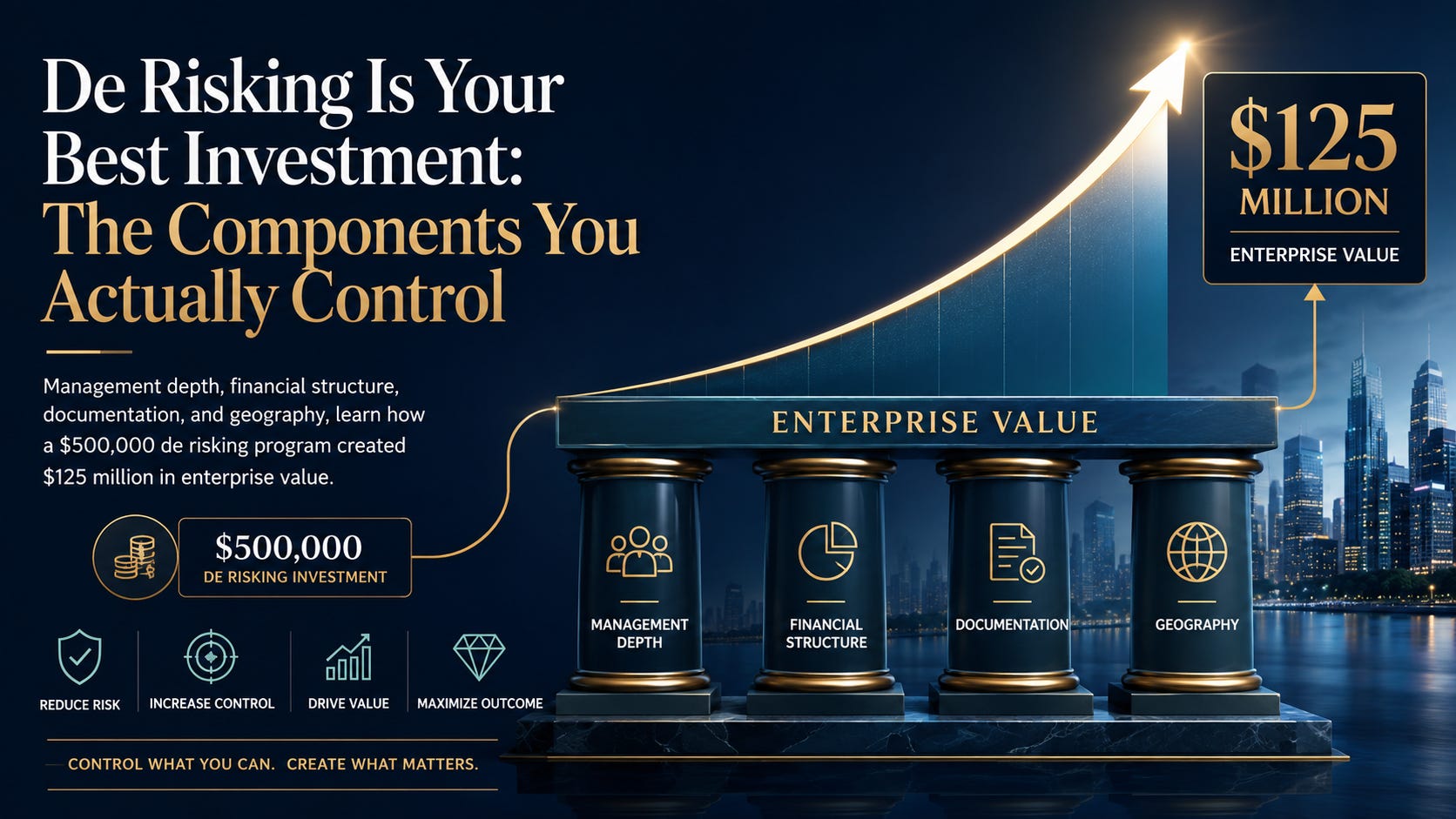
Management depth, financial structure, documentation, and geography, learn how a $500,000 de risking program created $125 million in enterprise value. De risking is the highest return investment most owners never make. Management depth, financial structure, documentation, and geographic exposure are the corporate risk components you actually control. One company turned a $500,000 systems investment into $125 million in enterprise value. Which would you choose, growing income or shrinking risk?
10 KEY TAKEAWAYS, THE COMPONENTS YOU CONTROL
1. Management depth first: Being the sole decision maker destroys your own value.
2. Get over yourself: The founder’s highest value act is making themselves replaceable.
3. Financial structure cuts both ways: High fixed costs magnify profit swings and buyer fear.
4. Documentation transfers value: Systems, not personalities, are what buyers actually purchase.
5. The 25,000% return: A $500,000 systems investment created $125 million in enterprise value.
6. Country risk is real: International exposure adds a premium many owners never consider.
7. Geography can cut risk too: Diversifying across stable markets can lower, not raise, risk.
8. Predictable beats big: Buyers overpay for predictable, low risk cash flow, not just cash flow.
9. The only customer: The ultimate purchaser of your business is your real customer.
10. You are in the selling business: Every day you build for the buyer, not just the operation.
READING PREREQUISITES
This post applies the risk recipe and exponential math from the first two posts to the specific levers you can pull. You should understand that corporate risk is your controllable component and that the multiple is the inverse of the required return.
Recommended Prior Reading:
• Chapter 15, Post 1, The Risk Recipe
• Chapter 15, Post 2, Exponential Risk Destruction
• Chapter 3, Building Transferable Systems
Management Depth, Get Over Yourself
If you are the single person making every company decision, congratulations, you are destroying your own value. This is where owner dependency bites you in the wallet. If you are not replaceable, you are not valuable, and that is the mathematical proof.
The founder’s real job:
• Build a management team that decides without you
• Document roles, reporting lines, and succession
• Remove yourself from routine approvals
• Obsess over vision, not daily operations
The highest value activity of any founder is making themselves unnecessary. That is not a demotion, it is the single move that converts a person dependent operation into a transferable, premium priced business. Kroll’s Cost of Capital Navigator shows how professionals quantify the company specific premiums that owner dependency inflates.
Financial Structure, The Double Edged Sword
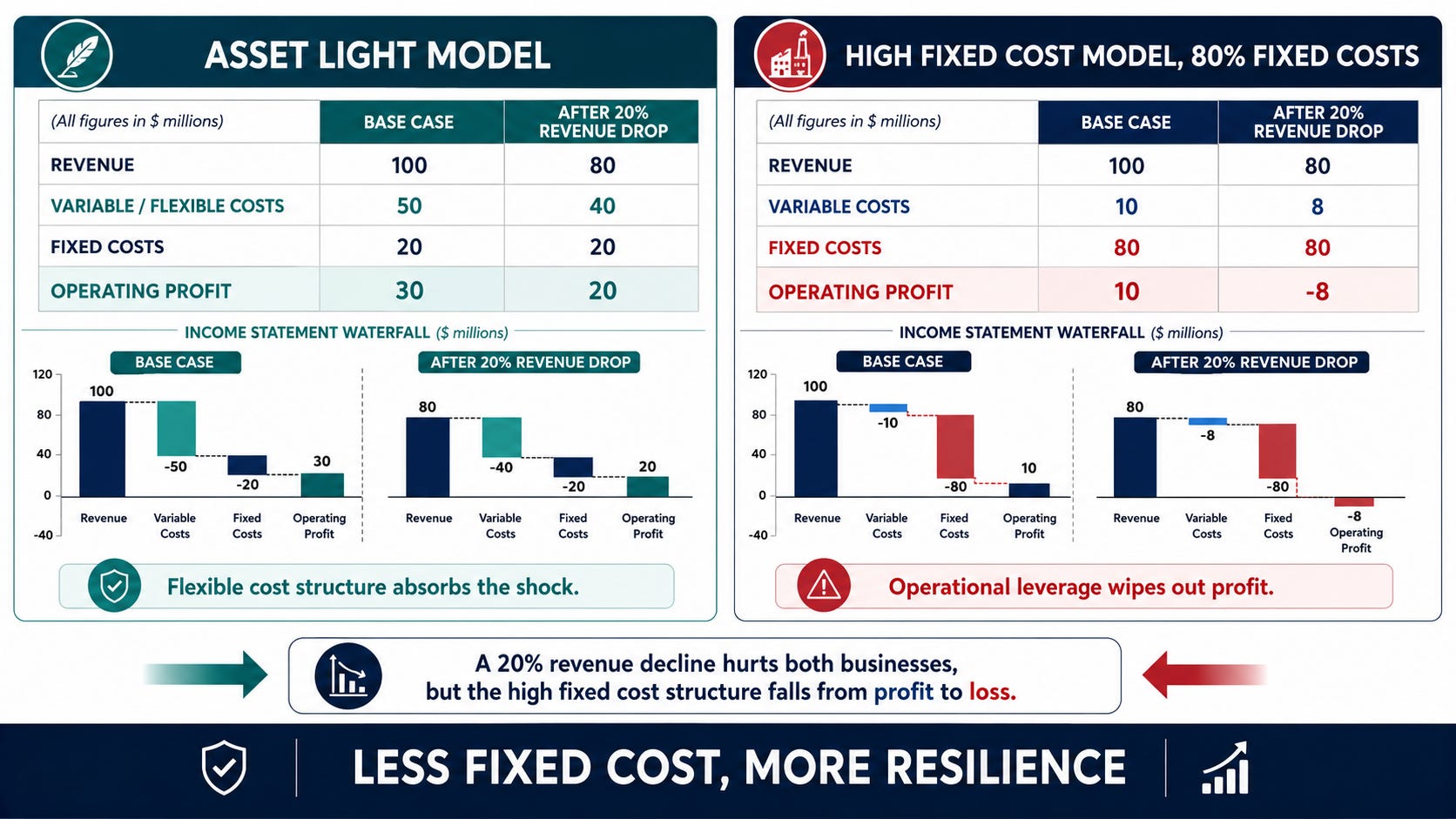
If your company is financed primarily by equity, financial risk is minimal. Load up on debt, and financial risk climbs. But this goes beyond debt ratios to operational leverage. Companies with high fixed costs face magnified profit swings, and in downturns they get crushed while asset light structures hold their margins.
A company with 80% fixed costs might save money in good times, but when revenue drops 20%, profits can disappear entirely. Buyers see that operational leverage and may demand a 4% additional risk premium. On a typical mid market company, that single premium can reduce value by $5 million to $10 million. Investopedia on operating leverage explains why fixed cost structures amplify both upside and downside.
[IMAGE: A side by side comparison of two income statements, one asset light and one with 80% fixed costs, showing how a 20% revenue drop erases profit in the high fixed cost structure. Alt text: “Comparison of asset light versus high fixed cost business showing operational leverage erasing profit during a revenue decline”]
Documentation, Systems Beat Personalities
Buyers purchase future cash flows, not your sparkling personality. Consider a company that invests $500,000 in documenting processes, cross training employees, and establishing redundant suppliers. These investments can reduce operational risk premiums from 8% to 4%.
On $10 million in annual cash flow, that shifts the multiplier from 12.5x, which is 1 divided by 0.08, to 25x, which is 1 divided by 0.04. Enterprise value climbs from $125 million to $250 million, a $125 million increase for a $500,000 investment. That is a 25,000% return. Show me a marketing campaign that delivers that.
What documentation actually creates:
• Knowledge that lives in systems, not people
• Consistent quality independent of who performs the work
• Redundancy that removes single points of failure
• A business a buyer can operate on day one
The International Wrinkle
The Country Risk Premium, or CRP, is the extra return investors expect for exposure to foreign countries. If your business touches international customers, suppliers, or operations, you face premiums many owners never consider. Yet companies that diversify across multiple stable markets can actually reduce risk through geography. It is not about avoiding international business, it is about structuring it to lower rather than raise risk. In 2025, a more uncertain trade environment puts a fresh spotlight on the CRP, and Damodaran’s country risk premium data remains the standard public reference
.
