

Multiple Choice Questions
1. According to the post, the founder’s highest value activity is:
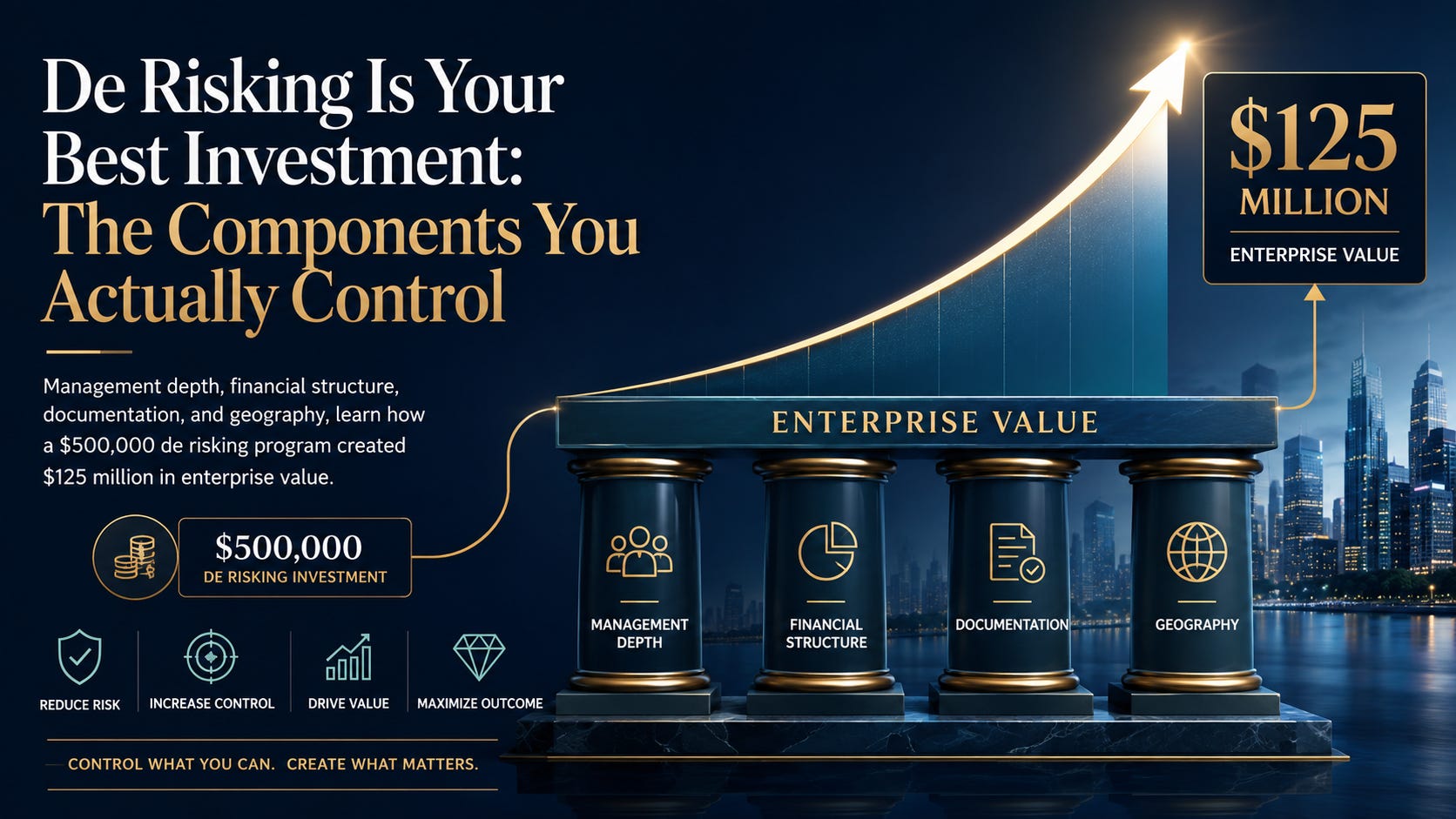
a) Personally closing every sale
b) Making themselves replaceable through systems
c) Approving all expenditures
d) Holding all client relationships
2. A company reducing its operational risk premium from 8% to 4% changes its multiple from:
a) 10x to 20x b) 12.5x to 25x c) 8x to 16x d) 5x to 10x
3. The $500,000 documentation investment in the post produced approximately what return?
a) 2,500% b) 5,000% c) 12,500% d) 25,000%
4. A company with 80% fixed costs faces heightened:
a) Tax risk b) Operational leverage risk c) Currency risk d) Regulatory risk
5. True or False: Buyers overpay for predictable, low risk cash flow rather than merely large cash flow.
6. CRP stands for:
a) Corporate Risk Premium b) Country Risk Premium c) Currency Risk Premium d) Capital Risk Premium
7. True or False: Geographic diversification across stable markets can only increase risk, never reduce it.
8. According to the post, the only customer in your business is:
a) Your largest account b) Your bank c) The ultimate purchaser of your business d) Your best employee
9. An additional 4% operational leverage premium can reduce a mid market company’s value by roughly:
a) $1 to $2 million b) $5 to $10 million c) $15 to $20 million d) $25 to $30 million
10. True or False: Buyers prefer exciting, owner dependent operations over boring, documented systems.
Essay Questions
1. Explain why making yourself replaceable is described as the founder’s highest value activity.
2. Walk through the math of the $125 million value creation from a $500,000 documentation investment.
3. Explain how operational leverage creates risk, using the 80% fixed cost example.
4. Describe the Country Risk Premium and explain how geographic exposure can both raise and lower risk.
5. Using the Marchetti Facilities Group case, explain which risk category drove the largest value increase and why.
SOLUTIONS, ASSESSMENT 3
Multiple Choice Answers
1. b) Making themselves replaceable through systems.
2. b) 12.5x to 25x, since 1 divided by 0.08 is 12.5 and 1 divided by 0.04 is 25.
3. d) 25,000%, a $125 million gain on a $500,000 investment.
4. b) Operational leverage risk, from high fixed costs.
5. True, predictability commands the premium.
6. b) Country Risk Premium.
7. False, diversification across stable markets can reduce overall risk.
8. c) The ultimate purchaser of your business.
9. b) $5 to $10 million, the stated range for a mid market company.
10. False, buyers prefer boring, documented, systematic businesses.
Essay Answers
1. Making yourself replaceable is the highest value activity because owner dependency is a large, quantifiable risk premium. A business that cannot run without its founder carries key person risk that buyers heavily discount, since that founder’s knowledge does not transfer in a sale. By building management depth, documenting processes, and removing themselves from routine decisions, the founder converts a person dependent operation into a transferable system, which lowers the required return and lifts the multiple. The founder becomes worth more precisely by becoming less necessary.
2. The company invests $500,000 to cut its operational risk premium from 8% to 4%. On $10 million of annual cash flow, the multiple is the inverse of the required return. At 8% the multiple is 12.5x, giving $125 million in value. At 4% the multiple is 25x, giving $250 million. The premium reduction doubles enterprise value, a $125 million increase. Dividing $125 million by the $500,000 cost yields a 25,000% return, far exceeding what any growth campaign typically delivers.
3. Operational leverage arises when a large share of costs is fixed rather than variable. With 80% fixed costs, profits swing violently with revenue because costs do not fall when sales do. A 20% revenue decline can erase profit entirely. Buyers recognize this fragility and demand additional risk premium, often around 4%, which on a mid market company can reduce value by $5 to $10 million. Asset light structures, by contrast, protect margins in downturns and earn lower premiums.
4. The Country Risk Premium is the additional return investors demand for exposure to foreign markets, reflecting political, economic, and currency uncertainty. International customers, suppliers, or operations can raise this premium, especially in uncertain trade environments. However, spreading exposure across multiple stable markets can reduce overall risk through diversification, since no single country failure would cripple the business. The goal is not to avoid international activity but to structure it so it lowers rather than raises the total risk premium.
5. In the Marchetti case, operational risk was the largest single premium at 8%, driven by undocumented methodologies and supplier dependency. Reducing it to 4% through a documentation and redundant supplier program delivered the biggest share of the multiple expansion, because the multiple is the inverse of the required return and this was the largest point reduction. Combined with cuts to management, customer, and financial risk, the total premium fell from 23% to 10%, lifting the multiple from about 3x to 5x and moving value from roughly $12 million to roughly $22.5 million, mostly from de risking rather than the modest EBITDA growth.
