

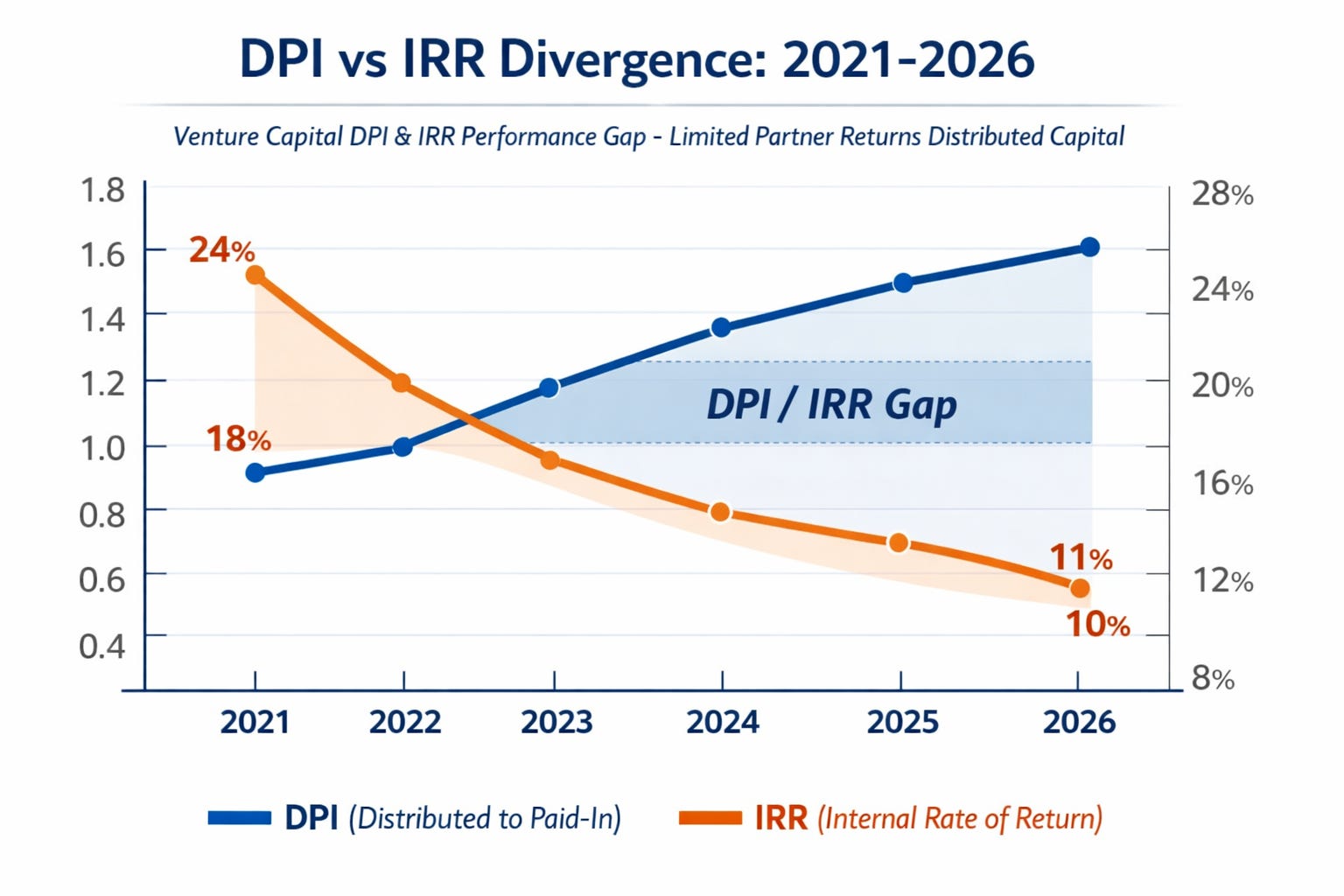
Limited partners have fundamentally changed the venture capital success metric. “DPI is the new IRR” means LPs demand actual cash returned to investors, not paper valuations that may never convert to liquid exits. This forces VCs toward alternative structures that return capital programmatically rather than requiring exit events, creating unprecedented opportunity for properly designed patient capital deployment.
10 KEY TAKEAWAYS - THE DPI REVOLUTION
DPI replaces IRR as success metric: Distributed to Paid-In Capital measures actual cash returned, ending reliance on mark-to-market paper gains that never materialized.
2021 unicorns destroyed LP confidence: Inflated private valuations that exited at massive down-rounds or never exited created LP skepticism of reported performance.
GPs face unprecedented pressure: General partners must deliver actual liquidity rather than promising eventual exits that fund timelines can no longer accommodate.
M&A accelerates as primary exit: Brex’s $5.15 billion acquisition exemplifies VCs pushing strategic sales rather than waiting for IPO markets to fully recover.
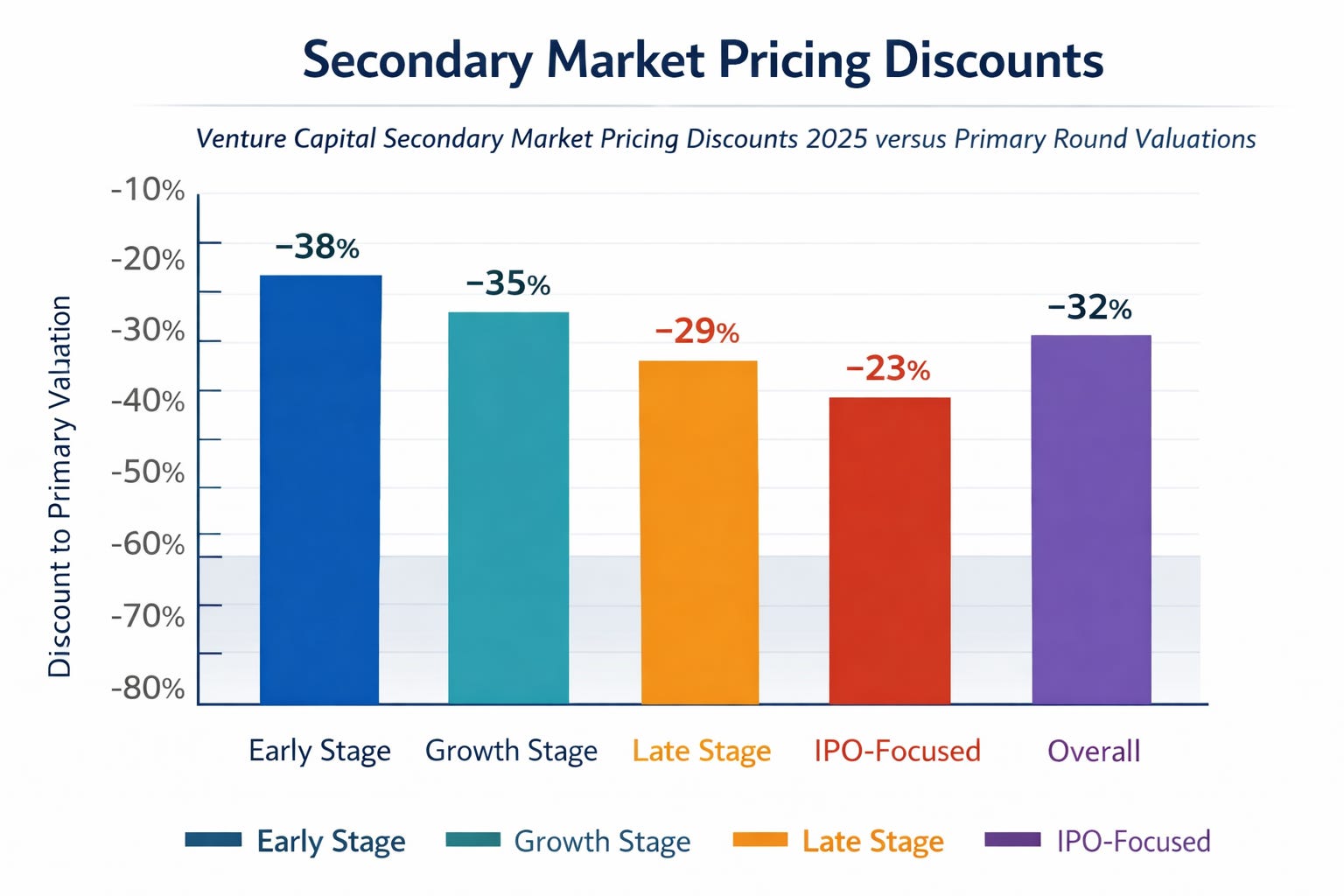
Secondary markets provide partial relief: $160 billion in 2025 secondary transactions offer liquidity but at significant discounts to last-round valuations.
Fund cycle compression intensifies: LPs demanding faster DPI force VCs toward shorter holding periods, further misaligning with companies requiring patient capital.
Alternative structures gain mainstream acceptance: Revenue guarantee mechanisms that return capital throughout development rather than requiring exits address LP liquidity demands.
Insurance-backed structures emerge: Downside protection through insurance enables patient capital deployment while providing LPs comfort on capital preservation.
Portfolio construction shifts dramatically: VCs increasingly avoid long-cycle opportunities regardless of quality, because LP pressure demands portfolio liquidity concentration.
Patient capital sources seek new mechanisms: Family offices, high-net-worth individuals, and sovereign wealth funds want structures accommodating longer timelines traditional VC can’t provide.
📚 READING PREREQUISITES
Understanding the DPI revolution requires familiarity with venture capital fund economics, LP-GP relationships, and how fund performance gets measured. The shift from IRR to DPI represents fundamental change in how capital gets allocated across the entire ecosystem.
Recommended Prior Reading:
Understanding VC Fund Economics and LP Relationships
Why IRR Became Meaningless in 2020s Venture Capital
The Liquidity Crisis in Venture Capital 2022-2025
What DPI Actually Measures, Why It Matters Now
DPI (Distributed to Paid-In Capital) calculates actual cash returned to limited partners divided by the capital they invested. A DPI of 2.0x means LPs received $2 for every $1 invested, regardless of how long it took or what the intermediate paper valuations showed.
Contrast this with IRR (Internal Rate of Return), which measures annualized return rate including unrealized paper gains from mark-to-market valuations of portfolio companies. A fund holding unicorns valued at $1 billion each shows spectacular IRR even if those companies never exit or ultimately exit at far lower valuations.
The critical difference:
IRR can look fantastic based on paper valuations that never materialize
DPI only measures actual cash that LPs can spend, reinvest, or distribute to their stakeholders
IRR rewards fast markups regardless of exit reality
DPI rewards actual liquidity regardless of how long it took
Why January 2026 Marks the Inflection Point
After four years of liquidity drought (2022-2025), limited partners have lost patience with promises of eventual exits. The 2021-era unicorns that raised at peak valuations created unprecedented disconnect between reported fund performance (high IRR based on markups) and actual returns (low or zero DPI because companies can’t exit at those valuations).
The numbers tell a brutal story:
Hundreds of “unicorns” raised at $1+ billion valuations in 2021
Most have been unable to exit via IPO or strategic acquisition at those prices
Many face down-rounds or have stagnated waiting for market conditions to improve
LPs who invested in 2018-2020 vintage funds still haven’t received distributions
Meanwhile, inflation eroded the real value of whatever eventual returns might materialize
January 2026’s market developments, particularly the selective IPO reopening and M&A acceleration, create first meaningful DPI opportunities in years. But LPs now demand structural changes ensuring future portfolios generate actual liquidity rather than paper valuations.
How DPI Pressure Changes VC Behavior
The shift from IRR to DPI as primary success metric fundamentally alters how venture capitalists construct portfolios, evaluate opportunities, and structure deals.
Avoiding Long-Cycle Opportunities Regardless of Quality
VCs increasingly pass on exceptional opportunities that require 7-12 year development timelines, not because the opportunities lack merit, but because LP pressure demands portfolio liquidity. This creates systematic market failure where high-quality companies requiring patient capital can’t access traditional VC regardless of fundamentals.
The vicious cycle:
LPs demand DPI, forcing GPs toward shorter-cycle investments
GPs pass on long-cycle opportunities to avoid LP criticism
Long-cycle companies can’t access traditional VC funding
Remaining patient capital sources lack structures to deploy effectively
Market failure creates $290 billion alternative funding gap
This explains why non-AI companies with validated products, proven market demand, and sustainable economics still can’t raise traditional VC. It’s not that they’re bad investments, it’s that they don’t fit fund timelines driven by LP liquidity demands.
Pushing Portfolio Companies Toward Premature Exits
VCs facing DPI pressure increasingly push portfolio companies toward strategic acquisitions even when longer independent development would create more value. The Brex acquisition by Capital One, while representing fantastic outcome, exemplifies this dynamic.
The founder’s dilemma:
Strategic acquirer offers $5 billion today
Continuing independent development might create $15 billion company in 5-7 years
But VCs need liquidity now to satisfy LP demands
Board pressure intensifies toward accepting premature exit
Founder forced to choose between personal vision and investor relationships
The VC Risk Swap structure eliminates this pressure because it generates programmatic cash flows to funders throughout development rather than requiring exit event for returns. Funders get DPI from revenue guarantees while founders retain option to pursue optimal long-term strategy.
Increasing Reliance on Secondary Markets
The $160 billion in secondary transactions during 2025 provided some relief valve, allowing VCs to generate DPI by selling positions to other investors rather than waiting for company exits. But secondary pricing typically occurs at substantial discounts to last-round valuations, destroying returns.
Secondary market dynamics in DPI-focused environment:
Sellers (VCs needing DPI) accept discounts to generate liquidity
Buyers (patient capital sources) acquire positions at attractive valuations
Companies suffer reputation damage from down-round secondary sales
Founders see cap tables churn with investors who weren’t there at inception
Long-term patient capital gets rewarded while short-term capital exits at loss
This creates opportunity for alternative structures that attract patient capital sources from inception, avoiding secondary market discounts while providing founders with committed, long-term partners aligned with actual business timelines
The Capital One-Brex Deal as Case Study
Capital One’s $5.15 billion acquisition of Brex on January 22, 2026 represents the largest bank-fintech deal in history and exemplifies how DPI pressure reshapes exit decisions.
Why This Deal Happened Now
Brex raised substantial capital during 2021-2022 at valuations reportedly approaching $12+ billion. The company built exceptional expense management and corporate card platform with real revenue, strong unit economics, and defensible market position. But several factors aligned to make $5.15 billion acquisition attractive despite being well below peak private valuation:
From Capital One’s perspective:
AI-native fintech stack they couldn’t build internally in relevant timeframe
Proven technology serving exactly the SMB and mid-market segments Capital One targets
Strategic imperative to compete with AI-powered competitors
Ability to deploy Brex technology across entire Capital One customer base
Willingness to pay premium for speed-to-market and talent acquisition
From Brex investors’ perspective:
Clear exit providing actual DPI after years of waiting
Valuation, while below peak, still represents strong multiple on actual revenue
Certainty versus continuing independent path with uncertain IPO timing
Capital One integration provides portfolio company exit precedent for other holdings
LP pressure to generate distributions making bird-in-hand attractive
From Brex founders’ perspective:
Opportunity to impact massive customer base through Capital One distribution
Liquidity for team and early employees after multi-year journey
Board and investor pressure toward accepting premium strategic offer
Recognition that independent IPO might require more years of waiting
The deal validates patient capital structures that don’t force premature exits. Had Brex been funded through VC Risk Swap mechanisms, founders could have waited for higher valuation or pursued independent path without investor pressure demanding liquidity.
What This Signals for M&A Market
The Brex acquisition signals that strategic acquirers recognize they must buy AI-native capabilities they can’t build internally. This creates robust M&A exit environment for companies that built defensible positions, even if valuations haven’t reached 2021 peaks.
Implications for alternative funding structures:
Patient capital enabling longer development cycles produces more valuable strategic acquisition targets
Revenue-generating companies with proven economics command premium strategic valuations
Founders who retained control through non-dilutive structures negotiate from strength
Insurance-backed structures providing downside protection enable patient capital deployment into potential strategic acquisition targets
Alternative Structures That Generate DPI Without Requiring Exits
The DPI revolution creates urgent need for funding mechanisms that return capital to investors throughout company development rather than requiring exit events for liquidity.
