

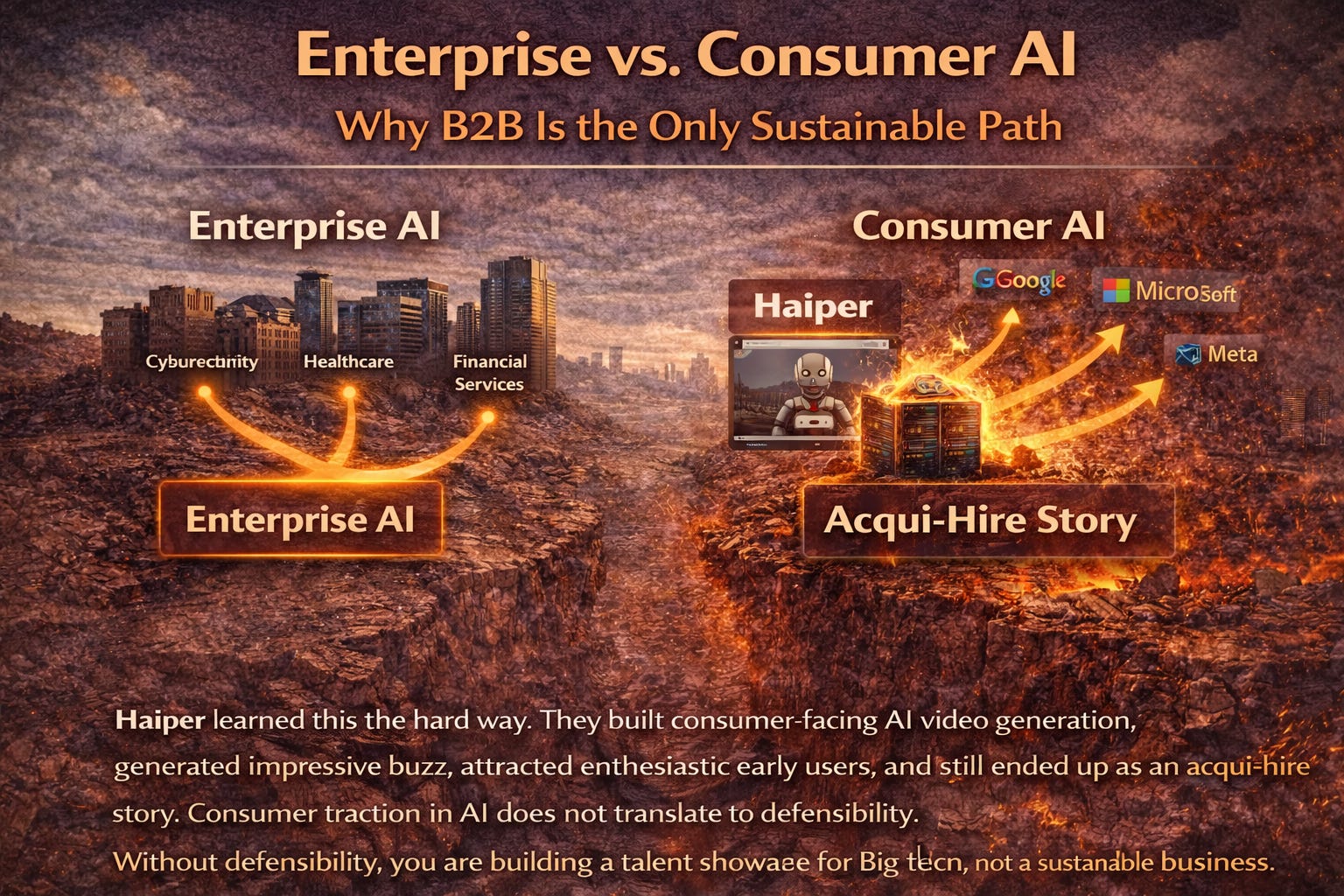
Haiper learned this the hard way. They built consumer-facing AI video generation, generated impressive buzz, attracted enthusiastic early users, and still ended up as an acqui-hire story. Consumer traction in AI does not translate to defensibility. Without defensibility, you are building a talent showcase for Big Tech, not a sustainable business.
10 KEY TAKEAWAYS - ENTERPRISE VS. CONSUMER AI
1. Consumer AI competes with unlimited budgets: Google, Microsoft, and Meta can subsidize services and distribute to billions instantly.
2. Consumer pricing expectations are brutal: ChatGPT set the expectation that cutting-edge AI should cost $20 per month maximum.
3. Consumer retention cliffs are steep: The wow factor drives signups but month 3 retention tells the real story.
4. Enterprise integration creates switching costs: Deep workflow integration with Salesforce, SAP, or Epic makes replacement painful.
5. Compliance value commands premium pricing: Enterprises pay 10-50x more for AI meeting HIPAA, SOC 2, or FDA requirements.
6. Enterprise contracts create predictable revenue: Multi-year contracts churn 5-10% annually versus 5-10% monthly for consumer subscriptions.
7. ROI clarity justifies enterprise budgets: Cost savings and revenue increases survive budget scrutiny in ways consumer value does not.
8. Enterprise adoption protects against acqui-hires: Customer relationships create value that survives talent absorption.
9. Revenue guarantees accelerate enterprise GTM: The VC Risk Swap funds slow enterprise sales cycles without premature equity dilution.
10. Consumer can validate, but enterprise must sustain: Use consumer for technology validation, pivot to enterprise for business building.
📚 READING PREREQUISITES
This post builds on concepts from earlier posts including AI company taxonomy, compute economics, and reverse acqui-hire dynamics. Understanding why pure AI companies face hyperscaler risk provides essential context for evaluating consumer versus enterprise strategies.
Recommended Prior Reading:
• Post 1: The AI Valley of Death - Why Seed Funding Timelines Are Broken
• Post 2: Pure AI vs. AI-Enabled - The Taxonomy That Determines Fundability
• Post 3: The Compute Trap - Why AI Startups Burn Seed Capital in Months
• Post 4: The Reverse Acqui-Hire Crisis - When Your Team Becomes Your Liability
• Series overview available at SaferWealth.com
The Consumer AI Trap: Why Headlines Do Not Equal Defensibility
Here is what consumer AI companies face in 2025: You are competing with hyperscalers who have unlimited compute budgets, can subsidize services at scale, and can integrate AI features across massive existing user bases. Google can launch AI video generation and distribute it to YouTube‘s 2 billion users overnight. Meta can add AI features to Instagram and reach 2 billion users instantly. Microsoft can bundle AI capabilities into Office 365 and touch 400 million enterprise users.
Your consumer AI startup with 100K users is not competing on product quality. You are competing against unlimited distribution and willingness to operate at losses indefinitely.
The Consumer AI Problem Set:
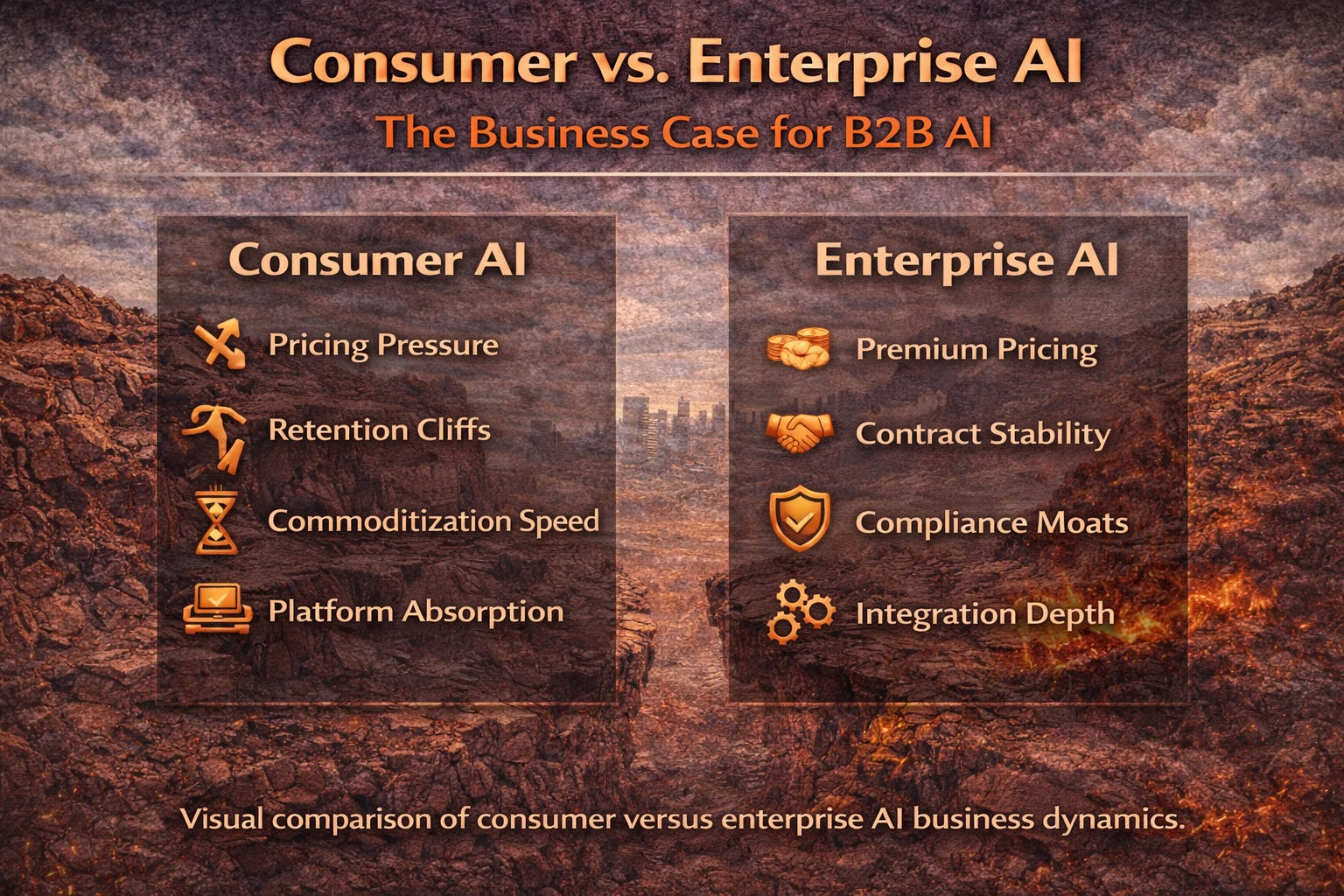
• Pricing psychology: Consumers expect AI tools to be free or nearly free. ChatGPT set the expectation that cutting-edge AI should cost $20 per month maximum.
• Retention nightmare: AI consumer products are novel toys until they are not. The initial wow factor drives signups but what is retention at month 3? Month 6?
• Commoditization velocity: Foundation models improve monthly, not yearly. The AI writing quality that differentiated your product in January is table stakes by June.
• Feature absorption: Every horizontal AI tool will be absorbed into platforms. Microsoft 365 will have all the AI writing tools. Adobe will have all the AI design tools.
Why Enterprise AI Builds Defensible Businesses
Compare consumer dynamics to enterprise AI companies, even early-stage ones, who can build real moats:
Integration Complexity Creates Switching Costs
B2B AI that plugs into Salesforce, SAP, Epic, or other enterprise systems creates real friction to switching. Once you are integrated into a company’s procurement workflow, financial reporting system, or clinical decision-making process, ripping you out requires extensive change management, data migration, and retraining. That is not a moat you can build on TikTok.
Compliance Value Commands Premium Pricing
Enterprises will pay 10-50x more for AI that meets regulatory requirements. Healthcare AI with HIPAA compliance, FDA clearance pathway, and clinical validation studies can charge $500K-$2M per hospital system. Financial services AI with audit trails, explainable decisions, and regulatory reporting can charge $1M+ per major bank. Legal AI with attorney-client privilege protection and jurisdiction-specific training can charge $200K+ per law firm.
Consumers will never pay these prices, but enterprises will, and those prices support sustainable businesses.
ROI Clarity Justifies Budgets
You can demonstrate concrete cost savings or revenue increases with enterprise AI. This AI reduced customer service costs by $2M annually or This AI increased sales conversion by 8% generating $5M additional revenue creates clear ROI calculations that survive budget scrutiny. Consumer AI value propositions are squishy: makes your writing better or helps you be more creative do not translate to willingness to pay.
Enterprise Contracts Create Predictable Revenue
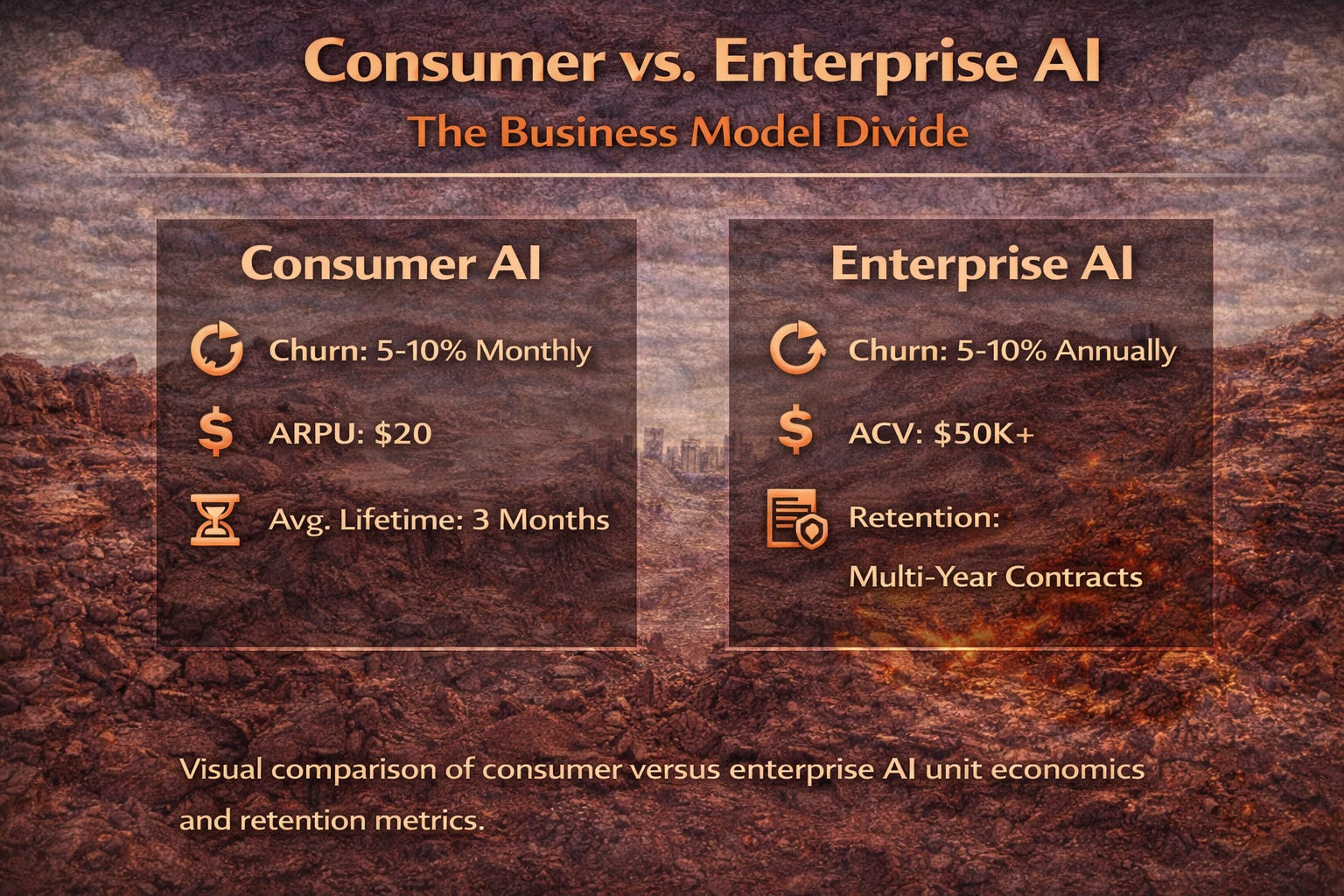
Multi-year contracts with annual renewals, committed minimums, and expansion clauses create the type of predictable revenue streams that support venture-scale businesses. Consumer subscriptions churn at 5-10% monthly. Enterprise contracts churn at 5-10% annually. That difference compounds dramatically over fundraising cycles.
[IMAGE SUGGESTION: Side-by-side metrics comparison showing Consumer AI (5-10% monthly churn, $20 ARPU, 3-month avg lifetime) versus Enterprise AI (5-10% annual churn, $50K+ ACV, multi-year contracts). Alt text: Visual comparison of consumer versus enterprise AI unit economics and retention metrics]
Enterprise Adoption Protects Against Reverse Acqui-Hires
The data is unambiguous. Look at successful AI startup exits in the past 24 months. Every single one had significant enterprise adoption before acquisition. The consumer AI companies that got acquired were reverse acqui-hired, talent absorbed, investors got nothing. The enterprise AI companies that got acquired had real purchase prices that returned capital to investors.
Enterprise Success Stories:
• Glean: Valued at billions selling enterprise search
• Writer: Commanding premium valuations selling to enterprises
• Cresta: High valuations serving enterprise contact centers
• Harvey: Building for legal enterprises with compliance-first approach
• Pattern: The successful AI companies are all B2B. The consumer AI unicorns are mostly story companies that have not actually delivered sustainable returns.
Why Enterprise Protects Against Talent Absorption:
When hyperscalers consider acquiring talent from AI startups, they evaluate what they are leaving behind. For consumer companies, there is nothing, just users who will migrate to the next novelty. For enterprise companies, there are contractual obligations, customer relationships, integration commitments, and compliance certifications that require ongoing support.
Companies with real customer traction are harder to hollow out than pure research teams. The customer relationships create obligations that survive founder departure.
The Strategic Framework: Consumer to Validate, Enterprise to Sustain
Here is the strategic framework: If you are starting with consumer, have a clear plan to pivot to enterprise within 12-18 months. Use consumer to validate the technology, build credibility, and generate case studies. But recognize that consumer is the technology validation phase, not the business model.
Grammarly started consumer to prove AI writing assistance worked, then went enterprise where the real revenue lives. That is the playbook.
The Consumer-to-Enterprise Playbook:
1. Months 1-12: Consumer launch validates technology works and users engage
2. Months 6-12: Identify enterprise use cases from consumer usage patterns
3. Months 12-18: Build enterprise features: SSO, compliance, admin controls, audit trails
4. Months 18-24: Enterprise GTM motion with dedicated sales team
5. Months 24+: Consumer becomes freemium funnel for enterprise conversion
If You Are Building for a Specific Vertical:
Go enterprise from day one. Do not waste 18 months trying to get consumers to pay $20 per month for legal AI when law firms will pay $200K per year for the same underlying technology with compliance features, integration capabilities, and white-glove support. The revenue per customer is 1000x higher, the sales cycle is only 3-5x longer, and the retention is 10x better.
The VC Risk Swap: Funding Enterprise Sales Cycles
The challenge with enterprise AI: sales cycles are long. 6-18 months from first contact to contract signature. Traditional seed funding assumes you can demonstrate product-market fit within 12-18 months. Enterprise sales cycles consume that entire runway before you close meaningful revenue.
The VC Risk Swap addresses this timing mismatch by providing capital access that matches enterprise sales timelines without requiring premature equity dilution.
How the VC Risk Swap Supports Enterprise GTM:
Five-year funding horizon: Traditional seed assumes 18-month cycles. Enterprise AI needs 3-5 years to build meaningful customer bases. The VC Risk Swap provides a five-year structure that matches enterprise business development timelines rather than forcing consumer-speed metrics.
Milestone-based capital deployment: Revenue guarantees release capital as enterprise pipeline develops. First enterprise contract triggers additional funding. This aligns capital with actual sales progress rather than arbitrary timelines.
Preserved equity during slow sales cycles: Enterprise sales take time. Traditional equity financing punishes slow starts with down rounds and founder dilution. The VC Risk Swap preserves founder equity during the pipeline-building phase, converting to equity participation only when enterprise revenue materializes.
Insurance-backed downside protection: Enterprise deals can collapse. Budgets freeze, champions leave, priorities shift. The insurance component of the VC Risk Swap provides funders with downside protection independent of any single enterprise deal outcome.
Why This Matters for Enterprise AI:
• Funds compliance investment: SOC 2, HIPAA, and FDA certifications cost money and time. Revenue guarantees fund this work.
• Supports long sales cycles: 6-18 month enterprise cycles need patient capital that traditional seed does not provide.
• Enables integration depth: Building deep integrations with Salesforce, Epic, or SAP requires sustained engineering investment.
• Protects against deal slippage: When enterprise deals push from Q4 to Q2, traditional runway assumptions collapse. Milestone funding adapts.
• Creates customer relationship value: Enterprise contracts create exactly the kind of durable value that protects against reverse acqui-hires.
The Metrics That Matter: Consumer vs. Enterprise
The measurement frameworks matter too. Consumer AI success metrics do not predict business success. Enterprise AI success metrics do.
Consumer Metrics (Vanity):
• DAU/MAU: Daily and monthly active users
• Virality coefficients
• App store rankings
• Social media mentions
Enterprise Metrics (Substance):
• ACV: Annual contract value
• NDR: Net dollar retention (expansion revenue)
• Logo retention: Customer count stability
• CAC payback: Time to recover acquisition costs
If a founder cannot articulate their enterprise GTM motion by the Series A conversation, they do not have a fundable business. They have a popular consumer app that will get feature-copied by a hyperscaler within 24 months.
💡 KEY TAKEAWAYS
Remember These Core Principles:
• Enterprise builds moats, consumer builds buzz: Integration depth, compliance value, and contract stability create defensibility
• Enterprise protects against acqui-hires: Customer relationships create value that survives talent absorption
• The VC Risk Swap funds slow sales cycles: Five-year horizon with milestone funding matches enterprise timelines
• Use consumer for validation only: Plan the enterprise pivot from day one if starting consumer
• Measure what matters: ACV, NDR, and logo retention predict success; DAU and virality do not
❓ FREQUENTLY ASKED QUESTIONS
Q: Why do consumer AI companies struggle to build defensible businesses?
A: Consumer AI faces three structural problems: hyperscalers can subsidize competing products indefinitely, ChatGPT set pricing expectations at $20 per month maximum, and foundation model improvements commoditize features within months. Without integration depth or compliance requirements, consumer AI companies have no switching costs to prevent user migration.
Q: What makes enterprise AI more defensible than consumer AI?
A: Enterprise AI builds four types of moats: integration complexity with systems like Salesforce and Epic creates switching costs, compliance certifications like HIPAA and SOC 2 take years to replicate, clear ROI justifies premium pricing, and multi-year contracts create predictable revenue. These moats exist independent of AI model quality.
Q: How does enterprise adoption protect against reverse acqui-hires?
A: When hyperscalers absorb talent from consumer companies, they leave nothing behind except users who will migrate to the next novelty. Enterprise companies have contractual obligations, customer relationships, and compliance certifications requiring ongoing support. These create value that survives founder departure and makes complete talent absorption impractical.
Q: How does the VC Risk Swap support enterprise sales cycles?
A: Enterprise sales take 6-18 months, consuming traditional seed runway before meaningful revenue materializes. The VC Risk Swap provides a five-year structure with milestone-based funding that releases capital as enterprise pipeline develops. This matches enterprise business development timelines rather than forcing consumer-speed metrics that enterprise companies cannot achieve.
Q: Should AI startups ever launch with consumer products?
A: Consumer launches work for technology validation and credibility building, but plan the enterprise pivot from day one. Use consumer to prove the technology works and identify enterprise use cases from usage patterns. By month 12-18, you should be building enterprise features. By month 24, enterprise should be your primary revenue source. Consumer becomes a freemium funnel, not the business model.
🎯 READY TO BUILD FOR ENTERPRISE?
Understanding the consumer-enterprise divide is essential for AI startup survival. Enterprise builds defensible businesses while consumer builds acquisition targets. The VC Risk Swap provides funding structures that match enterprise timelines.
Subscribe to SaferWealth for insights on alternative startup funding structures, AI commercialization strategies, and the VC Risk Swap framework. Join founders and funders who are building better capital structures for the AI era.
Have questions about your specific situation? Drop a comment below or reach out directly. I respond to every message.
📖 RELATED READING
Continue Your Learning:
• a16z Enterprise AI Playbook: Framework for building enterprise AI go-to-market strategies.
• Bessemer Cloud Index: Enterprise SaaS metrics benchmarks applicable to enterprise AI.
• OpenView SaaS Benchmarks: Industry data on enterprise software sales cycles and retention metrics.
CONNECT WITH SAFERWEALTH
Expand Your Learning Beyond This Post:
6. Web: SaferWealth.com - Alternative Startup Funding Structures
7. YouTube: TheCapitalToolkit - VC Risk Swap Educational Content
8. LinkedIn: LinkedIn @SaferWealth - Startup Finance Innovation
9. Rumble: @saferwealth - Educational video content on alternative funding
10. Instagram: @saferwealth - Quick insights and updates
👤 ABOUT THE AUTHOR
Sean Cavanagh, BAS, CPA, CA, CF, CBV
With over three decades in business valuations, M&A advisory, and tax structuring, Sean delivers unvarnished truth about startup funding challenges. Starting at Deloitte and Canada Revenue Agency, he now advises founders and funders on alternative capital structures through SaferWealth.com. The VC Risk Swap framework reflects his frustration with funding structures that consistently fail AI startups.
Connect with Sean:
• 🌐 SaferWealth.com
📚 DO YOUR OWN RESEARCH
The concepts discussed in this article are grounded in industry data and market analysis. Below are authoritative sources for readers who want to dive deeper:
Enterprise AI Companies:
• Glean - Enterprise AI Search
• Writer - Enterprise AI Writing
Enterprise Systems & Compliance:
Key Terms & Definitions:
• Investopedia - Annual Contract Value
• Investopedia - Net Dollar Retention
• Investopedia - Customer Acquisition Cost
This section empowers readers to verify information, explore topics deeper, and develop their own informed perspectives on enterprise versus consumer AI strategies.
⚖️ EDUCATIONAL DISCLAIMER
This guide provides information only, not professional advice. Consult qualified advisors for your specific situation. All cases are fictional, created for educational purposes from collective industry experience. Neither the author nor SaferWealth accepts liability for actions based on this content. This material supplements but never replaces proper professional consultation and judgment.
SaferWealth is an educational platform dedicated to helping founders and funders understand alternative capital structures for AI startups.
© 2026 SaferWealth. All rights reserved.
