

Background
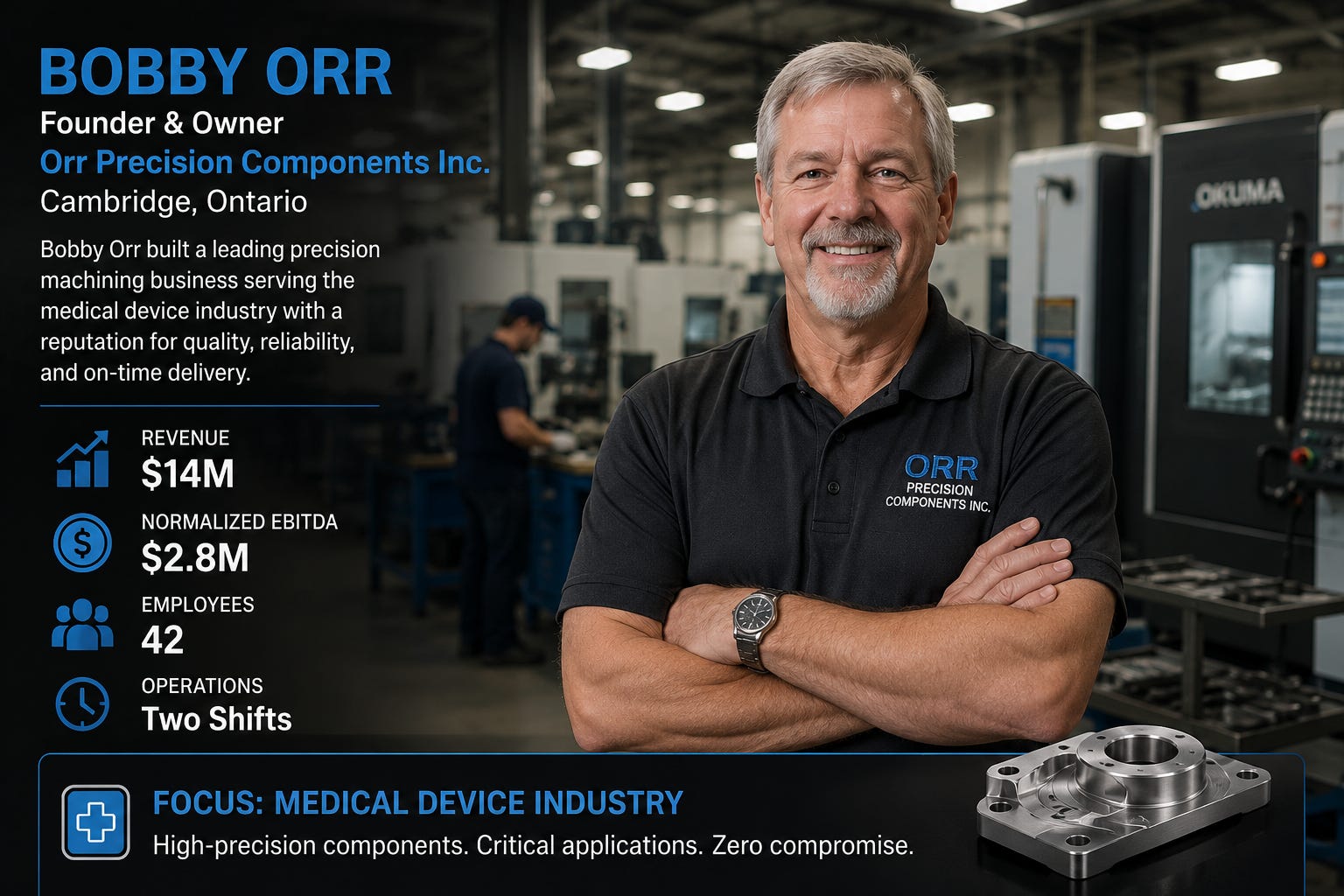
Bobby Orr, age 58, owned Orr Precision Components Inc., a Cambridge, Ontario-based precision machining business serving the medical device industry. The business generated $14M in revenue and $2.8M in normalized EBITDA, employing 42 people across two shifts.
Bobby’s accountant suggested a Fair Market Value range of $11M to $13M based on a 4x to 4.6x EBITDA multiple. Three private equity firms expressed interest, with informal offers clustering around $12M. Bobby was unimpressed. Twenty-six years of work, and the financial buyers were treating the business like a commodity.
His M&A advisor suggested expanding the buyer universe beyond traditional financial buyers. Three unconventional buyer categories deserved consideration.
The Individual Buyer: David from Munich
David Becker was a 51-year-old former operations executive at a German medical device manufacturer. After a corporate restructuring offered him a generous severance, David was searching North America for a business to own and operate personally. His criteria were specific.
Turnkey operations requiring no operational overhaul
Manufacturing business he personally understood
Located in southern Ontario for family reasons
Strong existing management team
Orr Precision was a perfect fit. David’s offer came in at $13.5M, with 90% cash at closing, financed through a combination of personal capital and SBA-equivalent Canadian acquisition financing through BDC.
David’s premium reasoning was not financial, it was emotional. The business gave him professional purpose, geographic fit for his family, and an industry he loved. He was willing to pay above the financial buyer range because the alternative was not buying any business at all.
The Family Office: The Thompson Family
The Thompson Family Office managed roughly $400M for three generations of an Ontario manufacturing family. They had recently allocated $50M for direct investments in lower-middle-market Ontario manufacturers with generational hold horizons.
The Thompson family conversations moved slowly. Three meetings stretched across two months, with family members evaluating cultural fit alongside financial returns. Bobby spent time with the family patriarch discussing manufacturing philosophy, employee treatment, and community involvement.
The Thompson offer eventually came in at $13.2M with an unusual structure, 100% cash at closing with an optional five-year consulting agreement at $200,000 annually. The family was buying generational wealth, not optimizing IRR. Their math allowed premium pricing because their hold period was 20-plus years.
The Search Fund: Margaret from Stanford
Margaret Chen was a 34-year-old Stanford MBA who had raised $400,000 from sophisticated investors to find, acquire, and personally operate one business for the long term. She had spent eighteen months searching, and Orr Precision matched her criteria perfectly.
Margaret’s search fund model brought several advantages for Bobby.
Hold period of 10 to 15 years, not the 3 to 5 years of typical private equity
Margaret would become the operating CEO, providing succession solution
Backed by patient capital from search fund investors
Career-defining commitment, not portfolio diversification
Margaret’s offer was $12.8M with 75% cash at closing, plus a structured advisory role for Bobby through the transition. Her premium trigger was the scalable platform potential of the medical device specialty, which her investor backers believed could double through bolt-on acquisitions.
The Decision Analysis
Bobby’s four real options:
Individual (David): $13.5M, 90% cash, fastest close
Family Office (Thompson): $13.2M, 100% cash, slow close
Search Fund (Margaret): $12.8M, 75% cash, includes succession
Private Equity (three firms averaging): $12M, 65% cash, 3-5 year hold
Bobby chose the Thompson Family Office offer at $13.2M, despite it being $300K below David’s higher number. The reasoning was nuanced and important. The Thompson family’s 100% cash structure delivered $13.2M immediately versus David’s $12.15M cash at closing. The Thompson family also committed to retaining Bobby’s entire workforce, which mattered enormously to him after twenty-six years.
