

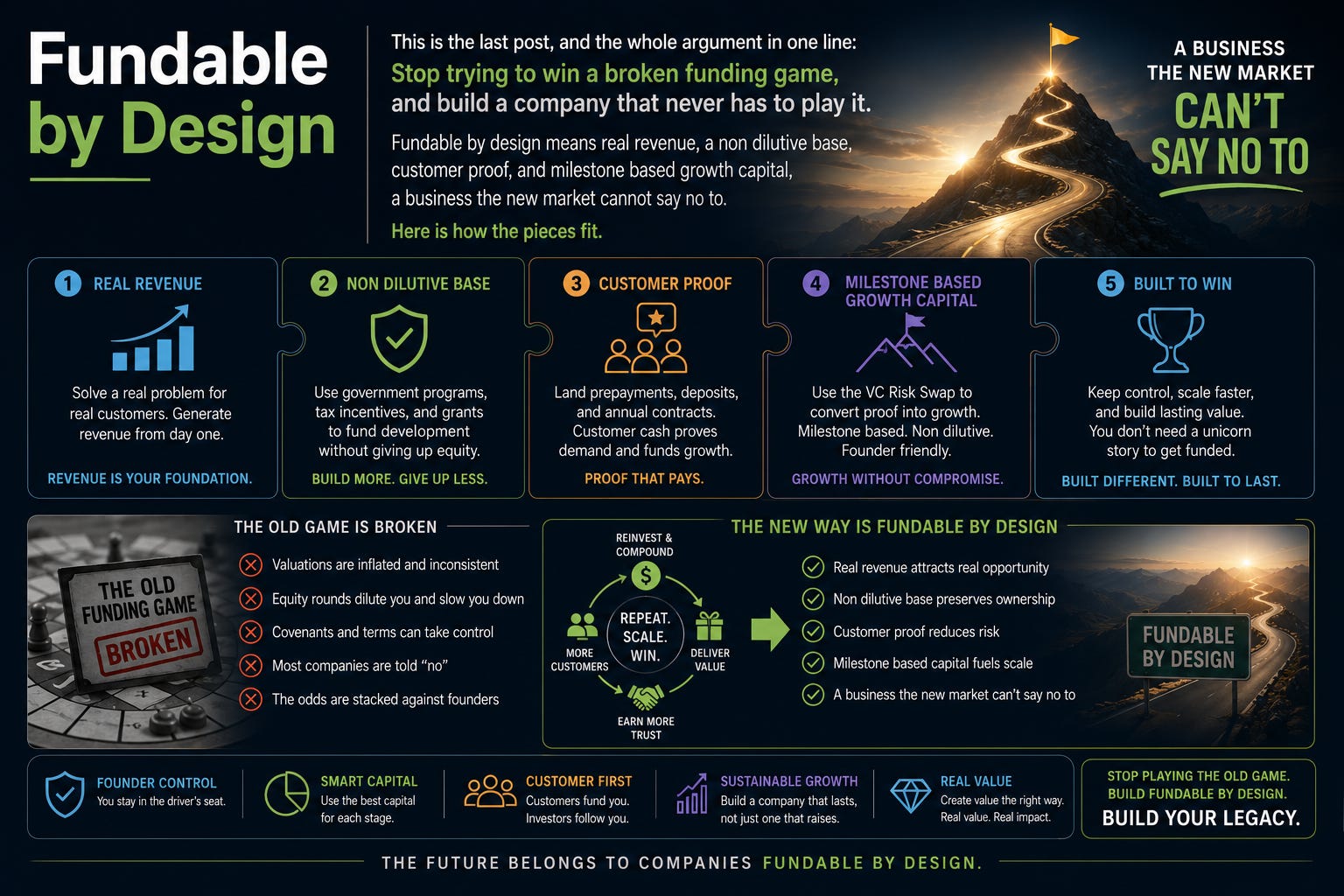
Seventeen posts of bad news and hard won answers come down to one shift in posture. Stop asking how to survive a funding market that has turned against you, and start building a company that does not need it to. The market now rewards performance over promise. So build to perform, and let the funding follow.
The Whole Argument in One Move
Seventeen posts is a long walk, so let me gather the whole journey into a single stretch before we finish it. The venture market split into two, poured its money into AI, and left everyone else fighting over the scraps at a punishing valuation. The terms on those scraps turned predatory, trading dilution for control through covenants and preference stacks. The exit that made the entire model work bricked itself shut. The rounds that used to arrive on a schedule dissolved into an endless sawtooth of bridges. And the emerging funds that once wrote the first cheque into companies like yours are quietly going extinct. That was the diagnosis, and it was grim.
Then came the playbook: a new capital stack, a generous Canadian non dilutive base, a clear eyed choice between revenue based financing and venture debt, the quiet power of customer cash, and the VC Risk Swap as the keystone that funds real growth without the priced round. Useful, all of it. But the deepest answer is not any single instrument on that list. It is a change of posture, and it fits in one move. Stop trying to win the old funding game, and build a company that never has to play it.
What Fundable by Design Means Now
The rules changed while a lot of founders were still playing by the old ones. Entering 2026, investors got religion about business basics, making capital efficiency, profitability, and clear unit economics the top priority while treating pure growth and cash burn with heavy skepticism. In the plainest terms, the market moved from rewarding potential to rewarding performance. The pitch that would have raised a fortune in 2021 now earns a polite pass.
At the centre of the new standard sits one deceptively simple idea: default alive versus default dead. A company is default alive if, without raising another cent, it will eventually reach profitability and survive, and default dead if it will not, and in 2026 investors rarely fund the default dead unless growth is top one percent explosive, preferring default alive companies where capital buys acceleration rather than survival. The whole burden of proof has flipped. You are no longer asking an investor to keep you alive. You are showing them a company that is already going to live, and inviting them to make it go faster.
Everything else follows from that. Fix the leaky bucket, your retention, before you pour capital into it. Mind your margins and your burn. And carry receipts, because traction is now the evidence behind every claim you make. As one guide put it, being fundable in 2026 is no longer about hype or a clever narrative. It is about building a quietly, almost boringly, durable business, the kind that the old raise fast and fix profitability later model never bothered to prove could work.
The Coherent Whole
Here is where the entire series clicks into a single design. Fundable by design is not a slogan, it is an architecture, and every piece of the playbook is a load bearing part of it.
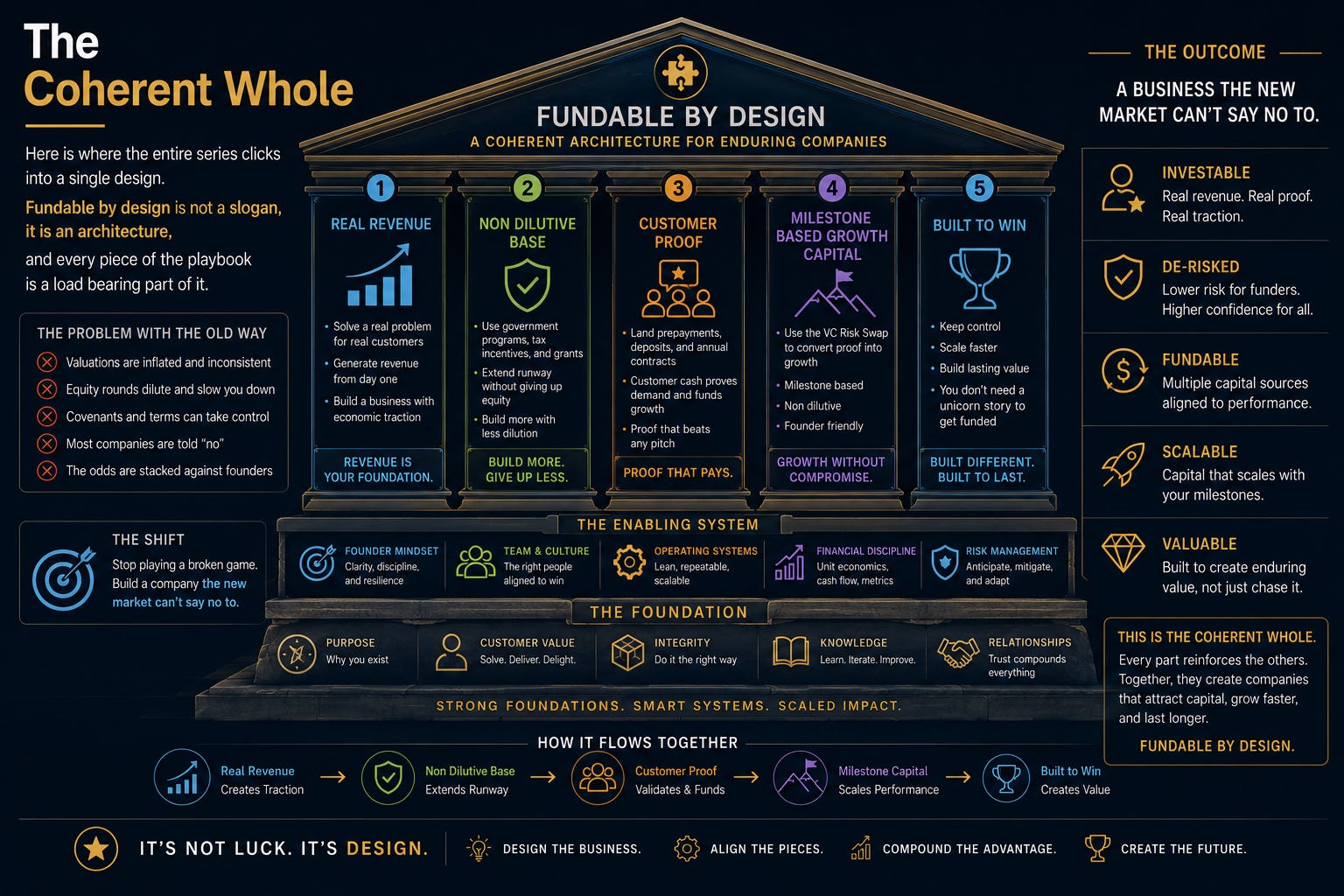
Build for real revenue and durable retention, and you are priced on proof rather than a valuation comp warped by AI mega deals. That answers the valuation problem. Fund the early climb with the non dilutive base, grants, SR&ED, and credits, layered with customer cash, and you delay or skip the priced round that quietly takes your board seats and your control. That answers the control problem. Let value flow back through performance and milestones instead of a sale, and you are no longer hostage to a frozen exit market. That answers the exit problem. Reach default alive, and the perpetual, dilutive scramble for the next round simply stops. That answers the sawtooth.
And the VC Risk Swap is the growth layer that fits this design like a final piece. It funds the scale of a fundable by design company on exactly the logic the rest of the company already runs on, performance rather than promise, without smuggling the dilution, the lost control, the exit pressure, or the valuation fight back in through a side door. It was never meant to be a silver bullet. It is the part that completes a coherent whole. The company you build this way is not fundable in spite of the broken market. It is fundable because of the discipline that broken market forced on it.
The Send Off
So this is where seventeen posts of diagnosis and one of design finally land. For a decade the advice was to raise big, grow fast, and sort out the business later, and for a decade, while money was free, it worked well enough. That world is gone, and for companies outside the AI boom it is not coming back. The new world belongs to the founder who builds a genuine company and funds it on genuine terms.
Build the company that does not need to win the valuation fight, does not have to surrender control, does not depend on a frozen exit, and does not ride the sawtooth, because you designed it, from the very first day, to need none of those things. Stack the non dilutive base. Let your customers fund the climb. Reach default alive. And when the moment to truly scale arrives, use the VC Risk Swap to fund it without handing the old broken game a single thing it used to demand.
The venture market spent this entire series telling every company outside AI that it was unfundable. It was wrong. Those companies were never unfundable. They were simply fundable by a different design, and now you are holding it. Thank you for reading all eighteen. Go build something they cannot say no to.
Subscribe to SaferWealth for more field notes from the part of the funding world the venture market overlooks, plus the structures that fund good companies on their own terms.
Questions about your specific situation? Reach out directly at riskswap@saferwealth.com.
CONNECT WITH SAFERWEALTH
Expand your learning beyond this post:
1. Web: SaferWealth.com, alternative startup funding structures.
2. YouTube: The Capital ToolKit, funding strategy and structure breakdowns.
3. Rumble: @SaferWealth.
4. Contact: riskswap@saferwealth.com.
ABOUT THE AUTHOR
Sean Cavanagh (BAS, CPA, CA, CF, CBV) is the founder of SaferWealth and creator of the VC Risk Swap, an alternative startup funding structure that preserves founder equity and control through milestone based, downside protected capital. With over three decades in business valuation, M&A advisory, and structuring, Sean writes about funding the businesses the venture market overlooks.
DO YOUR OWN RESEARCH
Sources referenced in this post:
• We Are Presta, what makes a startup fundable in 2026, default alive versus default dead and the new fundability standard.
• SeedScope, venture capital’s new era, investors returning to capital efficiency and business basics.
• Malcolm Tan, capital discipline in 2026, the market moving from rewarding potential to rewarding performance.
• WhatJobs, the profit pivot, the shift from growth at all costs to sustainable revenue.
• SeedScope, what investors want in 2026, traction as the receipts behind every claim.
• The VC Risk Swap, explained in video, the growth layer that completes the design.
📖 RELATED READING
• We Are Presta: What Makes a Startup Fundable in 2026: the default alive checklist, in full.
• The VC Risk Swap playlist: the structure that funds a fundable by design company.
• SeedScope: Venture Capital’s New Era: the new standard, and why it favours real businesses.
Educational disclaimer: This content is for educational purposes only and does not constitute legal, tax, financial, or investment advice. The VC Risk Swap is a sophisticated structure that must be implemented with independent professional advisors for your specific situation. All examples are illustrative. Neither the author nor SaferWealth accepts liability for actions based on this content. This material supplements but never replaces proper professional consultation and judgment.
© 2026 SaferWealth. All rights reserved.