

Multiple Choice Questions
Strategic buyers primarily purchase:
A. Your physical assets
B. Solutions to problems that keep them awake at night
C. Your tax losses
D. Your office leaseWhy do competitor buyers often pay premiums?
A. They enjoy overpaying
B. To eliminate a threat and stop rivals from getting stronger
C. They cannot read financials
D. They are forced to by regulatorsA supplier or customer buyer justifies a high price through:
A. Emotion
B. Synergies such as captured margin and guaranteed volume
C. Tax credits
D. Lower interest rates“Deployment pressure” on private equity refers to:
A. Pressure to fire staff
B. Pressure to deploy committed capital before a deadline
C. Pressure to lower fees
D. Pressure to relocateIn a leveraged buyout, financing most of the deal with debt:
A. Lowers the equity return
B. Amplifies the equity return
C. Has no effect on returns
D. Eliminates riskIn a roll up strategy, a final acquisition may command a premium because it:
A. Is the cheapest available
B. Completes the platform needed for a strategic exit
C. Has the lowest revenue
D. Reduces the buyer’s debtInstitutional buyers such as pension funds pay premiums largely due to:
A. Personal emotion
B. Allocation mandates and liability matching needs
C. A desire to avoid leverage
D. Lack of analysisThe market entry buyer pays a premium chiefly for:
A. Lower taxes
B. Compressed time to market versus building from scratch
C. Reduced headcount
D. A better brand nameIndividual buyers most often depart from rational pricing because of:
A. Regulatory rules
B. Emotional factors like purpose, lifestyle, and legacy
C. Interest rates
D. Currency exposureIn the Gretzky Logistics case, the winning buyer was motivated mainly by:
A. Tax benefits
B. Compressing years of expansion and fear of a rival gaining density
C. A pension mandate
D. Personal lifestyle
Essay Questions
Compare strategic buyers and financial buyers, explaining why each may pay a premium and which typically pays more.
Explain how leverage mathematics can make a premium price rational for a financial buyer even when it looks excessive on an enterprise value basis.
Describe deployment pressure in private equity and explain how a seller can use it to support a premium.
Explain how synergies allow a supplier or customer buyer to justify paying more than a company’s standalone value.
Using the Gretzky Logistics case, explain how matching the right motive to the right buyer produced a premium without any change in revenue or income.
SOLUTIONS, ASSESSMENT 2
Multiple Choice Answer Key
B. Strategic buyers buy solutions to pressing problems, competitive advantage, market position, and security, not merely physical assets.
B. Competitors pay to eliminate a threat and prevent a rival from becoming stronger, sometimes 40 percent above fair value.
B. Supplier and customer buyers justify premiums through synergies such as captured margin, guaranteed volume, or removed cost.
B. Deployment pressure is the need to invest committed capital before a deadline, or risk looking incompetent to limited partners.
B. Heavy debt financing amplifies the equity return, turning a modest asset return into a much higher return on the equity slice.
B. The final piece of a roll up can command a premium because it completes the platform required for a strategic exit.
B. Institutional buyers pay premiums to satisfy allocation mandates and to match predictable earnings to future liabilities.
B. Market entry buyers pay for time compression, buying immediate presence rather than spending years building.
B. Individual buyers depart from rational pricing for emotional reasons such as purpose, lifestyle, and legacy.
B. Richard National Transport won by paying to compress years of expansion and out of fear of letting a rival gain prairie density.
Essay Solutions
Strategic buyers acquire competitive advantage, synergies, threat elimination, and market position, valuing the business beyond its standalone financials. Financial buyers, primarily private equity, value the business for the returns it can generate through leverage and operational improvement, under deployment time constraints. Strategic buyers typically pay more because their synergies and strategic motives justify prices that pure return math cannot, whereas financial buyers are disciplined by the returns their model and investors demand.
When a buyer finances most of a deal with debt, only a slice of the purchase is funded by their own equity. If the business returns 15 percent on assets, that return accrues against a small equity base, lifting the equity return toward 35 percent. So a price that appears high relative to enterprise value can be entirely rational on an equity return basis, since the buyer is purchasing amplified returns on the equity they actually put in.
Private equity funds commit to deploying capital within a defined investment period. As the deadline nears, returning uninvested capital signals failure to limited partners. Firms in their final investment year have paid 15 to 20 percent premiums rather than return capital. A seller who understands a fund’s vintage and timeline can time the approach and apply competitive pressure when that deployment urgency is highest, supporting a premium.
Synergies are the cost savings or revenue gains a buyer captures by combining the target with its own operations. A customer that acquires its carrier removes the margin it was paying and guarantees supply, while a supplier captures volume and margin. A 10 million dollar acquisition that removes 3 million in annual costs is worth far more than 10 million to that specific buyer, so the synergy allows a price well above standalone value while still being economically sound for the buyer.
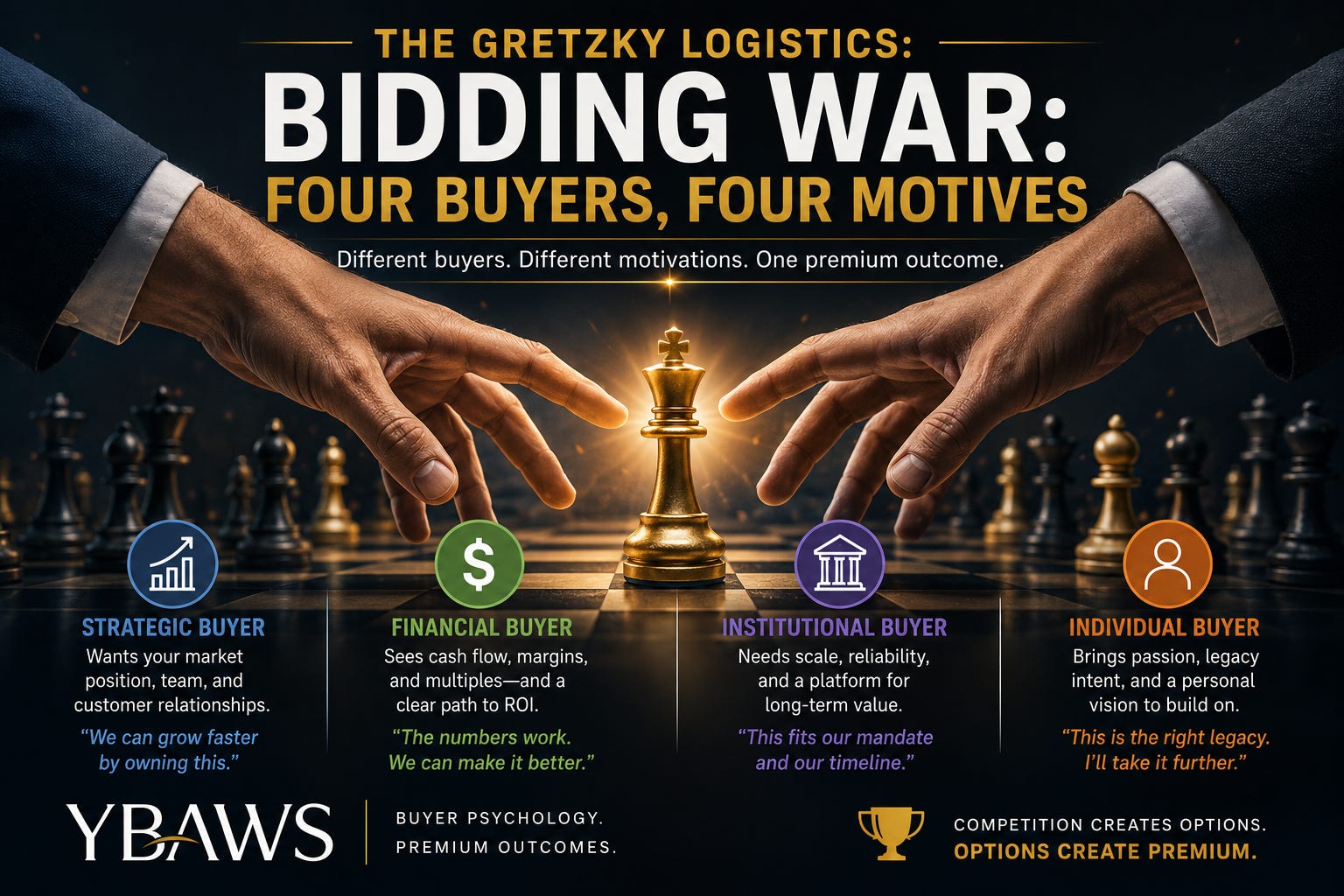
Dorothy researched four buyers and identified a distinct motive for each: Howe feared a national entrant, Orr needed guaranteed supply, Lemieux faced a fund deadline and platform gap, and Richard wanted to skip years of building. By positioning the company as the specific solution to each buyer’s specific problem and running a competitive process, she let those motives drive bidding. The winning price reflected the value of solving Richard’s expansion and threat problem, not any change in the company’s revenue or income.
⚖️ EDUCATIONAL DISCLAIMER: This assessment is for educational purposes only and does not constitute professional advice. All scenarios are fictional. © 2026 YBAWS! All rights reserved.