

January 2026 marks venture capital’s transformation from human-powered to AI-augmented operations. Sophisticated funds deploy autonomous agents identifying 200 potential targets while analysts find one, summarizing entire data rooms in minutes, and flagging risks humans take weeks to spot. This creates massive first-mover advantages for well-capitalized funds while opening billion-dollar opportunities in agent infrastructure layer
10 KEY TAKEAWAYS - AGENTIC AI IN VENTURE CAPITAL
Deal sourcing accelerates 200x: AI agents continuously monitor GitHub, patents, papers, and social signals identifying opportunities before formal fundraising begins.
Due diligence compresses from weeks to minutes: Agents summarize entire virtual data rooms, flagging legal risks, technical debt, and financial anomalies instantly.
First-mover advantages compound: Funds with sophisticated agent infrastructure identify and move on opportunities while competitors still conducting manual research.
Concourse raises $12 million: Agent platform funding exemplifies infrastructure layer boom as companies build tools enabling widespread agent adoption.
Documentation quality becomes critical: Agents flag inconsistencies and gaps that humans might miss, raising bar for “investment-ready” company documentation.
Deal timelines compress dramatically: Some AI rounds closing in days without formal pitch decks as agents accelerate evaluation cycles.
Agent infrastructure requires patient capital: Platform companies enabling ecosystem adoption need 5-7 years to establish lock-in, incompatible with traditional VC timelines.
Three-layer funding boom: Foundation models (OpenAI, xAI), agent infrastructure (Concourse et al), and vertical agents (industry-specific applications) each require different capital profiles.
Smaller funds face systematic disadvantage: Firms without agent capabilities increasingly compete on relationships rather than systematic deal discovery.
Alternative structures enable infrastructure plays: Patient capital accommodating multi-year platform development positions for ecosystem effects traditional VC timelines can’t capture.
📚 READING PREREQUISITES
Understanding how agentic AI transforms venture capital requires familiarity with both traditional VC operations (sourcing, diligence, portfolio management) and AI agent capabilities (autonomous task execution, tool integration, continuous monitoring).
Recommended Prior Reading:
Understanding AI Agents vs Traditional AI Systems
How Venture Capital Deal Flow and Due Diligence Actually Works
The Agent Infrastructure Stack and Ecosystem Economics
What Agentic AI Actually Means in VC Context
Agentic AI refers to autonomous systems that don’t just respond to prompts but proactively execute tasks, make decisions within defined parameters, and orchestrate multiple tools to achieve objectives. In venture capital context, agents:
Monitor continuously: Scan GitHub commits, patent filings, research publications, hiring patterns, and social signals 24/7 without human intervention
Execute autonomously: Identify potential investments, conduct preliminary research, draft investment memos, and flag opportunities requiring human review
Orchestrate tools: Integrate across data sources, analysis frameworks, communication platforms, and workflow systems
Learn and improve: Refine selection criteria based on past successes and failures, adapting to changing market conditions
This represents fundamental shift from “AI as tool that humans invoke” to “AI as autonomous colleague that proactively identifies opportunities and executes defined workflows.”
The January 2026 Inflection Point
Multiple developments in January 2026 signal that agentic AI in venture capital has moved from experimental to operational:
Andreessen Horowitz’s $15 billion raise: The firm’s announcement explicitly mentioned sophisticated agent infrastructure for deal sourcing and due diligence, representing competitive advantage attracting LP capital.
Concourse’s $12 million for finance-focused agents: Infrastructure platform specifically designed for finance teams exemplifies the booming agent infrastructure layer enabling widespread adoption.
Deal velocity acceleration: Multiple reports of AI rounds closing in days without formal pitch decks, possible only because agents accelerate evaluation cycles from weeks to hours.
Fund differentiation around agent capabilities: Limited partners increasingly evaluate GPs based on technological infrastructure and data science capabilities, not just brand and relationships.
This isn’t future speculation, it’s current reality reshaping competitive dynamics across venture capital ecosystem.
AI-Driven Deal Sourcing at 200x Human Speed
Traditional venture capital deal sourcing relied on networks, conferences, accelerator programs, warm introductions, and manual research. This human-powered approach created natural limits on deal flow quality and volume.
How Agents Transform Deal Discovery
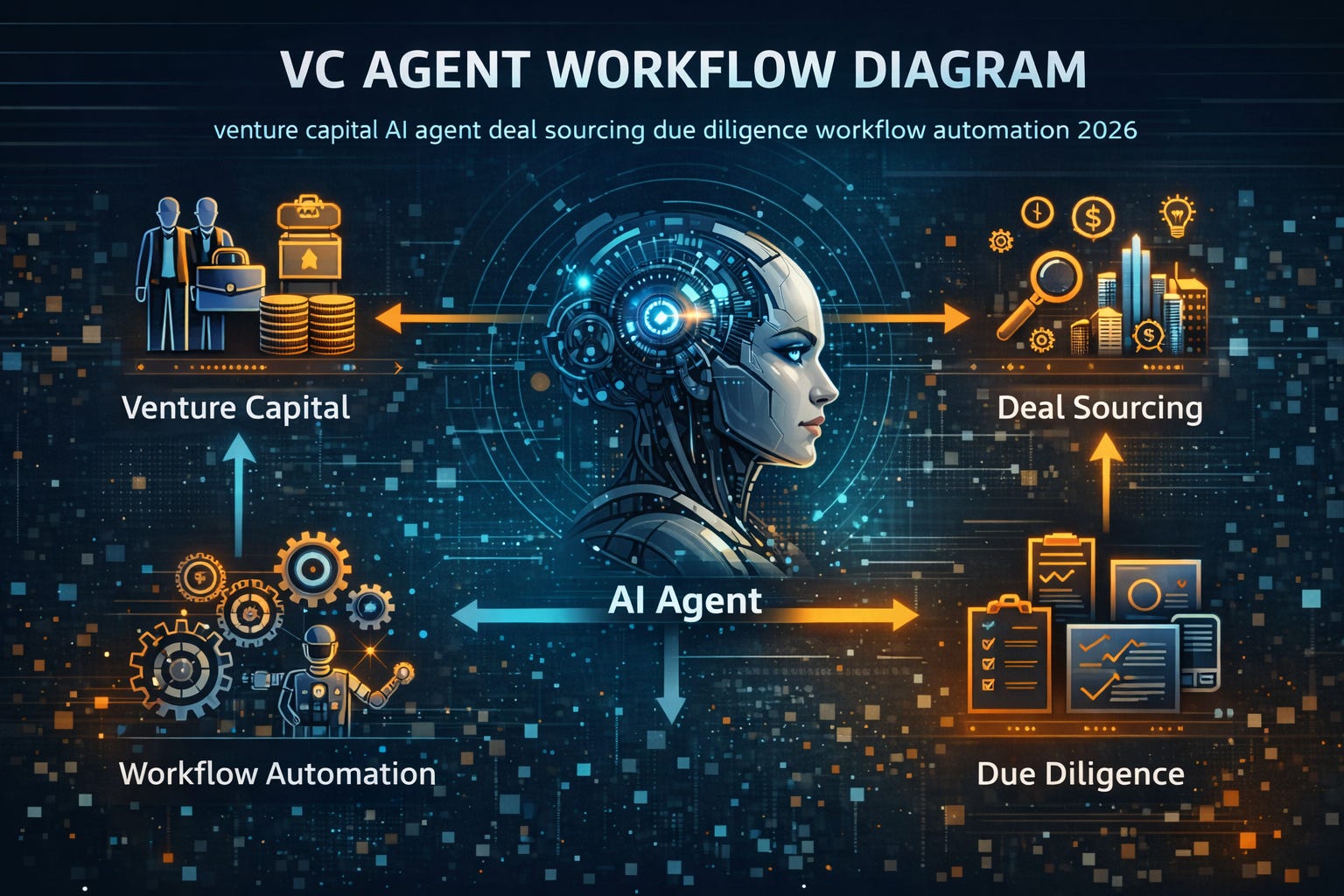
Modern AI agents deployed by sophisticated funds continuously monitor multiple signals:
Technical development indicators:
GitHub commits revealing breakthrough implementations before public announcement
Patent filings indicating novel approaches to existing problems
Research publications from labs transitioning to commercialization
Open source project momentum suggesting commercial potential
Stack Overflow questions revealing pain points others solving
Team and talent signals:
LinkedIn profiles showing founding teams with complementary expertise
Social graph analysis mapping relationships between successful founders and their former colleagues
Hiring patterns indicating companies scaling aggressively
Conference presentations revealing technical capabilities
Academic citations suggesting research impact
Market validation indicators:
Product Hunt launches demonstrating early traction
App store review velocity and sentiment analysis
Web traffic growth patterns via third-party analytics
Social media buzz around specific products or companies
Substack subscriber growth for thought leaders building products
Competitive intelligence:
Funding announcements from related companies indicating hot sectors
Acquihire patterns revealing what capabilities big tech values
Customer interviews and feedback revealing unmet needs
Regulatory changes creating new market opportunities
Economic shifts generating timing advantages
Agents integrate these diverse signals into comprehensive scoring systems, flagging opportunities that meet fund’s investment criteria before companies formally enter fundraising mode.
The 200x Speed Claim Substantiated
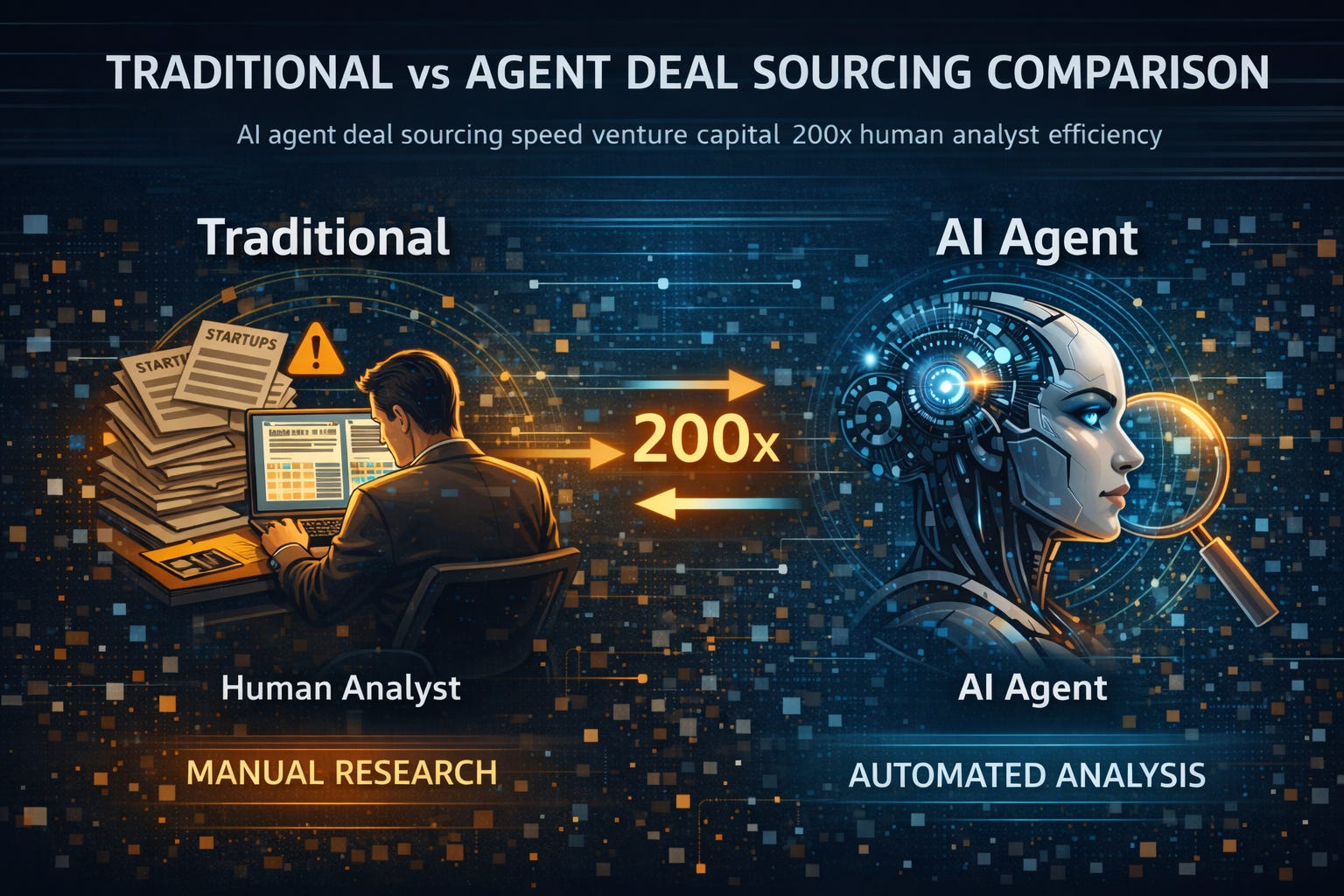
One VC reported their agents identify nearly 200 potential investment targets in the time it takes a junior analyst to find one through traditional methods. This isn’t hyperbole:
Traditional analyst approach:
Manually searches news, databases, networks for relevant companies
Researches each potential target individually
Drafts memo summarizing findings
Time per potential target: 4-8 hours
Sustainable throughput: 1-2 per week maximum
AI agent approach:
Continuously monitors thousands of signal sources simultaneously
Automatically scores and ranks opportunities against investment criteria
Drafts preliminary research memos for top-ranked targets
Time per potential target: 2-3 minutes
Sustainable throughput: hundreds per day
This creates dramatic first-mover advantage for funds with sophisticated agent infrastructure. They see opportunities earlier, move faster, and concentrate human expertise on highest-probability situations rather than wasteful manual searching.
Due Diligence Agents Compress Timelines from Weeks to Minutes
Beyond deal sourcing, AI agents fundamentally transform due diligence by summarizing virtual data rooms, flagging risks, and identifying patterns that manual review misses.
What Traditional Due Diligence Involved
Venture capital due diligence traditionally required teams spending weeks reviewing:
Financial diligence:
Historical financial statements and projections
Revenue composition and customer concentration
Unit economics and CAC/LTV analysis
Burn rate and runway calculations
Cap table and prior round terms
Legal diligence:
Corporate formation and governance documents
Intellectual property assignments and protections
Customer and vendor contract terms
Employment agreements and option grants
Regulatory compliance and pending litigation
Technical diligence:
Code quality and technical debt assessment
Architecture scalability and security review
Development velocity and process maturity
Technical team capabilities and gaps
IP ownership and open source usage
Commercial diligence:
Customer interviews and reference checks
Competitive landscape and positioning analysis
Go-to-market strategy and execution
Market size and growth trajectory validation
Partner and channel relationships
This manual process typically required 4-8 weeks with multiple team members, extensive back-and-forth with company management, and significant opportunity cost.
How Agents Accelerate Due Diligence
Modern AI agents process entire virtual data rooms in minutes, generating comprehensive summaries and flagging issues requiring human attention:
Document summarization:
Extract key terms from contracts automatically
Identify non-standard clauses requiring review
Compare terms across similar documents flagging inconsistencies
Generate executive summaries of financial performance
Create visual dashboards from raw data
Risk identification:
Flag legal language indicating potential liabilities
Identify customer concentration risks automatically
Detect technical debt patterns in code repositories
Highlight regulatory compliance gaps
Surface contradictions between documents
Pattern recognition:
Compare company’s metrics against portfolio benchmarks
Identify unusual financial patterns requiring explanation
Detect hiring or attrition trends suggesting issues
Flag compensation structures outside market norms
Recognize governance terms creating future conflicts
Automated inquiry generation:
Create comprehensive diligence question lists
Draft follow-up questions based on document review
Prioritize issues by materiality and urgency
Suggest areas requiring expert third-party validation
This compression from weeks to minutes creates several effects:
Competitive advantage for well-equipped funds: Ability to move faster means winning competitive situations where multiple funds pursue same opportunity.
Higher bar for company readiness: Agents flag inconsistencies and gaps that humans might miss, requiring companies to have cleaner documentation and more thorough preparation.
More efficient capital deployment: Due diligence costs drop dramatically when agents handle initial review, enabling funds to evaluate more opportunities at lower cost.
Faster capital deployment: Some January 2026 AI rounds reportedly closed in days without formal pitch decks because agents accelerated evaluation cycles sufficiently that traditional process became unnecessary.
The Agent Infrastructure Opportunity: Concourse and Beyond
While much attention focuses on foundation models and vertical applications, the agent infrastructure layer represents massive opportunity with unique capital requirements.
What Agent Infrastructure Provides
Agent infrastructure platforms like Concourse (raised $12 million January 2026) provide tools enabling companies to build, deploy, and manage AI agents without developing entire stack from scratch:
Core capabilities:
Pre-built agent frameworks reducing development time
Integration connectors for common tools and data sources
Orchestration layers managing multi-agent coordination
Monitoring and observability for agent performance
Security and compliance controls for enterprise deployment
Value proposition:
Accelerate agent development from months to weeks
Enable non-technical teams to deploy agents through low-code interfaces
Provide enterprise-grade reliability and security
Reduce total cost of ownership versus building internally
Why Agent Infrastructure Requires Patient Capital
Agent infrastructure platforms face unique capital requirements that traditional VC struggles to accommodate:
Network effects and ecosystem lock-in:
Platform value increases as more companies build on it
Developer ecosystem requires years to cultivate
Standards and conventions emerge slowly through community adoption
Switching costs build gradually as companies invest in platform-specific capabilities
Typical timeline to meaningful revenue:
Years 1-2: Product development and initial customer acquisition
Years 3-4: Ecosystem cultivation and standard-setting
Years 5-6: Network effects begin compounding value
Years 7-10: Platform effects enable premium pricing and defensibility
Capital intensity and burn:
Significant R&D investment required for competitive platform capabilities
Developer relations and ecosystem support creating substantial overhead
Enterprise sales cycles requiring patient go-to-market development
Competition from well-funded players demanding sustained investment
This 7-10 year timeline to achieve platform effects conflicts with traditional VC’s 5-7 year expected holding periods. Many promising agent infrastructure companies will face pressure toward premature exits before platform effects fully materialize, destroying long-term value for short-term liquidity.
The Three-Layer Agent Funding Boom
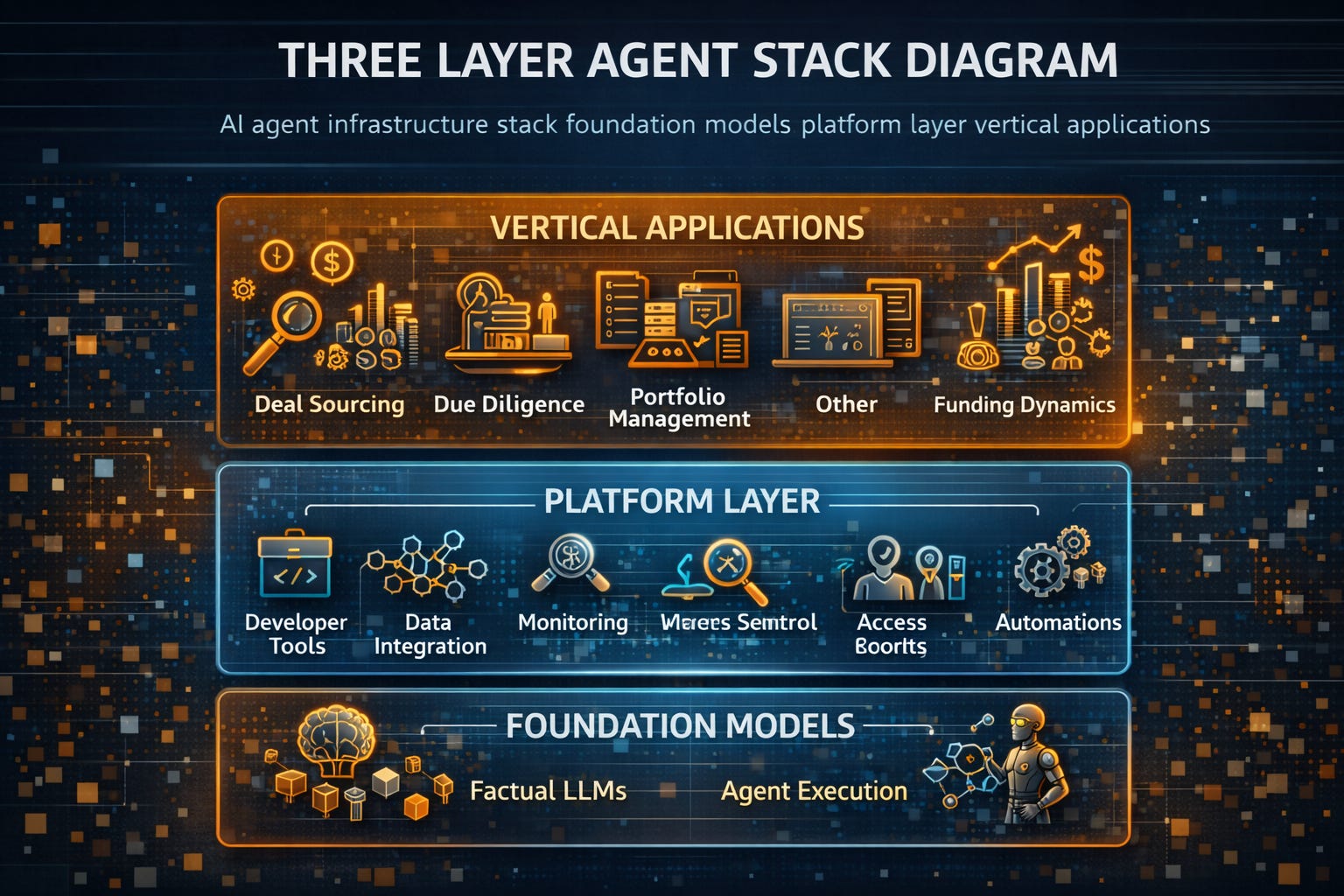
January 2026 reveals distinct funding dynamics across three layers of the agent stack:
Layer 1: Foundation Models (xAI $20B, OpenAI, Anthropic)
Massive capital requirements for compute and talent
Multi-year development cycles before commercial deployment
Limited number of viable players given capital intensity
Strategic importance attracting sovereign wealth and tech giants
Layer 2: Agent Infrastructure (Concourse $12M and dozens of competitors)
Moderate capital requirements for product development
Years to establish platform effects and ecosystem lock-in
Dozens of platforms competing across different verticals and use cases
Patient capital needed to survive consolidation and achieve scale
Layer 3: Vertical Agent Applications (thousands of startups)
Lower capital requirements for application development
Faster time-to-market building on existing platforms
Massive TAM across every industry and function
Traditional VC timelines more compatible with vertical application development
The most interesting opportunity for alternative structures like the VC Risk Swap lies in Layer 2, where platform economics require patient capital that traditional VC can’t accommodate but ecosystem effects create massive long-term value.
Competitive Implications for Venture Capital Firms
The rise of agentic AI in venture capital creates stark differentiation between funds with sophisticated capabilities and those relying on traditional methods.
First-Mover Advantages Compound
Funds that invested early in agent infrastructure now enjoy compounding advantages:
Earlier deal identification:
See opportunities before competitors even know companies exist
Establish relationships before formal fundraising begins
Offer value-added support (introductions, advice) positioning as preferred investor
Faster decision-making:
Compress diligence from weeks to days or hours
Win competitive situations through speed and certainty
Reduce opportunity cost of missed deals from slow evaluation
Better portfolio construction:
Evaluate more opportunities enabling higher-quality selection
Identify pattern correlations across portfolio performance
Allocate attention efficiently based on agent-driven prioritization
Enhanced LP fundraising:
Demonstrate technological sophistication attracting forward-thinking LPs
Provide data-driven performance attribution and insights
Differentiate in crowded fundraising environment
Smaller Funds Face Systematic Disadvantage
Venture capital firms without significant agent infrastructure increasingly compete at disadvantage:
Deal flow asymmetry:
Miss opportunities that agent-equipped funds identify systematically
Rely on networks and relationships becoming less comprehensive
Participate in competitive situations after sophisticated funds already passed
Resource inefficiency:
Waste analyst time on manual research agents automate
Higher cost per evaluation limiting sustainable deal volume
Longer timelines creating competitive disadvantages
LP pressure:
Limited partners increasingly evaluate technological capabilities
Difficulty raising follow-on funds without demonstrating innovation
Talent attraction challenges as skilled analysts prefer technologically sophisticated firms
This creates bifurcation similar to AI versus non-AI companies: funds with sophisticated agent capabilities pull away from those relying on traditional methods, potentially forcing consolidation or specialization among smaller players.
What This Means for Founders
If you’re building agent infrastructure or considering how agents affect your fundraising, several considerations matter:
