

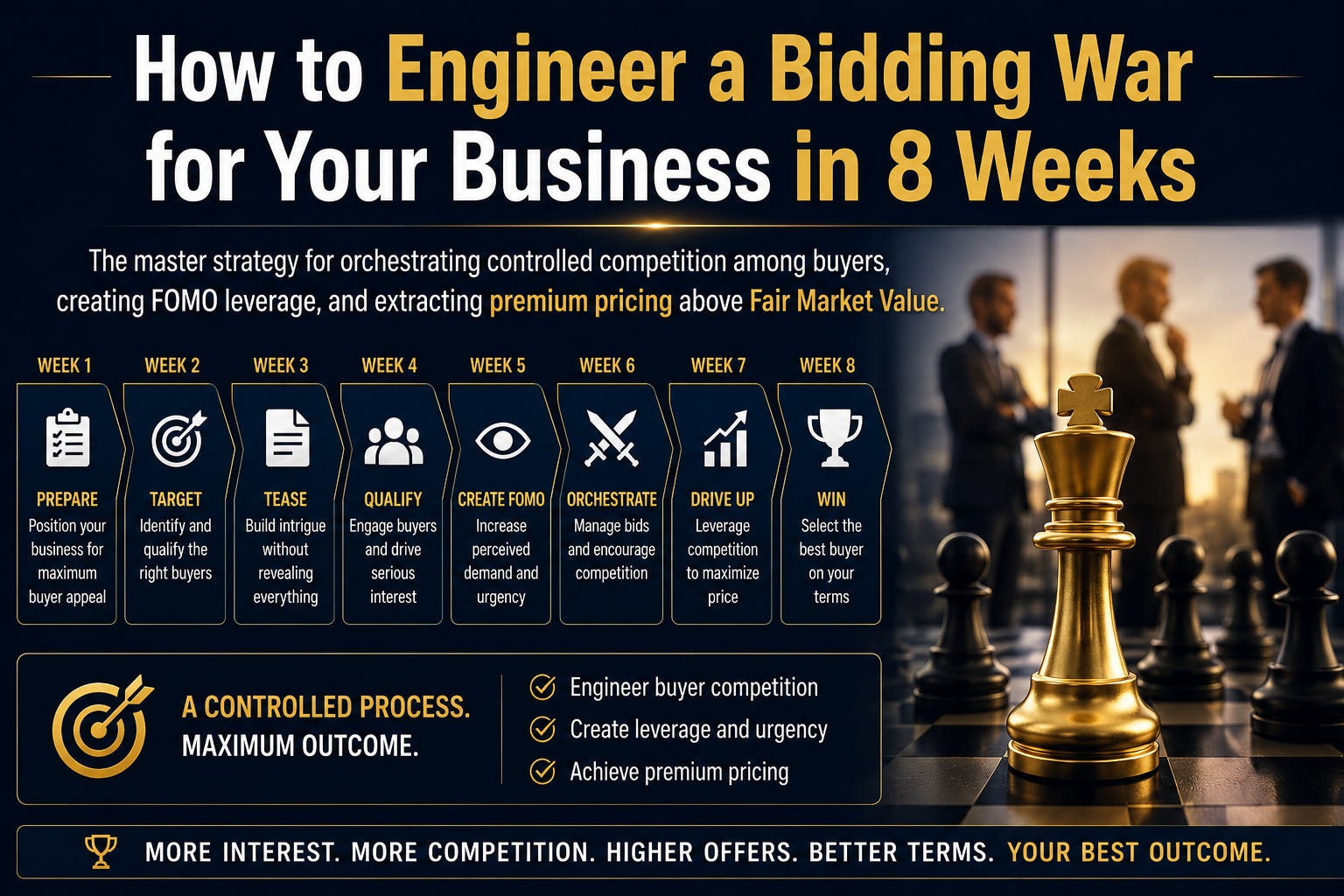
The single fastest way to add millions to your sale price is not improving operations, it is engineering a bidding war. Sellers who run controlled competitive processes routinely capture 20% to 40% premiums above what individual negotiations produce. Here is the 8-week playbook that makes buyers compete instead of negotiate.
10 KEY TAKEAWAYS — ORCHESTRATING THE BIDDING WAR
Competition creates premium, not negotiation: Multiple bidders force buyers to pay above their rational ceiling.
The 8-week timeline is non-negotiable: Compress or extend and the competitive dynamic collapses.
Run 6 to 9 qualified buyers: Fewer reduces leverage, more reduces seriousness.
FOMO is the master psychological lever: Make every buyer fear losing the deal more than overpaying.
Best and final offers extract maximum value: Sequential negotiation costs millions versus simultaneous bidding.
Buyer-specific positioning is mandatory: One pitch fits no one when you have diverse buyer types.
Closing certainty beats highest price: A $45M deal that closes outperforms a $55M deal that fails.
Compulsion management protects leverage: Sellers who eliminate their own urgency gain pricing power.
The right buyer wants it most, not bids most: The early high bidder rarely closes at that number.
Cash is king, everything else is wallpaper: Cash at closing trumps every other deal structure variable.
📚 READING PREREQUISITES
Each post in this series builds upon the technical groundwork laid in earlier entries. Key valuation concepts, models, and metrics are intentionally revisited and reinforced across multiple posts to ensure retention and clarity.
Recommended Prior Reading:
Buyer Types Part 1, Financial Strategic and Management Buyers
Buyer Types Part 2, Individual Family Search Fund and Institutional
Chapter 11: Compulsion, Leverage, and the Psychology of the Sale
Why Bidding Wars Beat Negotiation Every Time
In thirty years of M&A practice, I have watched the same pattern repeat itself. Owners who negotiate with one buyer sequentially leave money on the table. Owners who orchestrate controlled competition among multiple buyers capture premiums that single-track negotiations cannot produce.
The reason is fundamental to buyer psychology. A buyer negotiating alone is rational. A buyer competing against three other qualified parties becomes emotional, defensive, and willing to pay above their initial walk-away number. Harvard Program on Negotiation research consistently demonstrates that competitive auction dynamics produce 15% to 30% better outcomes for sellers than bilateral negotiations.
The challenge is that most owners do not know how to engineer this competition. They either run scattered processes that signal desperation or single-track conversations that surrender all leverage. Chapter 13 lays out the 8-week framework that solves this problem.

Weeks 1-2: Intelligence Gathering and Preparation
The bidding war begins long before any buyer hears about your business. Weeks 1 and 2 are entirely internal, building the foundation that makes competition possible.
Critical preparation activities:
Identify 2 to 3 serious buyers in each category, financial, strategic, individual, and so on
Understand each buyer’s strategic imperatives, what specifically drives their acquisition appetite right now
Map their decision-making processes and timelines, who approves, how long it takes
Identify each buyer’s must-have criteria and deal-breakers, fit your positioning accordingly
Engage an experienced M&A advisor, the right banker pays for themselves multiple times over
Prepare buyer-specific presentations, generic pitch decks signal amateur hour
This phase is invisible to buyers but determines whether the next six weeks produce premium pricing or commodity treatment.
