

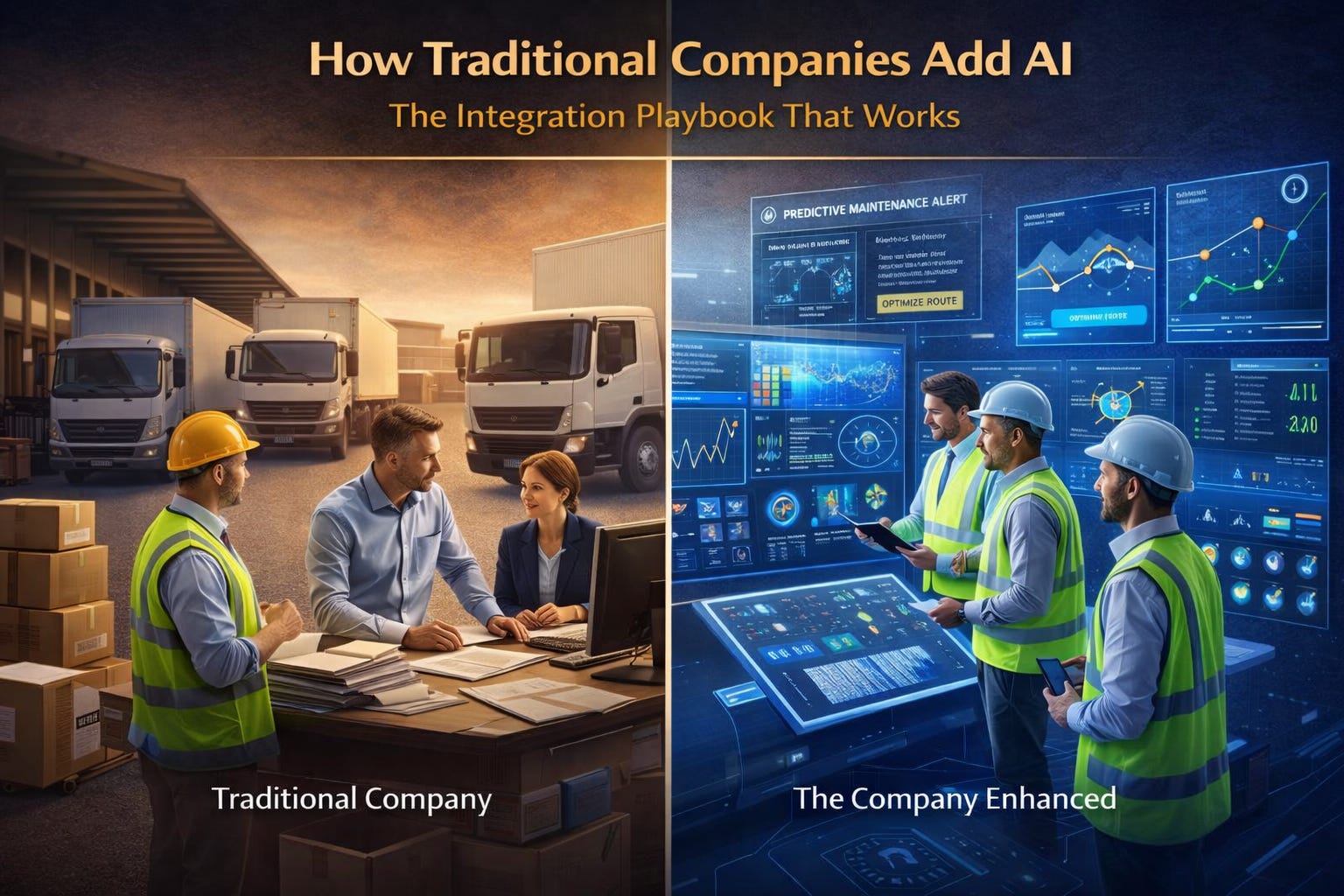
Most companies asking how do we add AI are asking the wrong question. The right question: what customer problems can we now solve that we could not solve before? Traditional companies have domain expertise and customer relationships that pure AI companies would kill for. That is the starting point.
10 KEY TAKEAWAYS - AI INTEGRATION FOR TRADITIONAL COMPANIES
1. Domain expertise is the moat: Knowing which problems AI can solve in your industry matters more than building AI.
2. API integration beats model building: Use OpenAI, Anthropic, or Google APIs rather than training custom models.
3. Start with workflows, not technology: Map customer pain points first, then identify where AI removes friction.
4. Customer relationships are irreplaceable: Pure AI companies have technology but no distribution. You have distribution.
5. Compliance is your advantage: Existing HIPAA, SOC 2, or industry certifications create barriers for AI-native competitors.
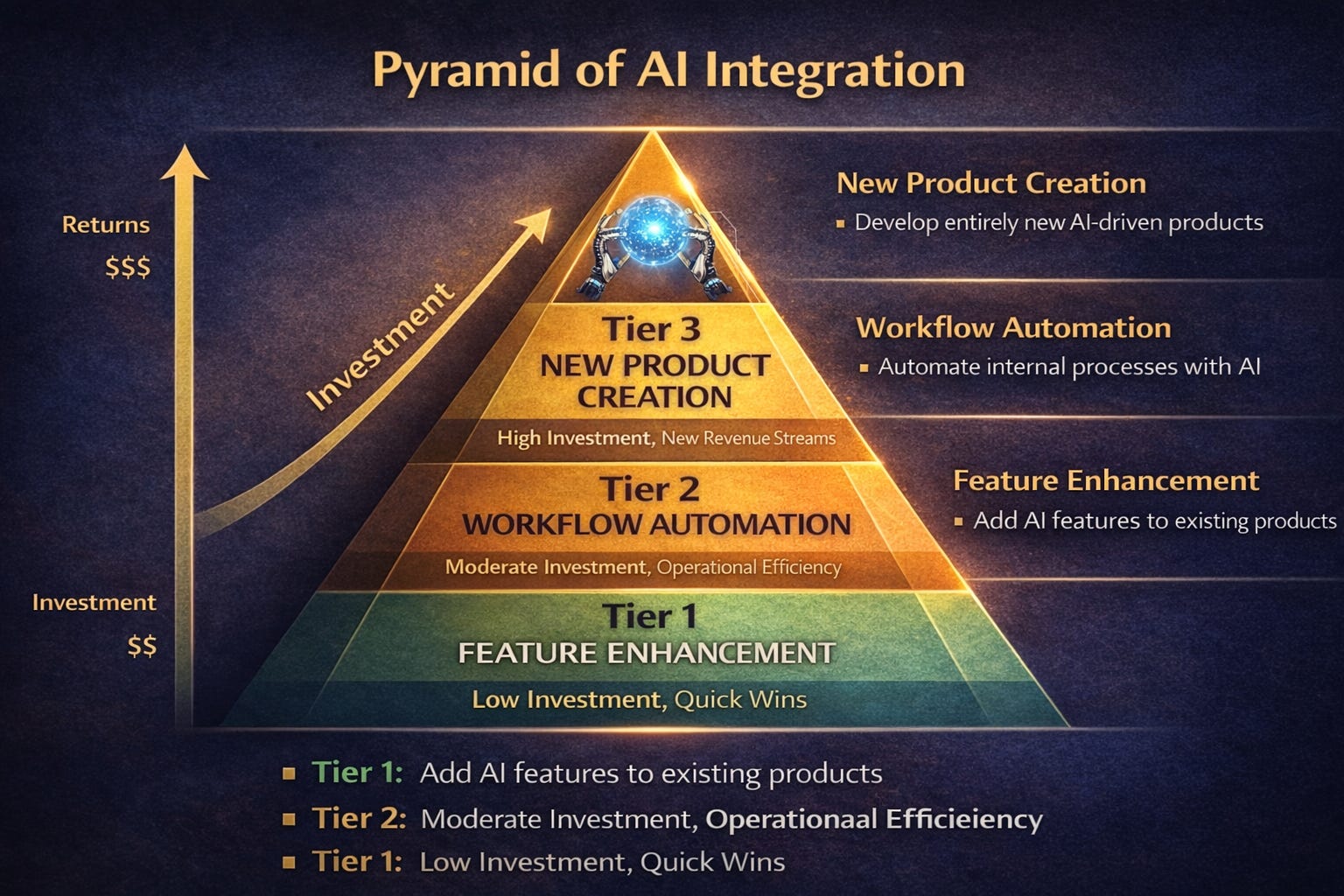
6. Three integration tiers exist: Feature enhancement, workflow automation, and new product creation require different investment levels.
7. Build versus buy analysis favors buy: Foundation model APIs are better and cheaper than anything you could build internally.
8. Data preparation is the real work: 80% of AI integration effort is data cleaning, not AI implementation.
9. Pricing power comes from outcomes: Charge for business results, not AI features. AI is the enabler, not the product.
10. Revenue guarantees fund transformation: The VC Risk Swap provides capital for AI integration without equity dilution.
📚 READING PREREQUISITES
This post provides practical guidance for traditional companies adding AI capabilities. Understanding the AI company taxonomy and moat analysis from earlier posts provides useful context for evaluating where your company fits.
Recommended Prior Reading:
• Post 2: Pure AI vs. AI-Enabled - The Taxonomy That Determines Fundability
• Post 5: Enterprise vs. Consumer AI - Why B2B Is the Only Sustainable Path
• Post 7: AI-Washing and Moat Myths - Separating Real Defensibility from Hype
• Series overview available at SaferWealth.com
The Traditional Company Advantage: What Pure AI Startups Lack
Here is the counterintuitive truth: traditional companies adding AI often have stronger positions than pure AI startups. Why? Because pure AI startups have technology but lack everything else. They are desperately trying to acquire what you already have: customer relationships, distribution channels, domain expertise, regulatory certifications, and established revenue streams.
What Traditional Companies Already Have:
• Customer relationships: Years of trust, contracts, and integration into customer workflows
• Domain expertise: Deep understanding of industry-specific problems, terminology, and workflows
• Compliance infrastructure: Existing HIPAA, SOC 2, or industry certifications that took years to achieve
• Revenue base: Cash flow to fund experimentation without venture capital dependency
• Data assets: Years of proprietary data about customer behavior, industry patterns, and operational processes
Pure AI startups would spend years and millions of dollars to acquire these assets. You already have them. The question is not can we become an AI company but rather how do we add AI capabilities to amplify what we already do well?
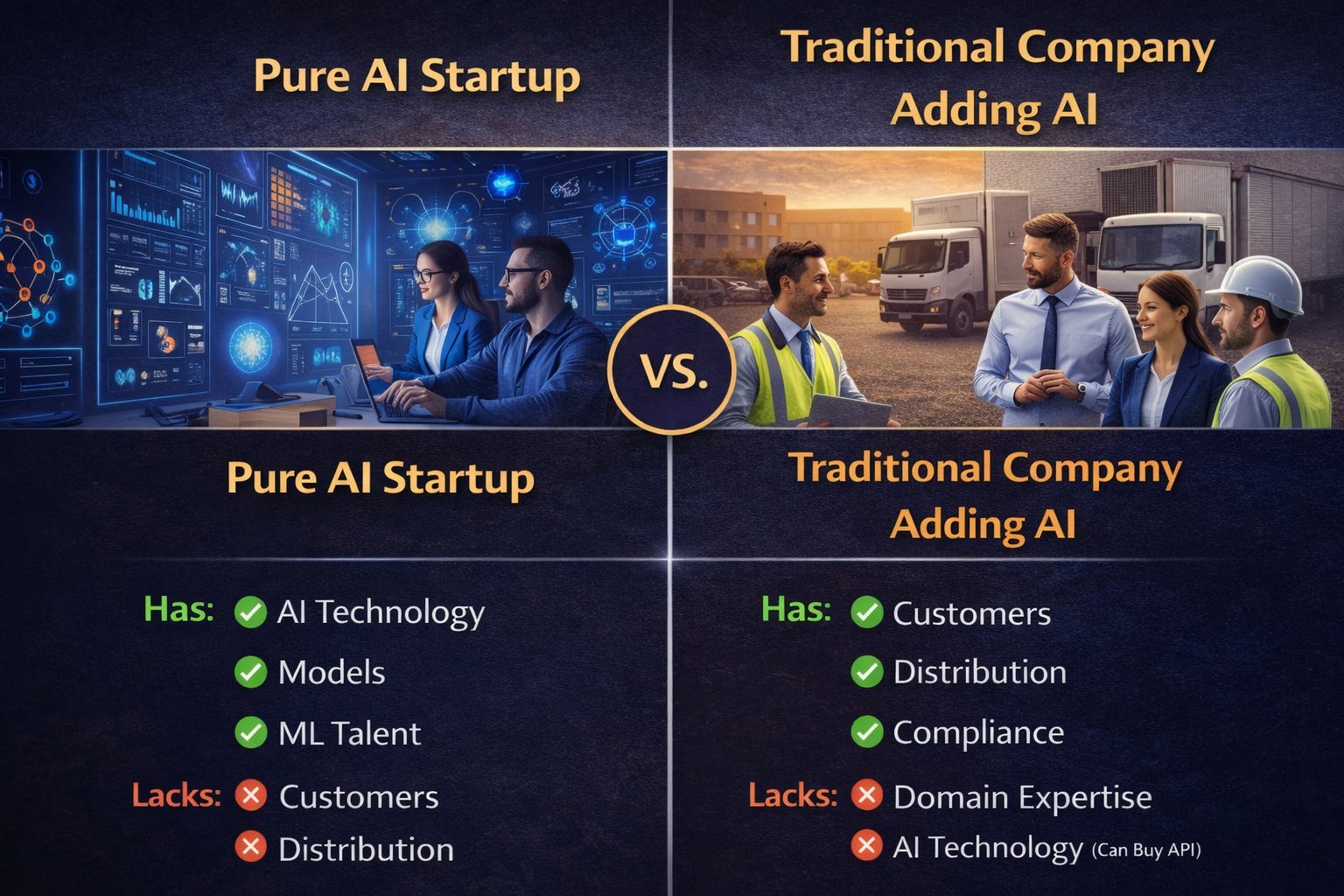
IMAGE SUGGESTION: Two-column comparison showing Pure AI Startup (has: technology, models, ML talent; lacks: customers, distribution, compliance, domain expertise) versus Traditional Company Adding AI (has: customers, distribution, compliance, domain expertise; lacks: AI technology which can be bought via API). Alt text: Visual comparison of pure AI startup assets versus traditional company assets]
The Three Tiers of AI Integration
Not all AI integration is equal. Understanding the three tiers helps you choose the right level of investment for your situation:
Tier 1: Feature Enhancement
What it is: Adding AI-powered features to existing products. Smart search, automated suggestions, content generation assistance, predictive analytics dashboards.
Investment level: Low to moderate. API integration, UI changes, prompt engineering. Can often be done by existing engineering team with some training.
Example: A legal document management system adds Claude-powered contract summarization. Users can click summarize and get key terms extracted automatically.
Tier 2: Workflow Automation
What it is: Using AI to automate multi-step processes that previously required human intervention. Document processing, customer service triage, quality assurance, compliance monitoring.
Investment level: Moderate to significant. Requires workflow mapping, integration with multiple systems, error handling, and human-in-the-loop design for edge cases.
Example: An insurance company automates claims processing. AI extracts information from submitted documents, cross-references policy terms, flags potential fraud indicators, and routes to appropriate human reviewers with recommendations.
Tier 3: New Product Creation
What it is: Building entirely new products or business lines enabled by AI capabilities that were not possible before.
Investment level: Significant. Requires dedicated team, new go-to-market strategy, potentially separate business unit. May justify external capital.
Example: An accounting firm creates an AI-powered tax advisory platform that provides personalized guidance to small businesses. This is a new product line serving a different customer segment than their traditional services.
The strategic insight: Most companies should start with Tier 1 to build organizational capability, move to Tier 2 for operational efficiency, and only pursue Tier 3 when they have proven AI competency and clear market opportunity.
6 The Practical Integration Playbook
Here is the step-by-step approach that works:
Step 1: Map Customer Pain Points
Start with problems, not technology. Interview customers. Shadow users. Review support tickets. Where are the friction points? What tasks are repetitive, time-consuming, or error-prone? What decisions require information synthesis that humans struggle with?
Key questions to ask:
• What tasks do customers complain take too long?
• Where do errors most frequently occur?
• What information do customers wish they had faster?
• What decisions require synthesizing large amounts of data?
Step 2: Identify AI-Solvable Problems
Not every problem is an AI problem. Large language models excel at text generation and summarization, classification and categorization, information extraction, translation and transformation, and question answering over documents. They struggle with precise numerical calculations, real-time data requiring current information, tasks requiring physical world interaction, and decisions requiring human judgment or accountability.
Good AI fit indicators:
• Task involves processing unstructured text or documents
• Humans currently do it but it is repetitive and time-consuming
• 80% accuracy with human review is acceptable
• Volume is high enough to justify automation investment
Step 3: Choose Build vs. Buy vs. Partner
Build (train custom models): Almost never the right choice for traditional companies. Requires ML expertise you do not have, costs millions, and foundation models will outperform you anyway.
Buy (API integration): Usually the right choice. OpenAI, Anthropic, Google, and AWS Bedrock provide better models than you could build, with predictable pricing and ongoing improvements.
Partner (white-label or embedded solutions): Sometimes right for complex implementations. Companies like Writer or Jasper offer enterprise AI platforms that can be embedded in your product.
Step 4: Prepare Your Data
This is where most projects stall. 80% of AI integration effort is data preparation, not AI implementation. You need to clean and structure existing data, create documentation and knowledge bases for RAG (retrieval-augmented generation), establish data pipelines for ongoing updates, and ensure data quality and consistency.
Step 5: Build Human-in-the-Loop Systems
AI is not magic. It makes mistakes. Design systems where AI handles the bulk of work but humans review, correct, and approve. This is especially critical for high-stakes decisions involving compliance, safety, or significant financial impact.
Step 6: Measure and Iterate
Define success metrics before launch. Track accuracy, user adoption, time savings, and customer satisfaction. AI implementations improve over time with better prompts, more training data, and refined workflows. Build feedback loops that capture what works and what does not.
