


Non dilutive is the most reassuring phrase in startup finance, and one of the most misleading. Two popular tools, revenue based financing and venture debt, let you fund growth without selling a share. Both also let a lender take the wheel the moment you stumble. Here is exactly where each one bites.
[Suggested image: two doors, one labelled Venture Debt with a tripwire across the threshold, one labelled Revenue Based Financing with a drain in the floor, both opening into the same room labelled Lost Control. Alternative: a steering wheel with two hands reaching for it, one holding a covenant, one holding a revenue meter.]
The Comforting Lie of Non Dilutive
Non dilutive is the warmest phrase in startup finance. It whispers that you can raise the money and still keep the whole company, no priced round, no board seat surrendered to a venture fund. The two workhorses of the non dilutive world, revenue based financing and venture debt, both make that promise, and on the surface both keep it. Neither hands a slice of your company to an investor at the table.
But as one lender’s own guide admits, the non dilutive framing understates the real cost. Non dilutive does not mean no strings. Each of these tools carries a different mechanism, buried in the fine print, that can seize control of your company at the precise moment you can least afford to lose it. They simply reach for the wheel through different doors.
Venture Debt, the Covenant Cliff
Venture debt is a loan extended to venture backed companies, usually alongside or just after an equity round. To a founder who has already survived a priced round, it can feel like a clean solution, cash without more dilution. But its structure is far more consequential than the headline interest rate suggests, and the danger lives in the covenants.
Covenants are tripwires. A venture debt deal typically requires you to hold a minimum cash balance, often three to six months of operating expenses, and to hit revenue or ARR targets. Miss one of those and you are in technical default, which hands the lender significant control over your company. On top of that sits the material adverse change clause, which lets a lender declare a default on a largely subjective judgment, a missed number or the sudden loss of a key customer, plus a change of control provision that turns any acquisition into an immediate repayment demand.
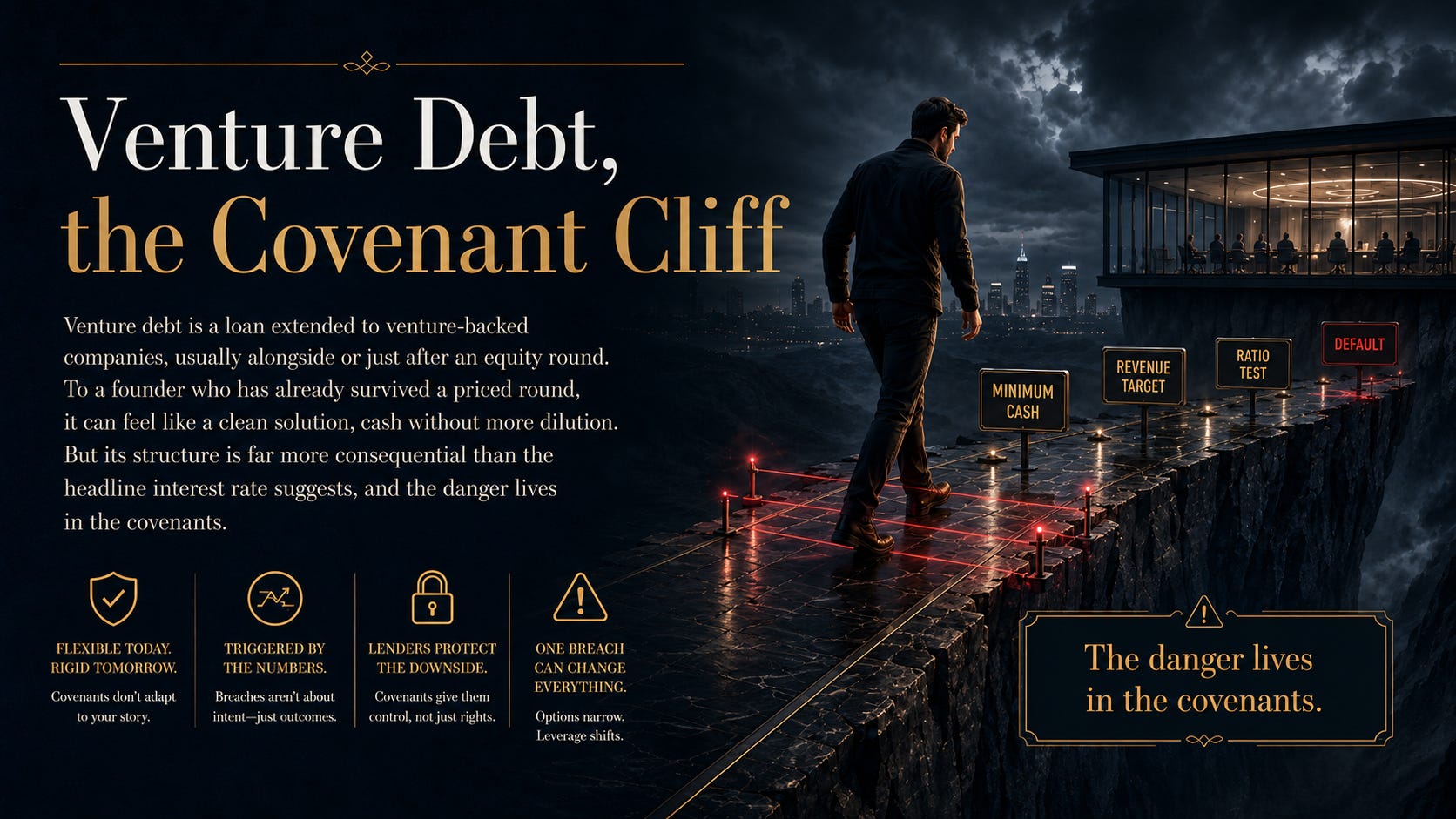
The 2026 version is sharper still. Roughly thirty percent of new growth stage venture debt deals now use a dynamic borrowing base, a hair trigger where a five percent jump in churn can force an immediate de-leveraging event, paying down principal out of your remaining equity. And it is not even fully non dilutive: warrant coverage has crept up from a historical 0.5 percent to as high as 2 percent of the fully diluted cap table.
Some of this is negotiable, and a sharp founder pushes back, requesting cure rights, grace periods to fix a breach before the lender accelerates repayment, and concrete dollar thresholds for what counts as a material adverse change, rather than leaving it to the lender’s imagination. But negotiation only softens the trap, it does not remove it. Underneath everything sits the plainest catch of all. Debt is debt. It must be repaid in cash, on a schedule, no matter how the business performs, so a twelve percent loan that comes due in a rough quarter can cost more than a dilutive round that never has to be repaid. Venture debt does not ask for a board seat. It asks for the keys, and it only reaches for them once you are already stumbling.
Revenue Based Financing, the Relentless Skim
Revenue based financing looks like the gentler cousin, and in important ways it is. Capital is advanced against a slice of your monthly revenue, and the good news is genuine: no financial covenants, no warrants, truly non dilutive, with repayments that flex down when revenue dips. There is no tripwire to accidentally trip and no covenant cliff to fall off. For a business with steady, predictable revenue, it can be a clean way to fund growth that the revenue itself repays.
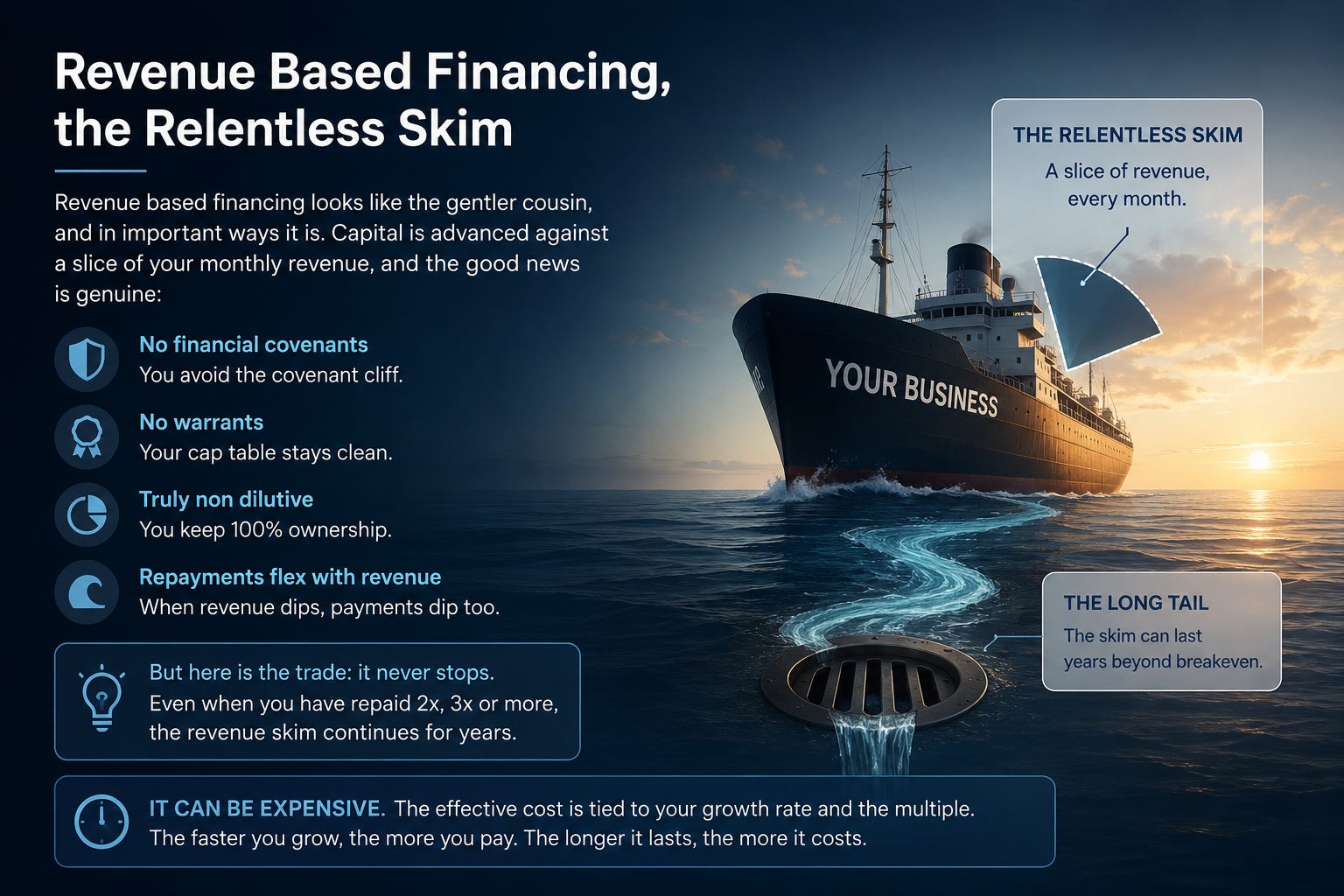
The trap is simply a different shape. Revenue based financing is expensive, and the cost is relentless. It typically runs about 1.3 to 1.5 times the principal, which annualizes to somewhere between 25 and 50 percent depending on how fast you grow, and that share comes off the top of every single month, skimming the exact cash you need to fund the growth you borrowed for. It does not seize control through a legal clause. It slowly strangles it through the bank account.
Worse, stacking is a death spiral. Piling a second, third, or fourth advance on top of the first stacks the remittances until they compound like stacked merchant cash advances and swallow the business whole. The founder who kept full control on paper can lose every practical degree of freedom to a revenue share that eats each dollar of growth before it can be spent. As one advisor puts it, if the model is broken, do not feed it debt. Fix the model first, because non dilutive tools amplify a healthy company and accelerate a sick one’s decline.
Put the two side by side and the pattern is clear. Venture debt threatens control through a legal tripwire that snaps in a bad quarter. Revenue based financing threatens it through a cash drain that tightens exactly when growth needs air. Neither takes a board seat, which is precisely how both get sold as founder friendly, and neither shows its teeth until performance dips, which is exactly when a founder has the least room to fight back. The common flaw is not the interest rate or the revenue share. It is that both instruments are built to protect the lender by taking something from you at your weakest moment.
Why The VC Risk Swap Has No Trap Door
The VC Risk Swap keeps control where both tools threaten it. There is no covenant to trip, so a bad quarter cannot flip you into technical default and hand a lender the wheel. There is no repayment cliff forcing a fire sale or a desperate raise in a rough month. No warrants nibble the cap table, and no revenue skim starves growth. The founder keeps control, not just equity on paper. The funder is protected by the structure itself, a milestone based guarantee backstopped by coverage, not by tripwires that seize the company. Protection for both, the wheel for neither.
Subscribe to SaferWealth for more field notes from the part of the funding world the venture market overlooks, plus the structures that fund good companies on their own terms.
Questions about your specific situation? Reach out directly at riskswap@saferwealth.com.
CONNECT WITH SAFERWEALTH
