

Multiple Choice Questions
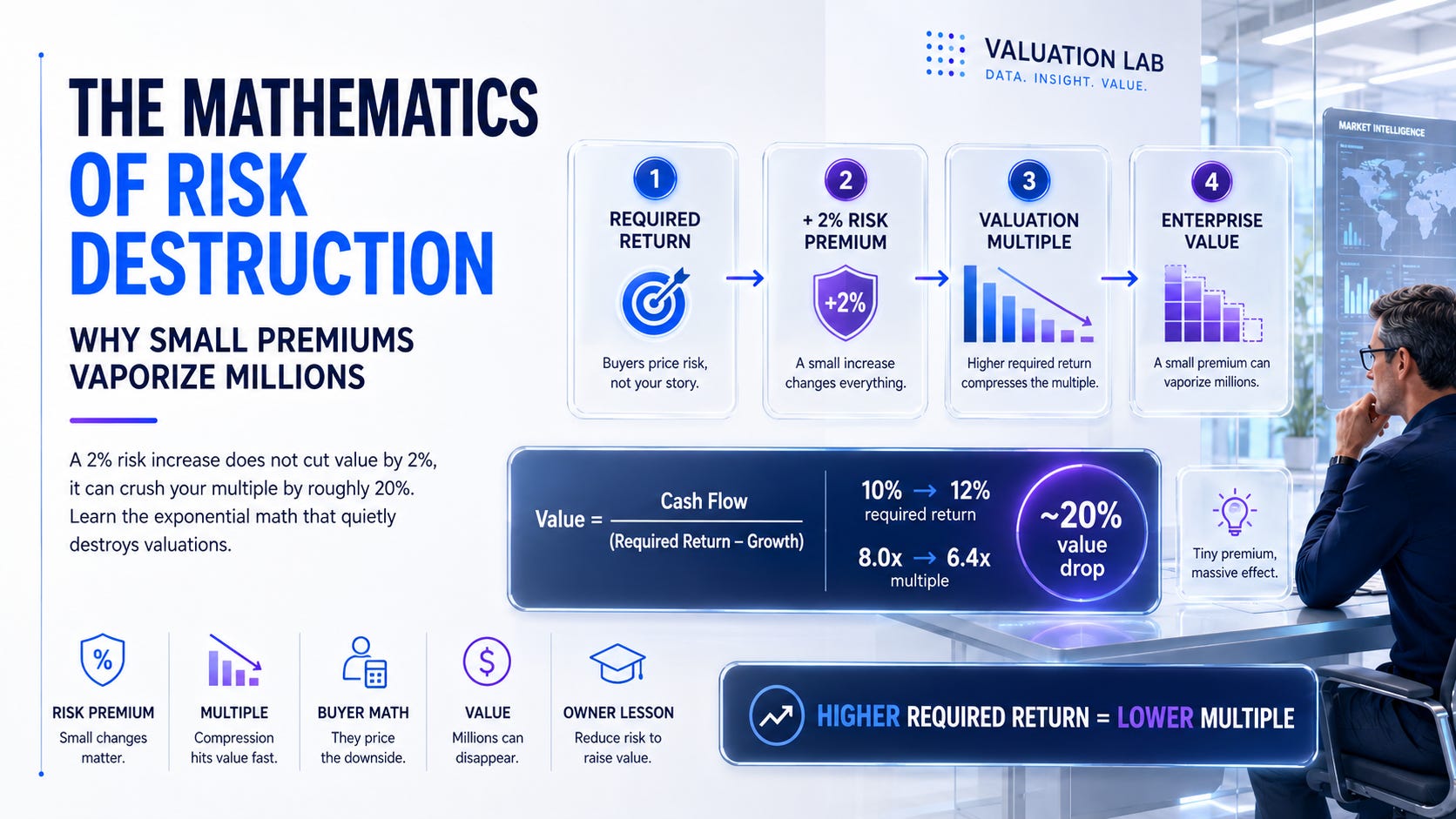
1. A required return of 15% corresponds to what multiple?
a) 5x b) 6.67x c) 7.5x d) 8x
2. Moving from a 20% to a 25% required return represents approximately what value destruction?
a) 5% b) 20% c) 40% d) 55%
3. In the key person example, the $6 million gap between Company A and Company B was driven by:
a) Different EBITDA b) Owner dependency versus systems c) Different industries d) Tax differences
4. The owner with a 64% customer wanted $40 million but was offered:
a) $5 million b) $10 million c) $20 million d) $30 million
5. True or False: The relationship between risk and value destruction is exponential, not linear.
6. Bill Gates reportedly stopped writing Windows code in which decade?
a) 1970s b) 1980s c) 1990s d) 2000s
7. True or False: Growing revenue always increases a company’s valuation multiple.
8. A 33% required return produces what multiple?
a) 2x b) 3x c) 4x d) 5x
9. According to the post, buyers primarily purchase:
a) The owner’s personality b) Transferable systems c) Brand awareness d) Office real estate
10. True or False: Customer concentration can lower a valuation multiple even while revenue grows.
Essay Questions
1. Explain why risk destruction is exponential rather than linear, using the multiple values from the post.
2. Describe the key person risk example and explain what created the $6 million valuation gap.
3. Explain how a company can grow revenue while destroying its own valuation multiple through customer concentration.
4. Why does the post argue that buyers pay for systems rather than the owner’s personal genius?
5. Using the Brennan Industrial Coatings case, explain how Niki nearly doubled value while EBITDA grew only modestly.
SOLUTIONS, ASSESSMENT 2
Multiple Choice Answers
1. b) 6.67x, since 1 divided by 0.15 is about 6.67.
2. c) 40%, the 5x to 4x drop represents a 40% value destruction in the post.
3. b) Owner dependency versus systems, Company A collapsed without Joe.
4. b) $10 million, against her $40 million ask.
5. True, small premium increases cause disproportionate value loss.
6. b) 1980s, Gates stopped coding Windows in the 1980s.
7. False, revenue growth can raise risk and lower the multiple.
8. b) 3x, since 1 divided by 0.33 is about 3.
9. b) Transferable systems, not the owner’s personality.
10. True, concentration risk can shrink the multiple despite revenue growth.
Essay Answers
1. Value destruction is exponential because the multiple equals 1 divided by the required return. As the return climbs, the multiple falls at an accelerating rate: 15% gives 6.67x, 20% gives 5x (a 25% loss), 25% gives 4x (a 40% loss), and 33% gives 3x (a 55% loss). Each additional point of risk removes a larger share of value than the last, unlike a linear reduction where each point would cost the same.
2. Two companies each earned $2 million EBITDA. Company A depended entirely on Joe, who held every decision, relationship, and vendor contact personally, earning a 3x multiple, roughly $6 million. Company B ran on documented systems and a management team, earning a 6x multiple, roughly $12 million. The $6 million gap was pure key person risk. Buyers discounted Company A heavily because the business could not survive Joe’s departure.
3. A company can quadruple revenue by winning one dominant customer, yet raise its risk profile if that customer represents most of sales without a contract. The concentration premium expands, and since the multiple is the inverse of the required return, the multiple contracts. In the post, revenue grew from $5 million to $20 million, but the offer fell to $10 million against a $40 million ask because a 64% customer made the cash flow fragile.
4. Buyers purchase future cash flows, not the owner’s charisma. A business dependent on the owner’s personal genius carries key person risk, because that genius does not transfer in a sale. Systems, documentation, and management depth do transfer, producing predictable cash flow a buyer can rely on. That is why buyers prefer boring, systematic, documented businesses over exciting, owner dependent ones, and pay premium multiples for them.
5. Niki reduced his dominant customer from 61% to 22% of revenue, added eleven recurring accounts, and converted the key relationship into a contracted master agreement. He also documented processes and installed an account team to cut key person risk. This dropped the company specific premium from about 18% to 7%, lifted the multiple from about 3.6x to about 5.9x, and, combined with modest EBITDA growth to $3.9 million, moved value from roughly $12.5 million to roughly $23 million. The multiple expansion from de risking, not EBITDA growth, drove most of the gain.
Educational Disclaimer
This assessment provides information only, not professional advice. All cases are fictional, created for educational purposes from collective industry experience. Consult qualified advisors for your specific situation.
© 2026 YBAWS! All rights reserved.