

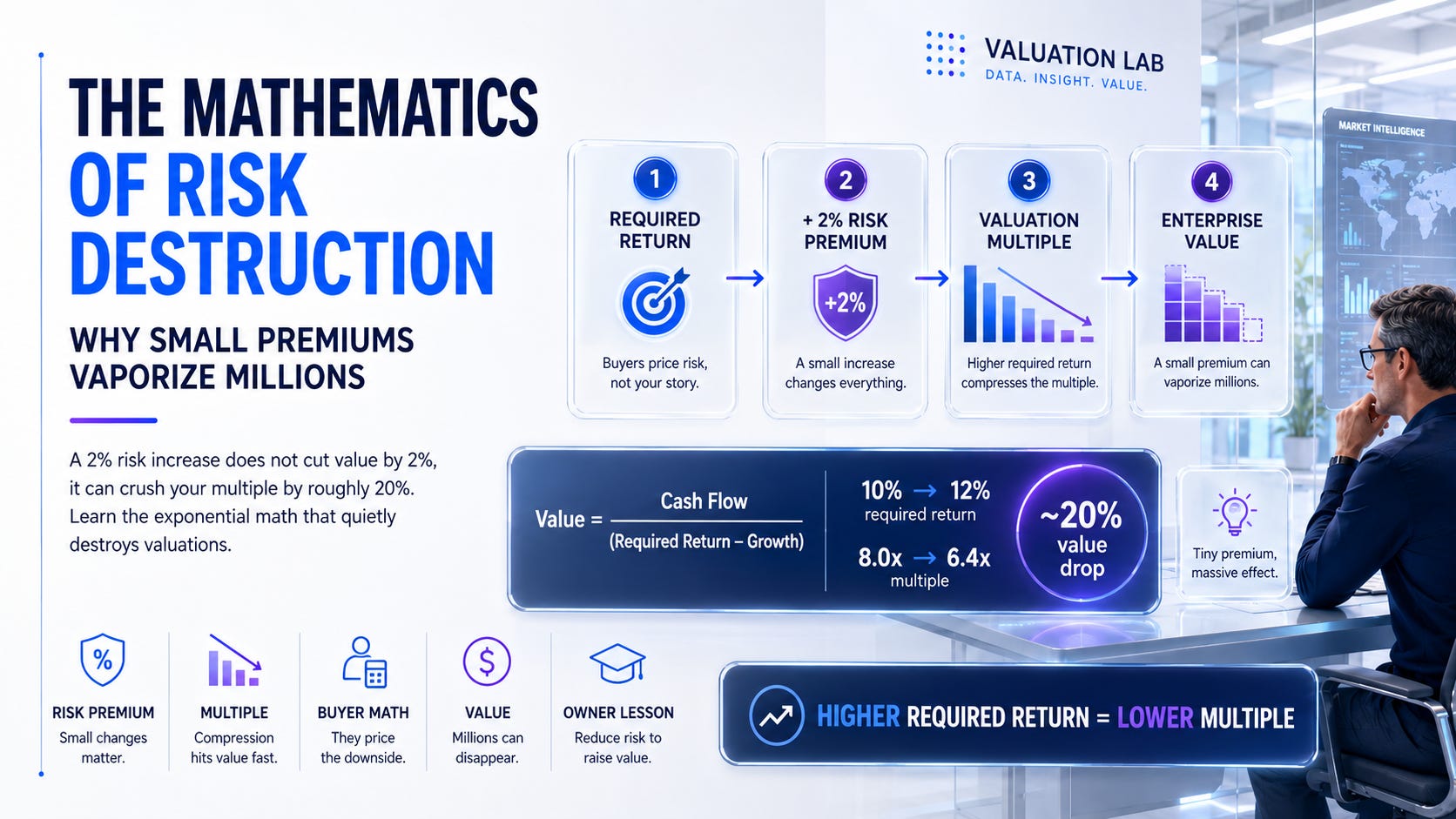
A 2% risk increase does not cut value by 2%, it crushes your multiple by roughly 20%, learn the exponential math that quietly destroys valuations. Risk destruction is exponential, not linear. A 2% increase in required return does not shave 2% off your value, it can crush your multiple by 20% or more. Key person dependency and customer concentration are the silent killers. See the math that separates the genius who never sells from the mogul.
10 KEY TAKEAWAYS, EXPONENTIAL RISK
1. Not linear, exponential: A small premium increase destroys a disproportionate share of value.
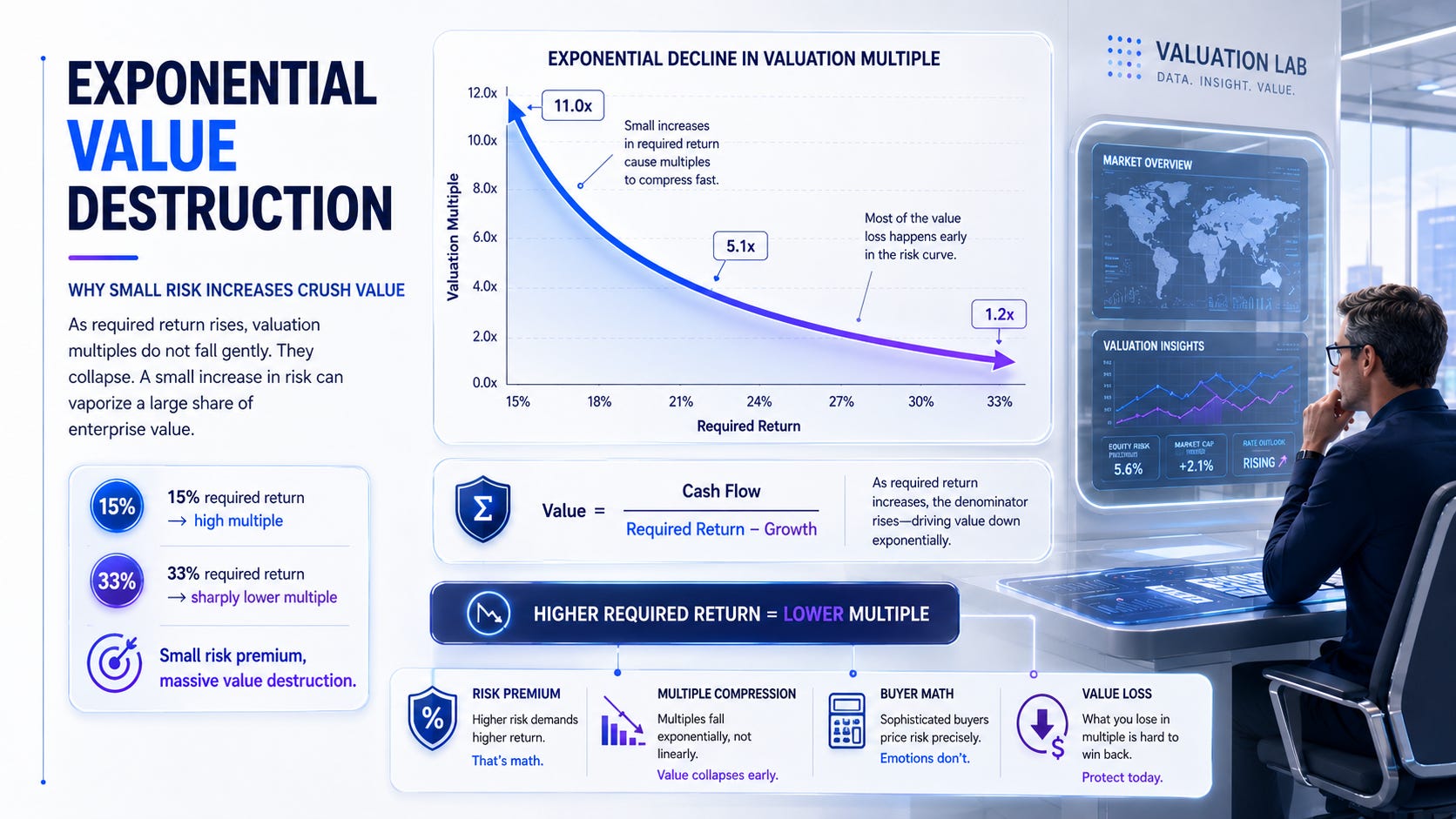
2. 15% to 33% return: Watch the multiple collapse from 6.67x to 3x as risk climbs.
3. The bucket with a hole: Pouring revenue in while risk drains value out is wasted effort.
4. Key person risk is real money: Owner dependency cost one company $6 million in the example.
5. Get out of your own way: The best founders hire good people, then let them run.
6. Concentration kills multiples: A 64% customer destroyed value even as revenue quadrupled.
7. Revenue is a shiny object: Growth without diversification raises risk, not price.
8. Systems beat personalities: Buyers purchase transferable systems, not your sparkling self.
9. Replaceable equals valuable: If the business needs you, it is worth less without you.
10. De risk for outsized returns: Cutting risk can return more per dollar than any growth campaign.
READING PREREQUISITES
This post builds directly on the risk recipe and the multiplier logic introduced earlier. To follow the exponential math, you should already understand that your multiple is the inverse of your required return.
Recommended Prior Reading:
• Chapter 15, Post 1, The Risk Recipe
• Chapter 1, The Control Freak Trap
• Chapter 6, Why the Denominator Beats the Numerator
The Exponential Truth About Risk
Here is what separates the genius who never reaches market from the mogul who keeps growing wealth: understanding that risk premiums create exponential, not linear, value destruction. A 2% increase in total required return does not decrease valuation by 2%. It crushes your multiple by roughly 20% at typical risk levels.
Look at the mathematical reality:
• 15% required return equals a 6.67x multiple
• 20% required return equals a 5x multiple, a 25% value destruction
• 25% required return equals a 4x multiple, a 40% value destruction
• 33% required return equals a 3x multiple, a 55% value destruction
This is why chasing income while ignoring risk is like filling a bucket with a hole in the bottom. You can pour all the revenue you want, but if risk factors are draining your multiple, you are wasting your time. Investopedia’s overview of valuation methods shows how the discount rate sits at the center of every income based approach.
The Key Person Risk Disaster
Picture two manufacturing companies, each making $2 million EBITDA. Company A is run by Joe, who makes every decision, knows every customer personally, and holds all vendor relationships in his head. Company B has a management team, documented processes, and clear succession plans.
Joe’s company gets valued at 3x EBITDA, roughly $6 million, because buyers see a business that could collapse if Joe disappears. Company B earns 6x EBITDA, roughly $12 million, because it is a system, not a person. That is a $6 million difference because Joe could not get out of his own way.
The only common strategy every successful founder shares:
• Hire good people
• Give them documented systems to run
• Then get out of their way
Bill Gates understood this early. He stopped writing Windows code in the 1980s. By getting out of the way, Microsoft became the world’s standard operating system. The difference between an obscure operator and a mogul is often that the former obsesses over operations while the latter obsesses over vision. For the research foundation, Harvard Business Review on succession planning reinforces why owner dependency is a value destroyer.
