

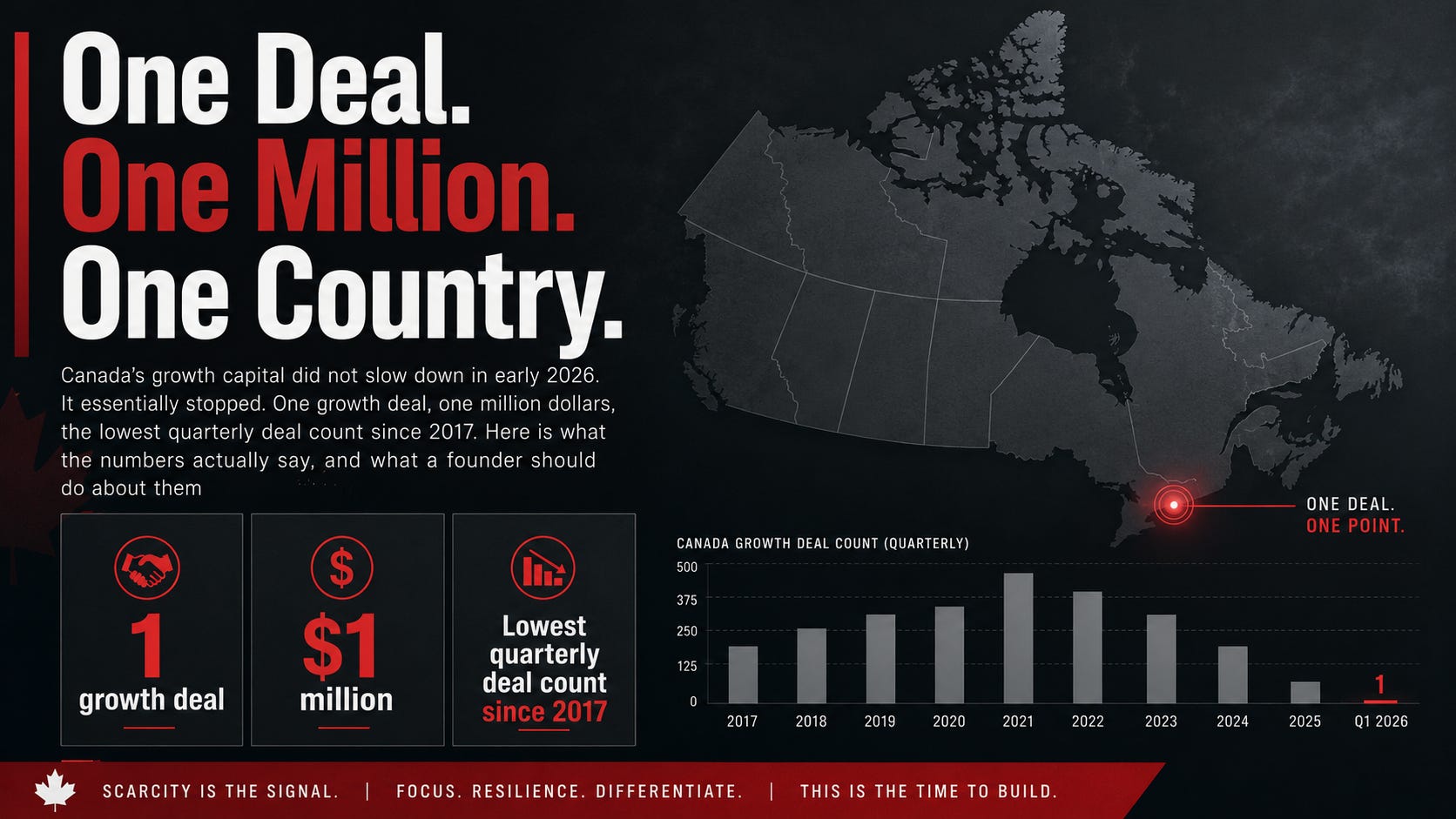
Some numbers argue. This one just stares at you. In the first quarter of 2026, all of the growth capital invested in every scaling company in Canada came to one deal worth about a million dollars. Not a slowdown, not a correction. A near total stop. Here is what the data really means for you.
The Number That Stops the Room
Statistics usually need a story wrapped around them. This one does not. In the first quarter of 2026, venture investment in Canadian growth stage companies fell to a single deal worth roughly one million dollars, against a typical first quarter of about $140 million. Read that again slowly. Not a million per company. A million for the entire growth stage, in a country of forty million people with a technology sector it likes to call world class.
The rest of the quarter fills in the picture. Canadian venture capital deployed CAD $936.3 million across 104 transactions, the lowest deal count in any quarter since 2017, with no initial public offerings at all. A typical first quarter runs closer to 171 deals. Average deal size landed at nine million dollars. Capital did not simply shrink, it retreated to the earliest stages and huddled there.
The shape of that retreat is the real story. Roughly seventy percent of everything invested went to companies at pre seed through Series B. The early end of the market is still breathing. The moment a company grows up and needs a serious cheque to scale, the room empties out. Canada is funding beginnings and abandoning middles.
The distortion runs through the neighbouring private equity numbers too. In the same quarter, two sectors, metals and mining and oil and gas, took $2.08 billion, about 54.5 percent of all private equity capital deployed, across just six transactions, with ninety five of 112 disclosed deals coming in below $25 million. Strip out a couple of enormous resource deals and what remains is a thin, cautious mid market. The averages look respectable. The typical company still cannot find a cheque.
What the Data Is Actually Telling You
Read carefully and the numbers are not saying Canadian companies are bad. They are saying the machine that funds them has jammed at a specific point. CVCA’s own analyst was careful and precise about it: one quarter does not confirm a structural shift, but the pattern has persisted across several quarters, and the absence of domestic growth capital warrants attention, because that is the stage where foreign participation increases, domestic ownership dilutes, and acquisition becomes more likely than an IPO.
Behind the deal data sits the fund data, and it is worse. The top five Canadian funds captured 46 percent of all capital raised in 2023. By 2025 that share hit 80 percent, while every other fund combined collapsed from $4.5 billion to $444 million, close to a 90 percent drop. The number of Canadian companies actively raising fell from 162 in early 2025 to just 61 a year later. Fewer funds, fewer cheques, fewer founders even trying. That is not a market taking a breather. That is a market quietly clearing its throat and leaving the building.
Zoom out to the full year and the concentration is just as blunt. Canadian startups raised about $8 billion in 2025, and just ten big ticket deals accounted for roughly half of it, with AI taking about half of all dollars invested. A handful of megadeals propped up the headline while the median company felt nothing at all. If the annual number looked survivable, that is because a few giants were doing all the lifting.
What a Founder Should Actually Do With This
Numbers this stark tend to produce two useless reactions. The first is denial, insisting your company will be the exception. The second is despair, concluding the market is closed and giving up. Both are wrong, and both are expensive. The useful response is to treat the data as a map, not a verdict.
A little intellectual honesty helps here. One quarter is one quarter. Growth deals are lumpy by nature, a single large financing could make the next quarter look almost normal, and American investment in Canada is showing early signs of recovering. Nobody should build a life philosophy on ninety days of data. But the direction has now held across several quarters, and that is the part that should focus the mind. You do not need certainty about the trend to act on it. You only need to notice that the cost of being wrong about it, running out of runway while waiting for a round that never lands, falls entirely on the founder.
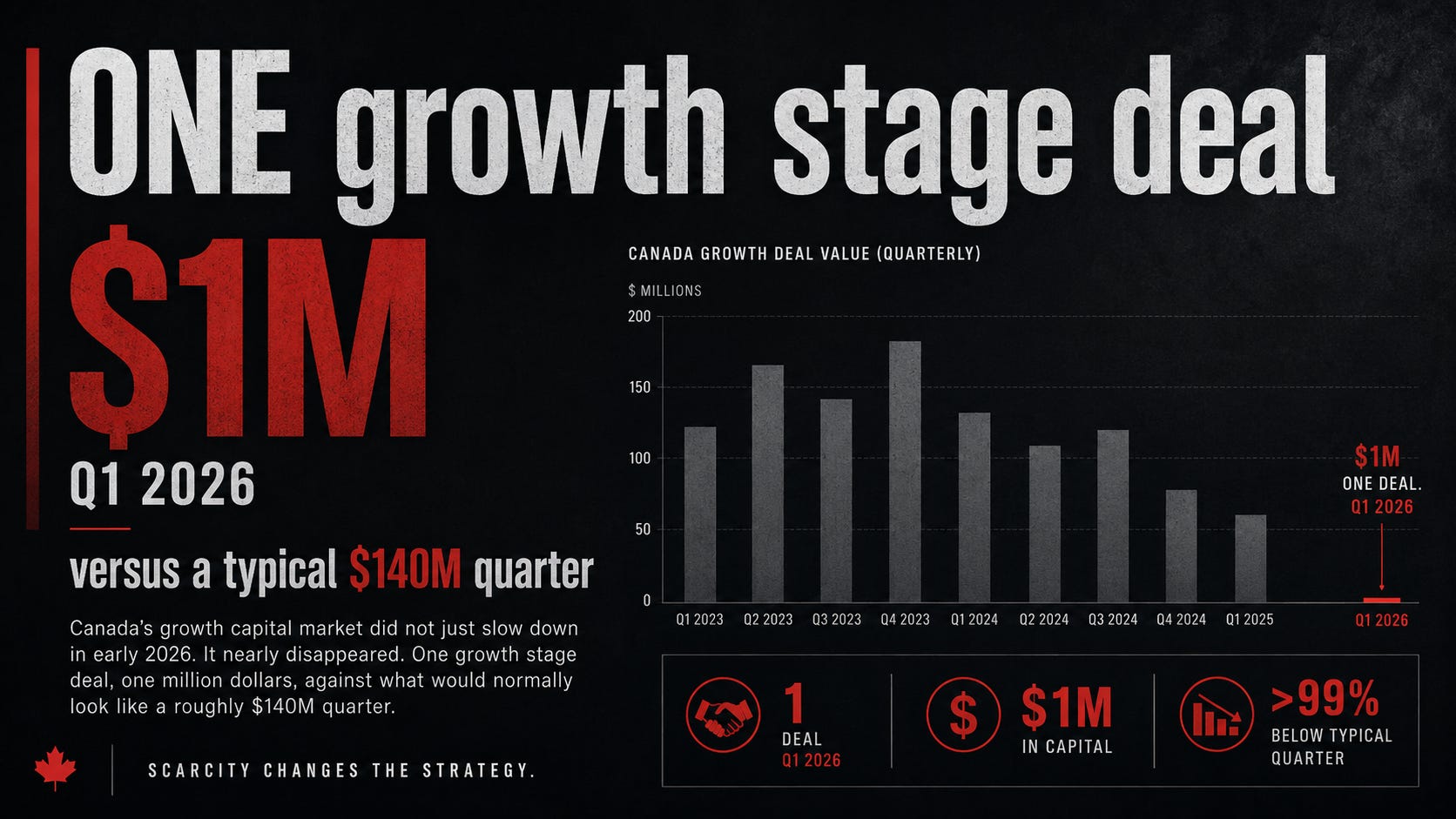
The map says three things. Early money still exists, so the seed round is not a fantasy. Growth money has effectively vanished, so do not build a plan whose survival depends on a Canadian led Series B arriving on schedule. And when the big round does come, it will probably come from abroad, which is where Canadian ownership thins from over 70 percent in small rounds to 12.7 percent in rounds above $50 million, carrying board seats and exit control across the border with it.
So plan for the gap rather than praying it closes. Stretch runway with non dilutive money, grants, credits, and customer cash. Reach profitability, or something close to it, earlier than you would have wanted. Assume the next equity cheque may not arrive, and build a company that does not need it to survive. Canadian investors themselves rank securing financing and liquidity as their number one worry, with 83 percent of venture investors naming it their chief concern for the future. When the people holding the money are that nervous, a founder relying on their generosity is planning with someone else’s optimism.
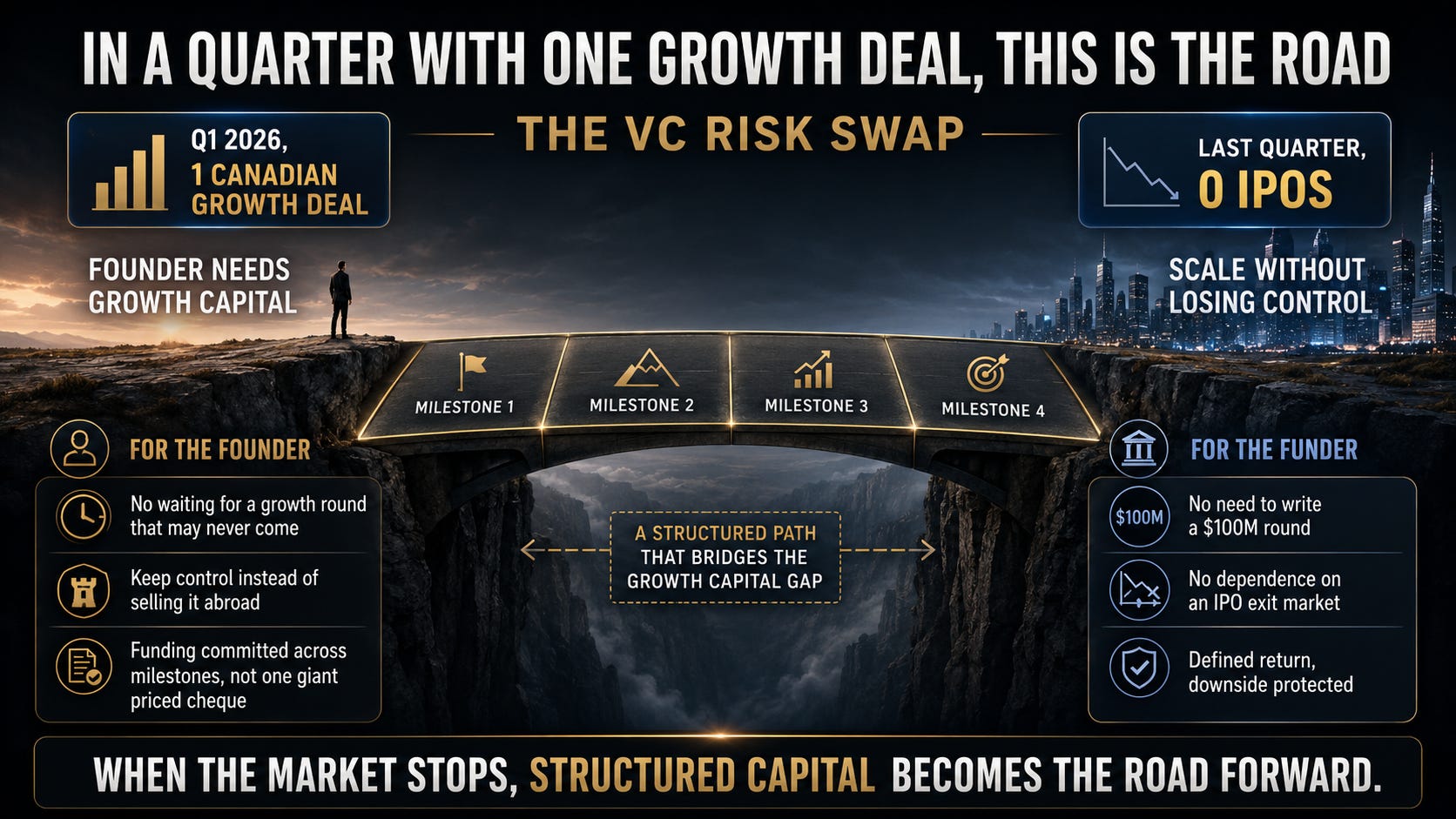
Why The VC Risk Swap Answers This Data
This is precisely the gap the VC Risk Swap was built to cross. The founder is not left waiting for a Canadian growth round the data says will not come, and does not have to sell control abroad to keep scaling, because funding is committed across milestones instead of one giant priced cheque. The funder does not need to write a hundred million dollar round or wait for an exit market that produced no IPOs at all last quarter, since the return is defined and downside protected. In a quarter with one growth deal, that is the road.
Subscribe to SaferWealth for more field notes from the part of the funding world the venture market overlooks, plus the structures that fund good companies on their own terms.
Questions about your specific situation? Reach out directly at riskswap@saferwealth.com.
CONNECT WITH SAFERWEALTH
Expand your learning beyond this post:
1. Web: SaferWealth.com, alternative startup funding structures.
2. YouTube: The Capital ToolKit, funding strategy and structure breakdowns.
3. Rumble: @SaferWealth.
4. Contact: riskswap@saferwealth.com.
ABOUT THE AUTHOR
Sean Cavanagh (BAS, CPA, CA, CF, CBV) is the founder of SaferWealth and creator of the VC Risk Swap, an alternative startup funding structure that preserves founder equity and control through milestone based, downside protected capital. With over three decades in business valuation, M&A advisory, and structuring, Sean writes about funding the businesses the venture market overlooks.
DO YOUR OWN RESEARCH
Sources referenced in this post:
• CVCA, Q1 2026 market overview, the $936.3 million across 104 deals and the lowest count since 2017.
• The Hub, near zero growth stage investment, one growth deal at about one million against a typical $140 million.
• RBCx, Canadian venture capital report 2026 mid year, fund concentration and the drop in active raises.
• BetaKit, Canada’s investment gap, ten deals taking half of all 2025 investment.
• The Logic, CVCA on growth funding, the ownership split by round size.
• CVCA Central, 2026 private capital outlook, financing and liquidity as the top investor concern.
📖 RELATED READING
• CVCA: Q1 2026 Market Overview: the full interactive data behind the quarter.
• RBCx: Canadian VC 2026 Mid Year Check In: what fund concentration means at the company level.
• The Hub: A Wake Up Call for Ottawa: the policy fight behind the numbers.
Educational disclaimer: This content is for educational purposes only and does not constitute legal, tax, financial, or investment advice. The VC Risk Swap is a sophisticated structure that must be implemented with independent professional advisors for your specific situation. All examples are illustrative. Neither the author nor SaferWealth accepts liability for actions based on this content. This material supplements but never replaces proper professional consultation and judgment.
© 2026 SaferWealth. All rights reserved.