

MULTIPLE CHOICE QUESTIONS
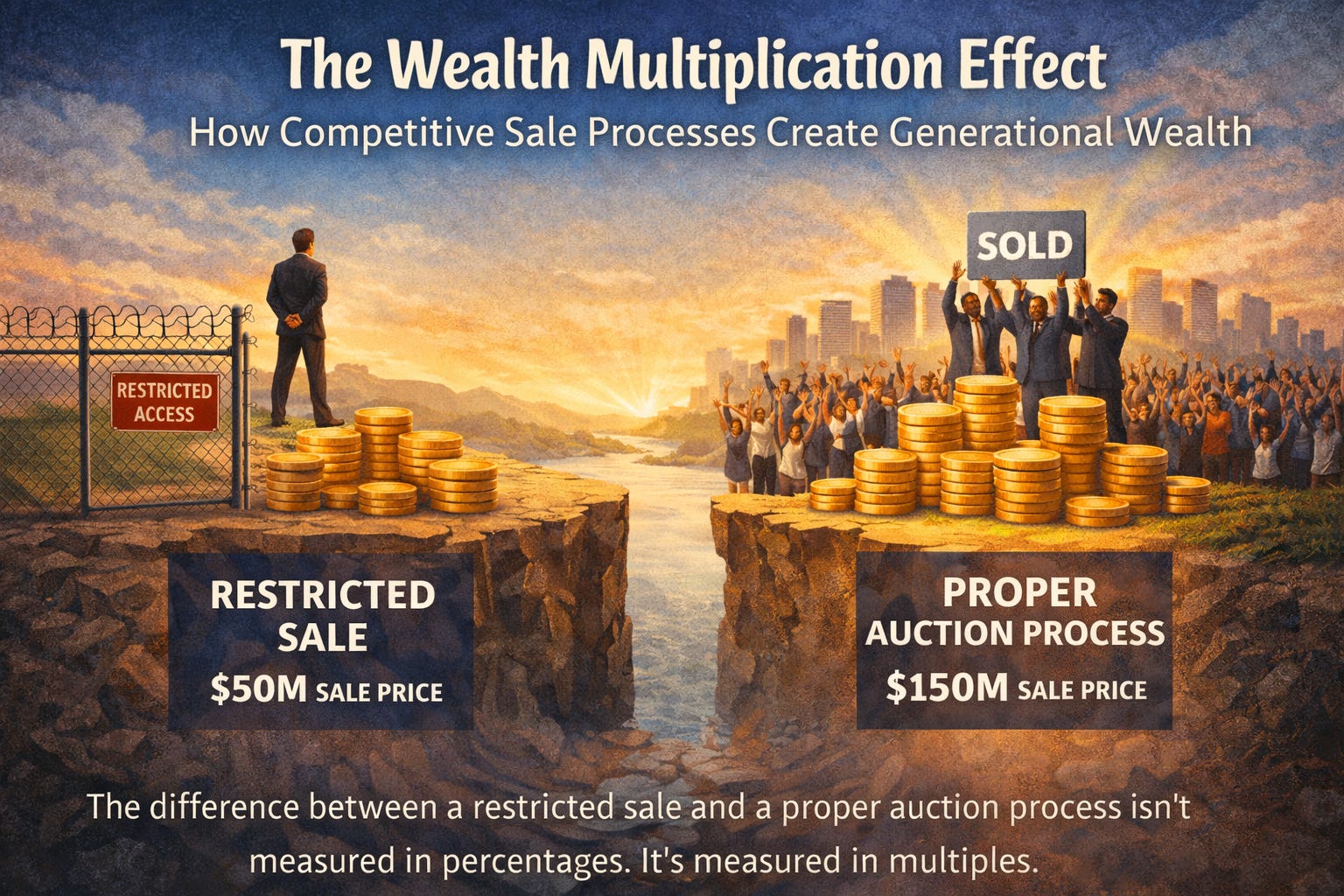
1. The “wealth multiplication effect” refers to: a) Businesses automatically doubling in value every few years through growth b) The difference between competitive processes and restricted sales measured in multiples, not percentages c) Mathematical compounding of business value through retained earnings d) Private equity’s ability to multiply returns through financial leverage
2. Purchase price allocation is important for sellers because: a) It determines the final tax consequences of the business sale b) It reveals which assets drove buyer pricing and whether they were properly identified pre-sale c) It’s required by GAAP accounting standards for acquisition reporting d) All of the above
3. In the four buyer universe model, why might the same business receive vastly different valuations? a) Each buyer type uses different required rates of return based on their risk perception b) Some buyers are legally required to pay premium multiples c) Market conditions change between different buyer presentations d) International buyers always have access to more capital than domestic buyers
4. The emotional cost of “leaving money on the table” is described as permanent because: a) Business owners who sell for less never recover financially from the shortfall b) The psychological damage of discovering what competitive processes would have produced lasts indefinitely
c) Legal remedies don’t exist for sellers who accept below-market offers d) Market conditions never return to allow second opportunities for optimal pricing
5. Competitive sale processes create wealth multiplication rather than incremental improvement because: a) Multiple buyers bid against each other, driving exponential price increases b) Legal requirements mandate premium pricing when more than one buyer participates c) Different buyer types apply fundamentally different risk assessments and strategic values d) Investment bankers receive higher fees for competitive processes and work harder
EXPLANATION QUESTIONS
1. Using the four buyer universe model (competitor, strategic, private equity, international), explain why Value = Income ÷ Required Rate of Return produces dramatically different results for each buyer category when evaluating identical businesses.
2. Analyze the Global Logistics purchase price allocation discovery (fictional scenario). How did the $38.5M in unidentified intangible assets nearly cost the seller millions, and what does this teach about pre-sale asset documentation?
3. Explain the “emotional mathematics” of leaving money on the table using the DigitalEdge vs. Omni case study (fictional scenario). Why do the psychological consequences extend beyond the immediate financial impact?
ANSWER KEY
Multiple Choice Answers:
1. B - The difference between competitive processes and restricted sales measured in multiples, not percentages The chapter’s case studies show $8M to $14.5M differences, this multiplication effect, not incremental improvement, is the norm for competitive processes.
2. D - All of the above Purchase price allocation affects taxes, reveals value drivers, and is required by accounting standards, all are important for sellers to understand.
3. A - Each buyer type uses different required rates of return based on their risk perception Same income, different risk perceptions based on strategic position and capital costs, dramatically different values.
4. B - The psychological damage of discovering what competitive processes would have produced lasts indefinitely Business owners who take restricted deals spend years learning what proper processes would have produced, affecting family outcomes permanently.
5. C - Different buyer types apply fundamentally different risk assessments and strategic values When competing simultaneously, buyers reveal which valuation methodology works most favorably, this isn’t incremental bidding, it’s discovering different value calculations.
