

Multiple Choice Questions
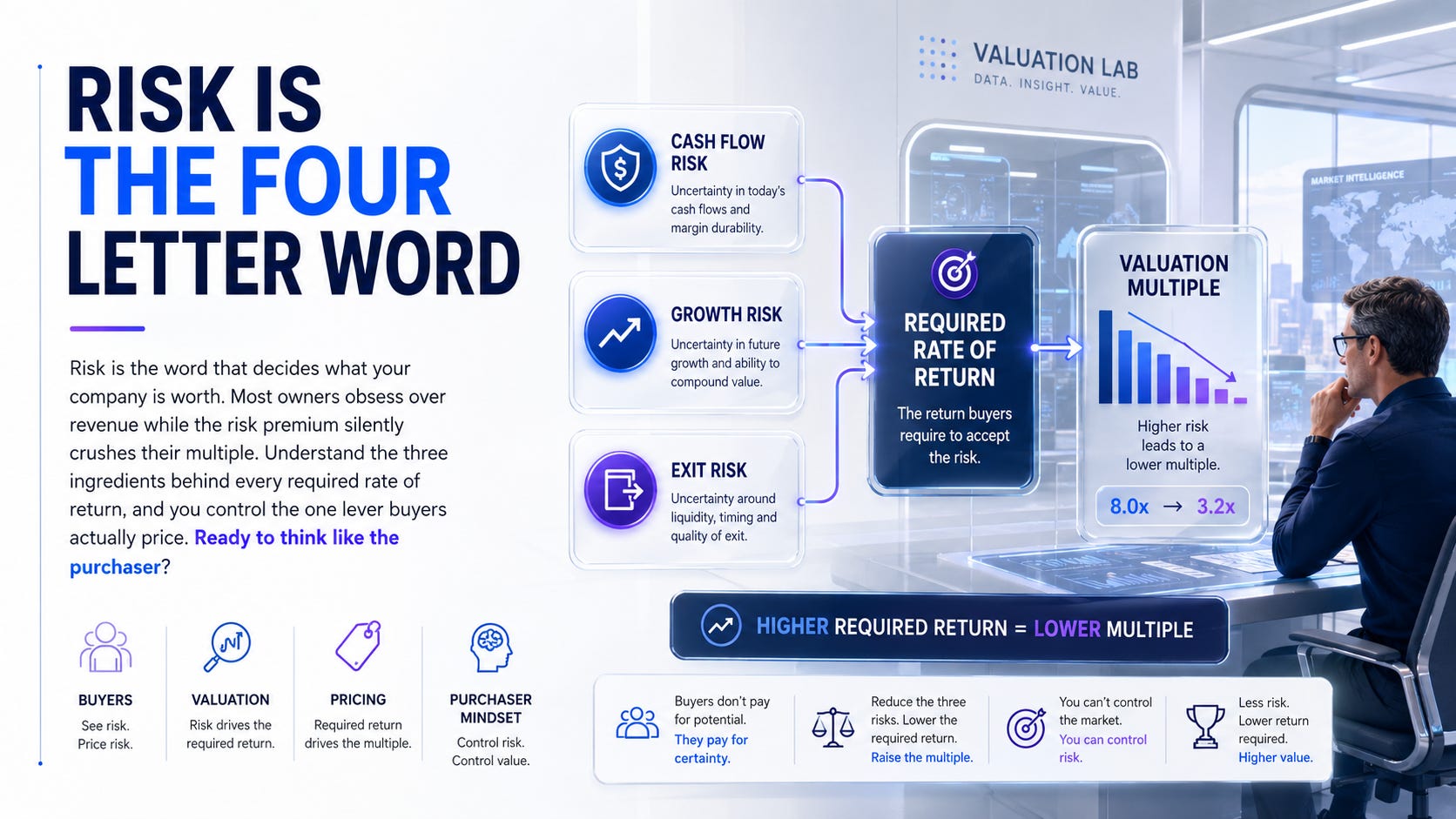
1. A 5x EBITDA multiple corresponds to what required rate of return?
a) 5% b) 10% c) 20% d) 25%
2. Which two risk ingredients are dictated by the market rather than the owner?
a) Corporate risk and operational risk
b) Risk free rate and equity risk premium
c) Customer risk and management risk
d) Country risk and financial risk
3. The risk free rate is typically based on which instrument?
a) A short term treasury bill
b) A corporate bond index
c) A ten year government bond
d) A money market fund
4. Company specific corporate risk typically ranges from:
a) 0% to 5% b) 3% to 30% c) 5% to 15% d) 10% to 40%
5. True or False: The valuation multiple is the inverse of the required rate of return.
6. If the required return is 25%, made of 10% market risk plus company specific risk, what is the company specific portion?
a) 10% b) 15% c) 20% d) 25%
7. True or False: According to the post, the equity risk premium was near 5.5% as of 2025.
8. The post argues that risk factors:
a) Always add together in neat silos
b) Multiply and compound each other
c) Cancel each other out
d) Do not affect the multiple
9. What single perspective does the post tell owners to adopt?
a) The seller who loves the business
b) The banker who wants fees
c) The purchaser who must justify the price to a board
d) The employee who wants security
10. True or False: The market risk baseline in the illustration was roughly 10%, made of a 4% risk free rate plus a 6% equity risk premium.
Essay Questions
1. Explain the three ingredients of a required rate of return and identify which one an owner can actually influence.
2. Describe why the valuation multiple is so sensitive to small changes in the required return, referencing the inverse relationship.
3. The post claims risk does not live in silos. Explain what this means and why it matters for valuation.
4. Why does the post insist owners “think like the purchaser who must justify the price to a board” rather than pricing on their own feelings?
5. Using the Ashford Precision case, explain how Jackie changed his value without primarily relying on revenue growth.
SOLUTIONS, ASSESSMENT 1
Multiple Choice Answers
1. c) 20%, because 5x equals 1 divided by 0.20.
2. b) Risk free rate and equity risk premium, both set by markets, not the owner.
3. c) A ten year government bond, since a business is a long term investment.
4. b) 3% to 30%, the stated range for company specific risk.
5. True, the multiple equals 1 divided by the required return.
6. b) 15%, since 25% total minus 10% market equals 15% company specific.
7. True, the post cites a 5.5% equity risk premium as of 2025.
8. b) Multiply and compound each other, the core “risk does not live in silos” point.
9. c) The purchaser who must justify the price to a board.
10. True, 4% plus 6% equals a 10% market baseline in the illustration.
Essay Answers
1. The three ingredients are the risk free rate (a long term government bond baseline), the equity risk premium (the extra return for owning stocks, historically near 6%), and corporate risk (the company specific premium). Only corporate risk is within the owner’s control, since markets dictate the first two.
2. The multiple equals 1 divided by the required return, so the return sits in the denominator. When the denominator moves, the multiple swings far more than the percentage change implies. A required return rising from 20% to 25% cuts the multiple from 5x to 4x, a 20% loss of value for a 5 point risk increase, which is why the relationship is exponential rather than linear.
3. It means risk factors interact rather than adding independently. Customer concentration amplifies key person risk, and industry headwinds compound cash flow fragility. This matters because a simple additive model understates true risk when several weaknesses coexist, and buyers price the compounded reality, not the tidy sum.
4. Because buyers price the probability that cash flow survives without the owner, not the owner’s passion. A purchaser must defend the price to a board using risk logic. An owner who prices on emotion anchors to a number the buyer will never justify, which stalls or kills deals. Adopting the buyer’s lens aligns the owner’s asking price with what the market will actually fund.
5. Jackie priced his own 21% company specific premium, then shrank it to 8% by adding management depth, diversifying customers, documenting processes, and professionalizing finance. That lowered the required return from 31% to 18% and lifted the multiple from about 3.2x to about 5.5x. Modest EBITDA growth from $2 million to $2.3 million helped, but the multiple expansion from de risking drove most of the roughly $6.25 million value increase.
Educational Disclaimer
This assessment provides information only, not professional advice. All cases are fictional, created for educational purposes from collective industry experience. Consult qualified advisors for your specific situation.
© 2026 YBAWS! All rights reserved.