

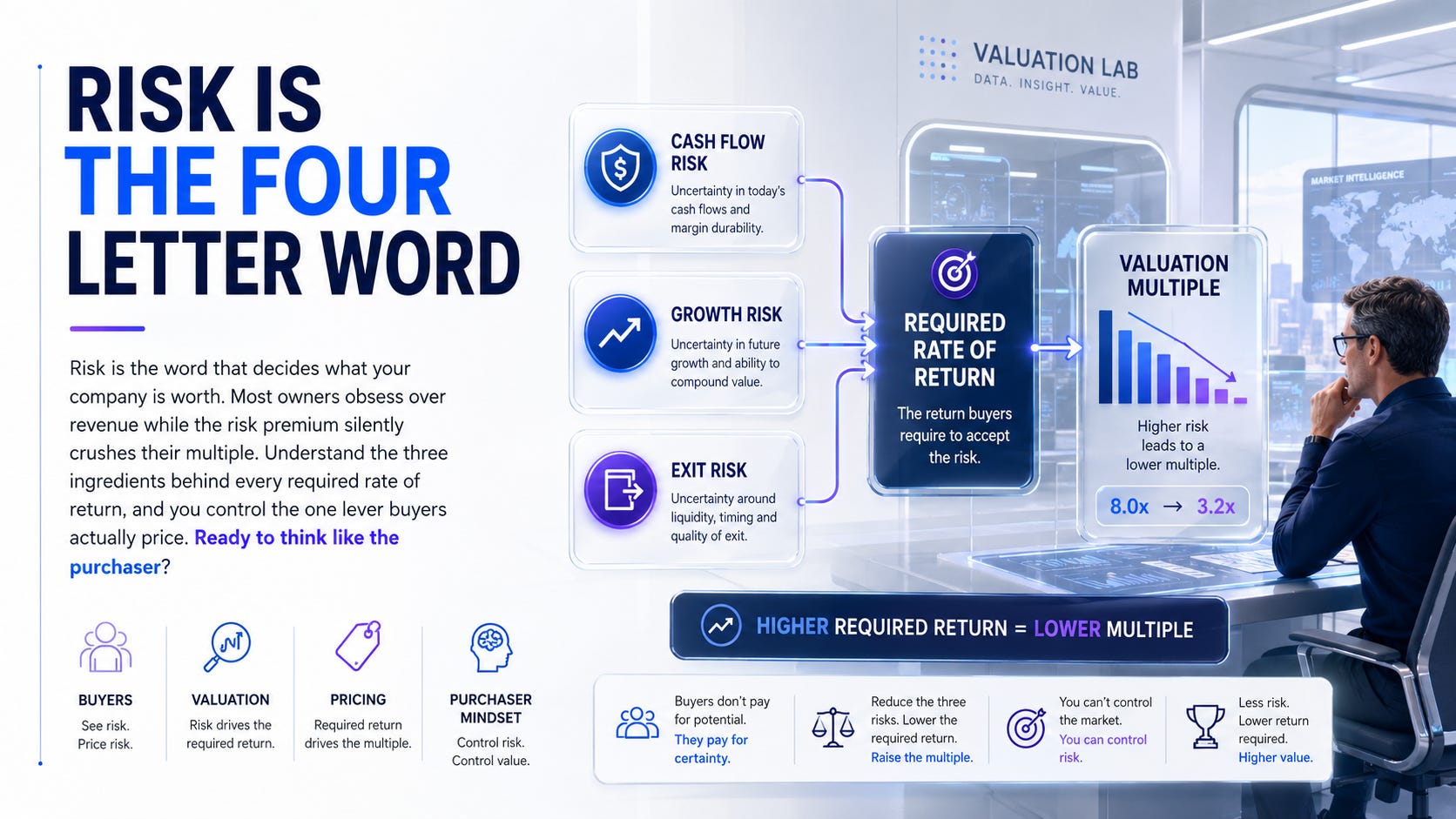
Risk is the four letter word that decides what your company is worth. Most owners obsess over revenue while the risk premium silently crushes their multiple. Understand the three ingredients behind every required rate of return, and you control the one lever buyers actually price. Ready to think like the purchaser?
10 KEY TAKEAWAYS, THE RISK RECIPE
1. Risk sets the multiple: The higher your business risk, the lower your value, full stop.
2. Three ingredients only: Every required return blends risk free rate, equity risk premium, and corporate risk.
3. You control one lever: The market dictates two ingredients, corporate risk is your playground.
4. Multiples are just math: A 5x multiple is simply 1 divided by a 20% required return.
5. The 25% breakdown: A 25% required return is roughly 10% market risk plus 15% company specific risk.
6. De risking often beats growth: Lowering risk can deliver more value per dollar than chasing income.
7. Corporate risk ranges wide: Company specific risk typically runs from 3% to 30%, and it is yours to shrink.
8. Buyers price nerves: Everything that makes a purchaser sweat becomes a corporate risk premium.
9. AI maps interactions: Risk factors multiply each other, and modern tools finally reveal those patterns.
10. Speak fluent risk: The bean counters with the money price your business, learn their language.
READING PREREQUISITES
Each post in this series builds on the technical groundwork laid in earlier entries. Concepts, models, and metrics are revisited deliberately so foundational ideas remain central to every analysis. To get full value from this post, revisit how risk types and multipliers were introduced earlier.
Recommended Prior Reading:
• Chapter 2, The Four Types of Business Risk
• Chapter 4, Rules of Thumb Will Rob You Blind
• Chapter 6, Why the Denominator Beats the Numerator
The Risk Recipe That Is Cooking Your Valuation
Remember those multipliers, 5x EBITDA, 12x income, and how you wondered where the hell they come from? They are not magic. They are the inverse of your required rate of return, the annual return an investor demands to justify the risk of owning your cash flow.
Here is the conversion you have seen before:
• 2x equals 1 divided by 50%
• 3x equals 1 divided by 33%
• 5x equals 1 divided by 20%
• 10x equals 1 divided by 10%
• 20x equals 1 divided by 5%
Those percentages are the price of risk. So how does a valuator arrive at a 25% required return? Three ingredients go into the pot.
The three risk ingredients:
• Risk Free Rate (RFR): Your baseline, typically a ten year government bond, because a business is a long term investment.
• Equity Risk Premium (ERP): The extra return investors demand for owning stocks instead of bonds, historically around 6%, though Aswath Damodaran of NYU Stern publishes current figures that shift with markets.
• Corporate Risk (CR): The premium buyers add because your specific company could implode.
Why the Math Matters More Than Your Feelings
Say the RFR is 4% and the ERP is 6%. Any investor can theoretically earn 10% with modest risk by hiring a competent financial planner. So a 25% required return breaks into 10% market risk and 15% “your company specifically might crash and burn” risk. As of 2025, the equity risk premium sat near 5.5%, and that single number can torpedo a valuation if you do not understand it.
Here is the liberating part. You cannot control the RFR or the ERP, the market sets both. But corporate risk is entirely your playground. This is where the lessons about business risk become an action plan. Reduce your company specific risk and buyers stop demanding a fat premium, which lifts your multiple.
One important disclaimer: These figures are for illustration only. Risk components change constantly with market conditions, and professionals spend years mastering accurate calculations. The point is the framework, not the exact percentages.
Risk Does Not Live in Silos
Textbook models slice corporate risk into neat buckets, size, industry, and so on, then add them up. That was all we had for decades. No hating. But the real world is messier. Your customer concentration risk does not merely add to your key person risk, they multiply each other. Industry headwinds compound your cash flow problems rather than stacking politely on top.
With modern analytical tools, we can finally map these interrelationships. Risk calculation used to be a sledgehammer. Now we can be surgical about exactly what makes buyers nervous about your particular business. For the professional foundation behind these discount rates, the Corporate Finance Institute EBITDA multiple guide and Mercer Capital on discount rates are strong primers.
Think Like the Purchaser
When you walked into your first negotiation, your instinct was probably the gambler’s line, “My company is worth what I think it is worth.” That approach loses. The winners calculate every angle. Your one job is to think like the purchaser who has to justify the price to a board. Buyers do not price your passion. They price the risk that your cash flow disappears.
KEY TAKEAWAYS
Remember These Core Principles:
• Multiples are inverses: Your multiple is simply 1 divided by your required rate of return, nothing mystical.
• Two ingredients are fixed: Stop fighting the risk free rate and equity risk premium, the market owns them.
• Corporate risk is yours: The 3% to 30% company specific band is where you create or destroy value.
• De risking is a strategy: Lowering risk can beat growing income on a value per dollar basis.
• Learn the language: Speak fluent risk premium or let buyers set your price for you.
FREQUENTLY ASKED QUESTIONS
Q: What is a required rate of return in business valuation? A: It is the annual return an investor demands to justify the risk of owning your cash flow. Your valuation multiple is the inverse, so a 20% required return equals a 5x multiple. Lower the risk, lower the return demanded, raise the multiple.
Q: What are the three components of a discount rate? A: The risk free rate, the equity risk premium, and a company specific corporate risk premium. The first two are dictated by markets. The third is driven by your business, which is where owners have real influence over value.
Q: Can I really control my valuation multiple? A: Partly, yes. You cannot move market rates, but corporate risk typically ranges from 3% to 30%. Reducing owner dependency, customer concentration, and process gaps shrinks that premium and lifts your multiple.
Q: Why does a small risk change move value so much? A: Because the multiple is 1 divided by the required return. Small movements in the denominator swing the multiple, and therefore value, far more than the percentage change suggests.
