


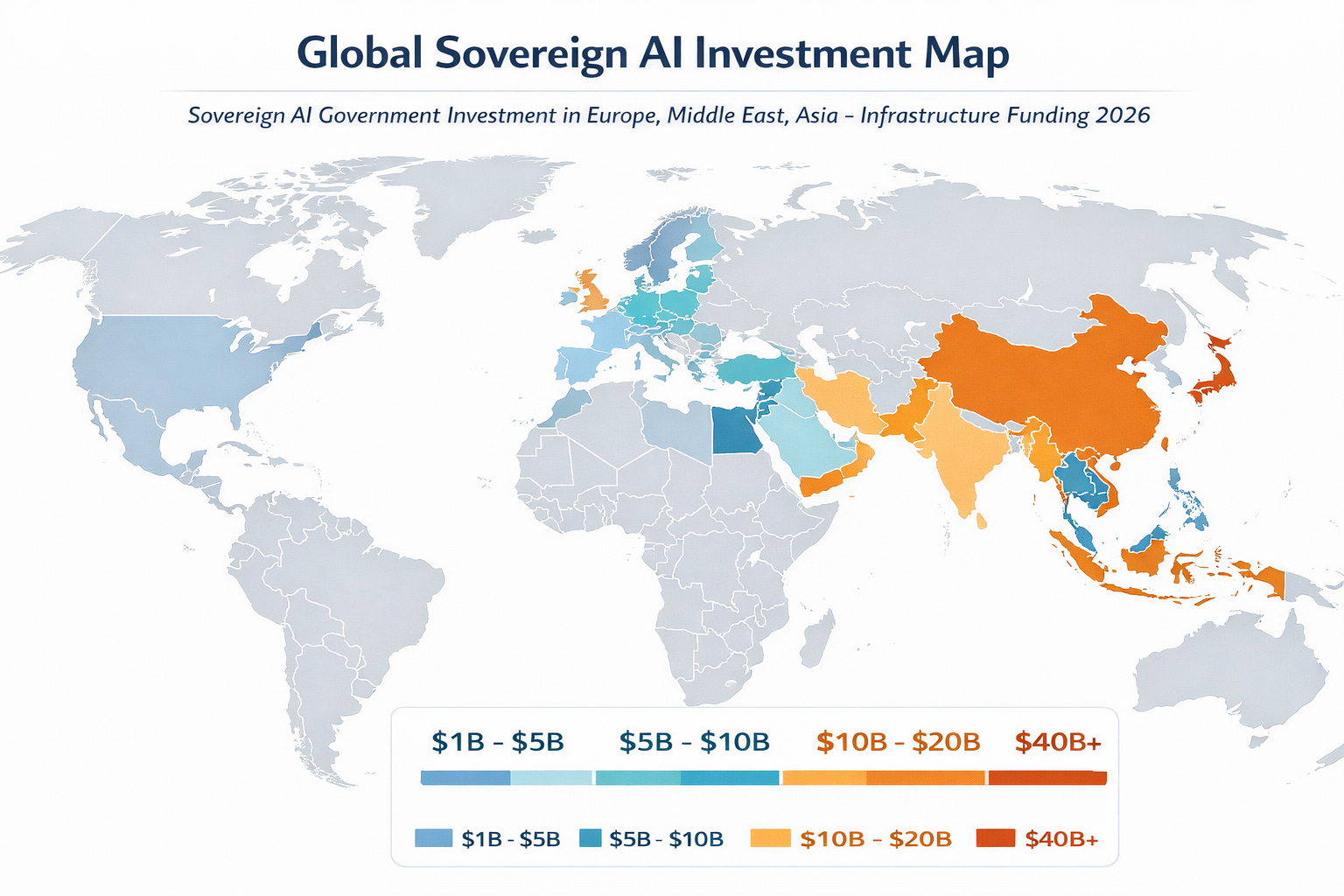
January 2026 witnessed explosion in “Sovereign AI” investments as nations recognize artificial intelligence infrastructure represents strategic national interest equivalent to energy independence or military capability. Poland’s €350 million, Quebec’s $500 million, and Middle East multi-billion commitments operate on fundamentally different timelines than traditional venture capital, creating massive opportunity for patient capital structures that can accommodate government co-investment
10 KEY TAKEAWAYS - SOVEREIGN AI OPPORTUNITY
Sovereign AI becomes strategic imperative: Nations recognize AI infrastructure as critical to economic competitiveness, national security, and cultural preservation.
Patient capital operates on decades, not fund cycles: Government investment timelines accommodate 10-15 year development horizons that traditional VC can’t match.
€350 million Poland commitment: Future Tech Poland fund targets localized LLMs ensuring Polish language and cultural context receive proper AI representation.
$500 million Quebec investment: Maintains Quebec’s AI research leadership while commercializing academic breakthroughs through patient government capital.
Middle East positioning as global hub: SuperReturn Saudi Arabia conference highlighted how Middle East becomes “Lending and VC hub” for AI infrastructure.
Regulatory sandboxes accelerate deployment: Government-backed testing environments reduce time-to-market for AI systems requiring regulatory approval.
Procurement commitments provide revenue visibility: Government agreements to purchase AI services once validated give investors confidence in monetization paths.
Tax incentives reduce effective capital requirements: Strategic government programs make capital stretch further through credits, grants, and favorable treatment.
Alternative structures enable co-investment: Mechanisms like VC Risk Swap can layer government funding with private capital in ways traditional equity often can’t.
Cross-border opportunities multiply: Nations watching EU implementation while developing own frameworks create massive addressable market for compliant AI infrastructure.
📚 READING PREREQUISITES
Understanding Sovereign AI requires familiarity with how nations increasingly view technology infrastructure as strategic national interest beyond pure economic returns. The shift from “industrial policy” to “technology sovereignty” represents fundamental change in government capital deployment.
Recommended Prior Reading:
Understanding National AI Strategies and Technology Sovereignty
How Government Co-Investment Changes Venture Capital Dynamics
The Geopolitics of AI Infrastructure and Compute Access
What Sovereign AI Actually Means
Sovereign AI refers to nations developing artificial intelligence infrastructure under domestic control, ensuring that:
Language models properly represent local languages, cultures, and contexts
AI systems comply with national values, regulations, and governance frameworks
Compute infrastructure resides within national borders or trusted jurisdictions
Technical talent develops domestically rather than concentrating in few global hubs
Strategic AI capabilities don’t depend on potentially adversarial foreign entities
Economic value from AI innovation accrues to domestic companies and workers
This isn’t protectionism or nationalism, it’s recognition that AI infrastructure constitutes 21st century strategic capability equivalent to 20th century energy independence, telecommunications networks, or military technology.
Why January 2026 Marks the Inflection Point
Three major Sovereign AI commitments in January 2026 signal that government capital deployment at scale has moved from theory to practice:
Poland’s €350 million Future Tech Fund (January 2026): Focused on developing localized large language models ensuring Polish language receives proper AI representation while building domestic technical capacity. This isn’t just about translation, it’s about cultural context, idioms, historical references, and knowledge bases that English-centric models systematically miss.
Quebec’s $500 million AI Commitment (January 2026): Targets maintaining Quebec’s position as global AI research leader (home to Yoshua Bengio and MILA) while commercializing academic breakthroughs. The funding explicitly accommodates patient timelines for translating research into deployable systems, recognizing that meaningful AI innovation requires decade-long development cycles.
Middle East Multi-Billion AI Infrastructure (Ongoing): The SuperReturn Saudi Arabia conference (January 26-27) highlighted how Gulf states position as global “Lending and VC hub” specifically targeting AI infrastructure with multi-decade investment horizons. Saudi Arabia, UAE, and other Middle Eastern nations deploy billions into compute clusters, data centers, and AI talent development.
These aren’t isolated initiatives, they’re leading edge of global wave as nations recognize that AI capability determines 21st century economic and geopolitical standing.
Why Government Capital Operates on Different Timelines
The fundamental advantage of Sovereign AI funding is that government success metrics operate on completely different timelines than venture capital fund cycles.
Decade-Scale Patient Capital
Traditional VC fund timeline:
10-year fund life with 5-7 year expected holding periods
Portfolio construction requiring some quick wins to offset longer bets
LP pressure for DPI creating exit urgency within fund cycles
Mark-to-market reporting driving valuation pressure each round
Fund economics requiring returning capital to raise next fund
Government investment timeline:
Multi-decade investment horizons measuring success across administrations
Success metrics including employment, tax revenue, strategic capability, not just financial returns
No forced liquidation at predetermined dates creating premature exit pressure
Willingness to accept below-market financial returns for strategic benefits
Patient capital enabling fundamental research and long-cycle commercialization
This timeline difference creates massive opportunity for companies requiring 7-15 years to achieve meaningful scale. Businesses that traditional VC systematically excludes become ideal targets for Sovereign AI capital seeking strategic positioning over pure financial optimization.
Strategic Benefits Beyond Financial Returns
Governments invest in AI infrastructure pursuing multiple objectives that traditional financial investors can’t accommodate:
Economic development:
High-paying technical jobs in domestic labor markets
Tax revenue from successful AI companies and their employees
Spillover effects as AI capabilities enhance traditional industries
Reduced dependency on foreign technology providers
National security:
Domestic AI capability reducing vulnerability to supply chain disruption
Compute infrastructure within trusted jurisdictions
Technical talent development ensuring workforce readiness
Intelligence capabilities enhanced by domestic AI systems
Cultural preservation:
Language models properly representing linguistic diversity
AI systems reflecting national values and governance frameworks
Digital sovereignty ensuring data privacy and protection
Competitive alternative to US/China AI dominance
Research leadership:
Universities attracting top global talent with government funding
Academic breakthroughs commercialized domestically rather than migrating overseas
Knowledge spillovers benefiting broader innovation ecosystem
National prestige from AI research leadership
Traditional VC funds can’t pursue these objectives because their fiduciary duty runs only to LP financial returns. Government capital explicitly balances financial, strategic, and social objectives, creating fundamentally different investment criteria.
[Insert IMAGE: Sovereign AI Strategic Benefits Framework with alt text: “government AI investment strategic benefits economic security cultural objectives”]
Poland’s €350 Million: Linguistic and Cultural AI Sovereignty
Poland’s Future Tech Fund exemplifies why nations invest in localized AI infrastructure despite robust English-language models already existing.
The Language Challenge in AI
Current foundation models predominantly train on English-language data, creating systematic bias toward English-language contexts, cultural references, and knowledge bases. For Polish language:
Grammatical complexity (7 cases, 3 genders, complex conjugation) poorly represented
Idioms and cultural references lost in translation
Historical and political context specific to Polish experience
Professional and technical terminology in Polish domains
Government, legal, and business documents in native language
Simply translating English model outputs to Polish produces inferior results compared to models trained natively on Polish corpus with Polish cultural context embedded from inception.
What Poland Funds Specifically
The €350 million targets several interconnected objectives:
Foundation model development:
Polish-native LLMs trained on comprehensive Polish language corpus
Cultural and historical knowledge bases specific to Polish context
Integration with Polish government databases and knowledge systems
Compute infrastructure:
Domestic data centers ensuring data sovereignty and privacy
GPU clusters for model training and inference within Polish borders
Redundancy and security meeting national infrastructure standards
Talent development:
University partnerships producing AI researchers and engineers
Industry collaboration programs commercializing research
Immigration policies attracting global talent to Polish AI ecosystem
Application layer support:
Startups building Polish-language AI applications
Enterprise adoption programs deploying AI across traditional industries
Government procurement using domestic AI capabilities
Patient Capital Structure Enabling Long-Term Development
The critical insight: developing competitive foundation models requires 5-7 years minimum, and building application ecosystem requires another 3-5 years. Traditional VC can’t accommodate these timelines, but government capital explicitly structured for decade-plus development cycles can.
For founders building Polish-language AI infrastructure, the €350 million creates opportunity to combine:
Government funding for foundational research and infrastructure
Private capital through alternative structures for commercialization
Strategic partnerships with Polish enterprises for deployment
Cross-border expansion once domestic market validates
The VC Risk Swap structure particularly benefits here because it can layer government co-investment with private capital, where revenue guarantees provide private funders downside protection while government funding de-risks technical development.
Quebec’s $500 Million: From Academic Excellence to Commercial Scale
Quebec’s AI commitment takes different approach, leveraging existing world-class research infrastructure to drive commercial outcomes.
Building on Existing Research Leadership
Quebec hosts some of world’s premier AI research institutions:
MILA (Montreal Institute for Learning Algorithms): Founded by Yoshua Bengio, one of three “Godfathers of AI” who won 2018 Turing Award
Université de Montréal, McGill University: Top-tier computer science and AI programs
Industrial partners: Established relationships with major tech companies funding research
Government support: Decades of investment in academic research infrastructure
The $500 million aims to commercialize this academic excellence, translating research breakthroughs into deployable systems and Canadian-headquartered companies.
The Valley of Death Between Research and Revenue
Academic AI research typically achieves proof-of-concept on well-defined problems but requires massive additional investment to:
Scale algorithms to production-ready performance levels
Build infrastructure for deployment at commercial scale
Navigate regulatory approval for safety-critical applications
Develop go-to-market strategies and sales infrastructure
Recruit business talent complementing technical researchers
This “valley of death” between research validation and revenue generation typically requires 5-8 years and $50-200 million. Traditional VC struggles with this profile because:
Early stage too technically uncertain for growth capital
Later stage too capital-intensive and long-cycle for traditional VC
Exit timelines extend beyond typical fund holding periods
Business risk compounds technical risk creating perceived “binary” outcomes
Government capital explicitly designed to bridge this gap enables commercialization that would otherwise migrate to US or other jurisdictions with more patient capital ecosystems.
Quebec’s Strategic Positioning
The $500 million positions Quebec as global center for AI commercialization by providing:
Proof-of-concept to prototype funding:
Grants bridging academic research to commercial validation
Infrastructure access for testing at scale
Technical talent from universities transitioning to commercialization
Growth capital with patient timelines:
Government co-investment in companies requiring long development cycles
Alignment with alternative structures accommodating decade-scale timelines
Willingness to accept strategic benefits alongside financial returns
Regulatory support and sandbox environments:
Government partnerships reducing time to regulatory approval
Testing environments for AI systems in healthcare, transportation, government services
Procurement commitments providing revenue visibility for investors
Talent retention incentives:
Competitive compensation for researchers staying in Quebec rather than migrating to US
Immigration programs attracting global talent to Quebec ecosystem
Quality of life advantages (healthcare, education, culture) enhancing recruitment
For founders commercializing AI research, Quebec offers unique combination of world-class technical talent, government patient capital, and regulatory support that few jurisdictions match.
[Insert IMAGE: Academic to Commercial AI Pipeline Diagram with alt text: “AI research commercialization valley of death government funding Quebec MILA”]
Middle East as Global Sovereign AI Hub
The SuperReturn Saudi Arabia conference (January 26-27, 2026) highlighted how Middle Eastern nations position as global center for AI infrastructure investment with capital scale and patient timelines that traditional VC can’t match.
Why Middle East Invests Massively in AI
Gulf states pursue AI infrastructure as core economic diversification strategy:
Energy transition hedge:
Diversifying from oil-dependent economies toward technology leadership
Building revenue streams independent of energy price volatility
Positioning for post-carbon economy decades ahead
Geopolitical positioning:
Establishing strategic independence from US/China AI duopoly
Building domestic capabilities in strategically critical technology
Attracting global talent and companies to Middle Eastern hubs
Sovereign wealth deployment:
Multi-hundred-billion dollar sovereign wealth funds seeking multi-decade returns
Patient capital with no forced distribution timelines
Willingness to accept strategic benefits alongside financial returns
Infrastructure advantages:
Abundant cheap energy for power-hungry compute clusters
Geographic positioning between Europe, Asia, and Africa
Government efficiency enabling rapid infrastructure deployment
The Scale of Middle East AI Investment
While specific figures remain partially confidential, public announcements reveal massive commitments:
Saudi Arabia: Multi-billion investments in compute infrastructure, AI research, and talent development
UAE: Positioning Abu Dhabi and Dubai as global AI hubs with research centers, corporate headquarters
Qatar: Investments in education, research, and AI applications across industries
The SuperReturn conference specifically focused on how Middle East becomes “Lending and VC hub” for AI infrastructure, meaning:
Direct equity investment in AI companies globally
Debt financing for infrastructure development
Strategic partnerships providing capital and deployment channels
Venture fund LPs providing capital for Western VC firms
What This Means for Founders and Funders
For founders building AI infrastructure requiring patient capital:
