

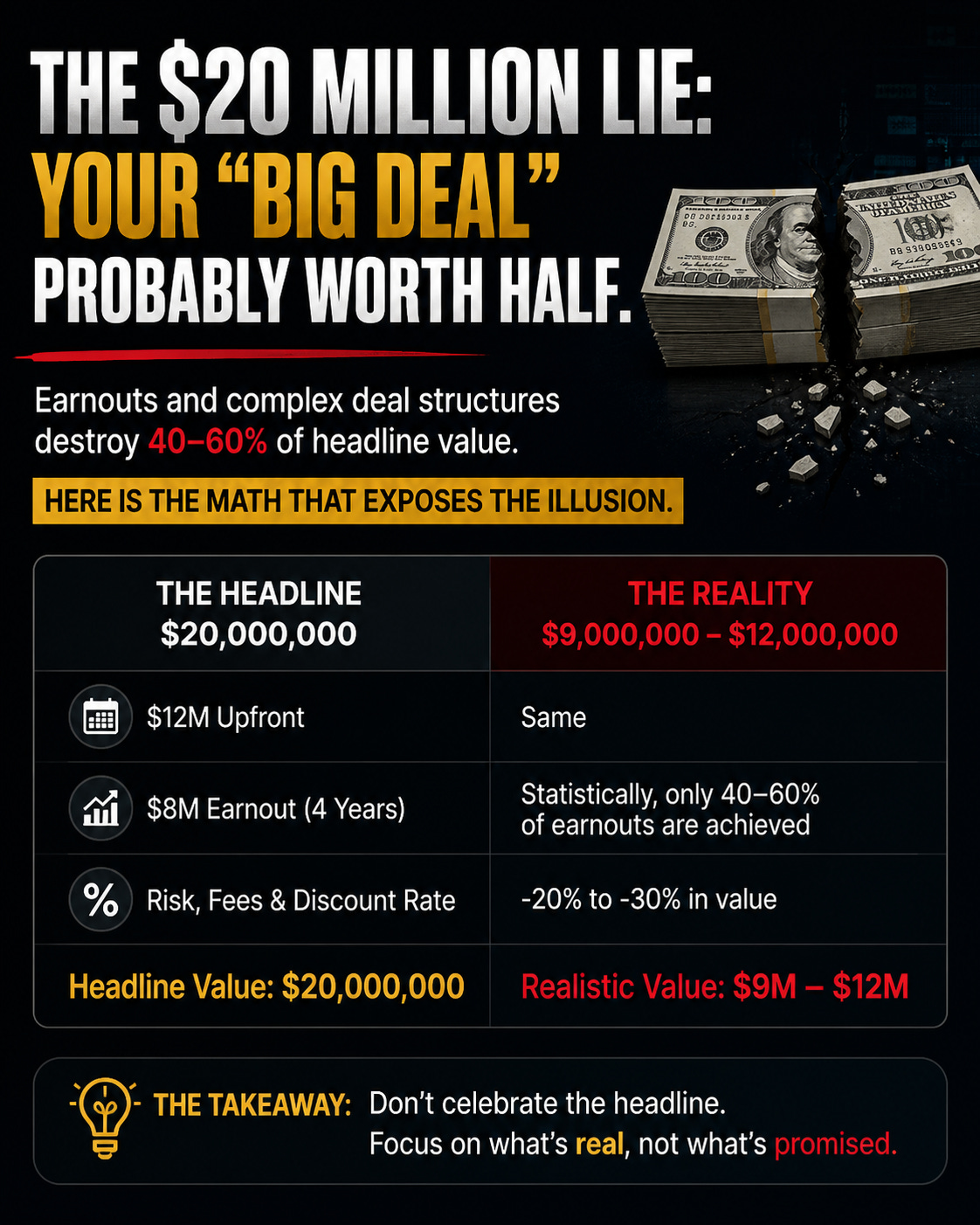
A business owner pops champagne over a $20 million offer. Twenty four hours later, his transaction specialist hands him the math, and the $20 million deal is actually worth $8.6 million. This is not a horror story. This is what most M&A “wins” look like once you do the arithmetic. Want to know why?
10 KEY TAKEAWAYS, EARNOUT MATH AND THE FMV CASH ASSUMPTION
Cash on closing is the only honest number: Fair Market Value assumes payment in cash, not promises.
Earnouts violate FMV: Future contingent payments are not “money or money’s worth” until they actually arrive.
The 57% haircut is normal: A $20 million headline routinely shrinks to $8 to $10 million in risk adjusted present value.
Time value of money is brutal: $1.7 million per year for ten years at 8% is worth roughly $11.4 million today, not $17 million.
Risk adjusted discount rates compound the damage: Years 4 to 7 deserve 15%, years 8 to 10 deserve 18%, because probability collapses over time.
Probability of achievement falls fast: Years 1 to 3 might run 75%, years 4 to 7 drop to 50%, years 8 to 10 sit near 30%.
Anchoring is a buyer’s weapon: Big numbers freeze your brain on the headline and make you ignore the structure.
The deal multiplier you celebrate is fiction: Reported transaction multiples almost always reflect nominal, not risk adjusted, values.
Information asymmetry is the buyer’s edge: They have teams of M&A lawyers trained to transfer risk while preserving your enthusiasm.
The arithmetic must be done before you sign: Probability weighted present value is the only number that tells the truth.
📚 READING PREREQUISITES
Each post in this series builds on the technical groundwork laid in earlier entries. Key valuation concepts and mathematical models are reinforced across posts to ensure retention.
Recommended Prior Reading:
Chapter 6, The Real Valuation Formula: Value Equals Income Divided by Risk
Chapter 7, Fair Market Value as Your Floor, Not Your Ceiling
[SUGGESTED IMAGE: Split image showing a champagne bottle on the left and a calculator with a red downward arrow on the right. Alt text: “Champagne celebration versus earnout math reality showing 57 percent value haircut on $20 million business sale”]
Cash on Closing: The Forgotten Foundation of FMV
Read the Fair Market Value definition one more time, and notice where it lands. The highest price obtainable in an open and unrestricted market, between informed and prudent parties acting at arm’s length and under no compulsion to act, expressed in terms of money or money’s worth.
That last phrase, money or money’s worth, is the part nobody reads carefully. In valuation practice, it means cash or cash equivalents on closing. Not promises. Not contingent payments. Not vendor notes. Cash, today, in your account.
Why does that matter? Because when someone offers you $20 million, your brain processes it as $20 million. The deal structure underneath, the part that determines whether you actually receive the money, gets filed under “details to be worked out by the lawyers.” That filing decision will cost you millions.
The transaction world has a saying that is repeated in every M&A negotiation textbook: “You name the price, I name the terms. The one who names the terms usually wins.” Buyers know this. Most sellers do not.
The honest deal evaluation framework:
How much is paid in cash on closing?
What payments are contingent, and on what conditions?
Who controls the variables that determine whether the contingent payments occur?
What is the probability weighted present value of the entire structure?
Most sellers can answer the first question. Almost none can answer the other three.
The $20 Million Math, Done Honestly
Let’s actually work through the numbers everyone avoids. A $20 million offer with this structure:
$3 million cash at closing
$17 million in earnout payments over 10 years
Targets contingent on revenue and operational metrics the buyer controls
Step one, time value of money. Using a conservative 8% discount rate, $1.7 million per year for ten years has a present value of approximately $11.4 million. We have already lost $5.6 million from the headline, and we have not even discussed risk yet.
Step two, risk adjustment by period. Earnout achievement probability is not constant. It collapses over time as the seller’s influence fades, the business gets restructured, and management priorities shift.
Years 1 to 3, the honeymoon period:
Earnout payments: $5.1 million
Probability of achievement: 75%
Risk adjusted discount rate: 12%
Present value: approximately $3.1 million
Years 4 to 7, reality sets in:
Earnout payments: $6.8 million
Probability of achievement: 50%
Risk adjusted discount rate: 15%
Present value: approximately $1.9 million
Years 8 to 10, hail Mary territory:
Earnout payments: $5.1 million
Probability of achievement: 30%
Risk adjusted discount rate: 18%
Present value: approximately $650,000
