

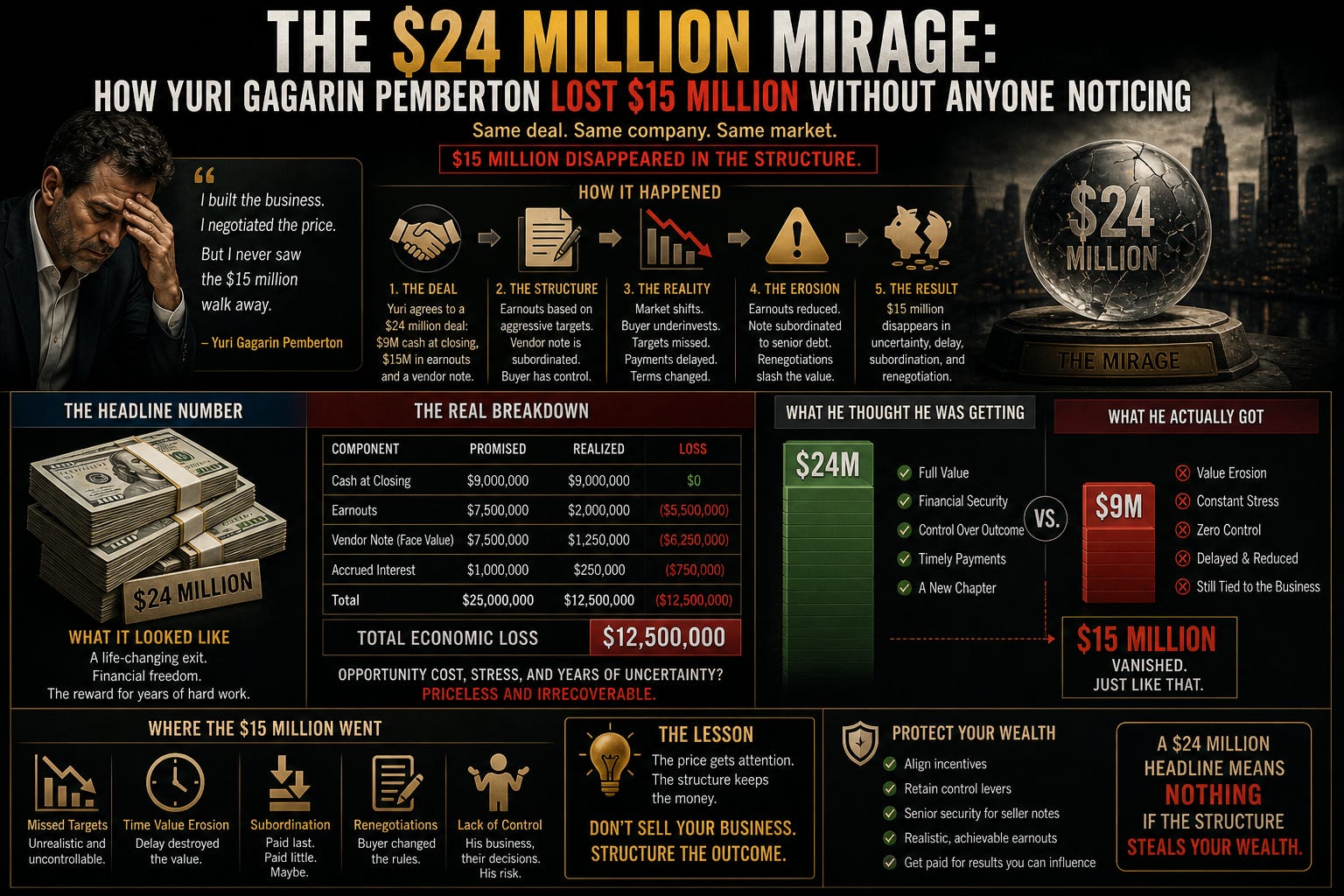
Yuri Gagarin Pemberton spent seventeen years building Orbital Logistics Group, a regional freight optimization company that helped mid market manufacturers reduce shipping costs through proprietary routing software. By 2023, Yuri had grown the business to $7.4 million in annual revenue with EBITDA margins consistently above 22%. He was 58, his wife wanted him home, and his back had started reminding him of every late night hauling pallets from his earliest years in the warehouse.
When Continental Freight Holdings approached with what they called a “$24 million strategic acquisition offer,” Yuri did exactly what most business owners do. He called his wife. He called his accountant. He called his brother. He did not call a transaction specialist who could read the deal structure with cold eyes.
The structure he eventually signed looked, on paper, like a generational outcome.
The $24 Million Headline Structure:
$4 million cash at closing
$12 million earnout over years 1 through 4, tied to Orbital’s standalone revenue and EBITDA targets
$5 million earnout over years 5 through 7, tied to operational efficiency metrics defined by Continental
$3 million in deferred consideration, payable at year 7 if Yuri remained available as an “advisory consultant”
Yuri’s local accountant, who had never closed an M&A transaction, told him it looked “favorable.” Yuri signed.
The Math Yuri Should Have Done Before Signing
Six months after closing, Yuri’s son in law, a chartered financial analyst with a private equity background, asked to see the deal documents. What he calculated over a single weekend changed every assumption in the family.
Time value of money adjustment. The $12 million in years 1 through 4 averaged $3 million per year. Discounted at 8%, the present value was approximately $9.94 million. The $5 million in years 5 through 7 averaged $1.67 million per year. Discounted at 8%, the present value was approximately $3.65 million. The $3 million in year 7 had a present value of approximately $1.75 million. Total discounted value, before any risk adjustment, was approximately $19.34 million. The headline had already lost $4.66 million.
Risk adjusted probability layer. Yuri’s son in law applied the realistic probability framework that every institutional buyer uses internally and that almost no seller applies during negotiation.
Years 1 through 4, achievement probability 70%, risk adjusted rate 12%. Probability weighted present value: approximately $6.4 million.
Years 5 through 7, achievement probability 40%, risk adjusted rate 15%. Continental controlled every operational metric used to calculate this earnout. Probability weighted present value: approximately $1.4 million.
Year 7 advisory consideration, achievement probability 50%, risk adjusted rate 18%. The “advisory consultant” requirement was effectively a buyer option. Probability weighted present value: approximately $450,000.
Total risk adjusted economic value:
Cash at closing: $4.0 million
Risk adjusted earnouts: $7.8 million
Risk adjusted deferred consideration: $0.45 million
Total real value: approximately $12.25 million
Yuri’s $24 million deal was actually worth $12.25 million in honest, present value terms. A 49% haircut from the headline.
The $15 Million Cash Alternative Yuri Never Considered
Two competing buyers had quietly signaled willingness to discuss all cash structures during the early conversations. One had floated $15 million cash on closing. The other had suggested $14 million cash plus a $2 million seller note with senior security. Yuri had dismissed both as “lowball” because the headline numbers were smaller than Continental’s $24 million.
The $15 million all cash offer would have delivered $15 million. Net of taxes and transaction costs, Yuri would have realized approximately $11.5 million in pocket. Comparable to the risk adjusted Continental outcome, but with one critical difference: certainty. The cash would have been in his account thirty days after closing.
The Continental deal, in contrast, would deliver its $12.25 million theoretical value only if every probability assumption held. In practice, none of them held. Continental redirected resources to a competing portfolio company in year two. Year three brought a software platform consolidation that crushed Orbital’s standalone revenue. By the end of year four, Yuri had received $4 million cash at closing and approximately $2.1 million in earnout payments. His total realization stood at $6.1 million, and the back end of the deal was effectively dead.
