

Disclaimer: The following case study is entirely fictional. The character name is inspired by a legendary maritime and polar explorer but represents a fictional individual with no connection to that real person, their family, or their estate. Financial figures are illustrative only.
Two regional distribution companies in the same market, same size, same industry, tell the whole story of this chapter. Both moved industrial supplies to contractors and manufacturers. Both posted roughly $20 million in revenue and $2.5 million in EBITDA in 2021. Three years later, one commanded a premium exit while the other was liquidated in a distressed sale. The difference was not luck. It was preparation.
Amundsen Supply, The Professional
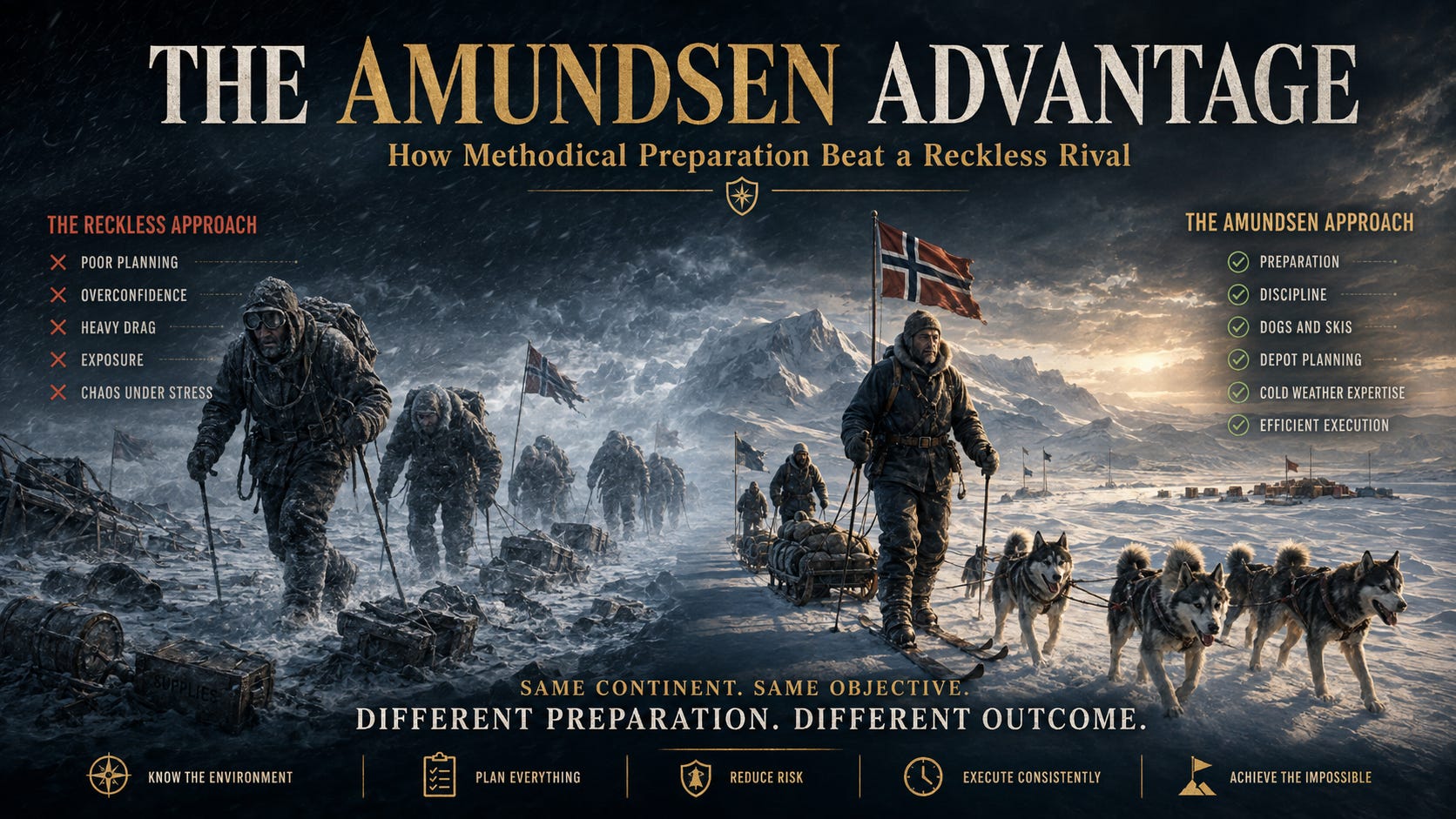
Roald Amundsen Castellano ran Amundsen Supply like a polar expedition leader, methodically, with contingencies for every scenario. Years earlier his advisor had flagged a company specific risk premium near 24%, driven by a top customer at 55% of revenue, thin management, and minimal reserves. Roald did not argue. He prepared.
Over three years he capped any single customer at 25% of revenue and diversified to more than forty active accounts through a formal sales process with CRM tracking. He built cash reserves equal to six months of operating expenses and established a committed credit facility across two banks. He documented every critical process, from inventory management to order fulfillment, and cross trained warehouse and sales staff so no single departure could stall operations. He hired an operations manager, promoted a senior lead into a fulfillment role with a documented succession plan, and established redundant supplier relationships so no vendor could hold him hostage. The program cost roughly $300,000 over three years.
Reckless Freight, The Amateur
His counterpart ran the opposite playbook. Convinced that fifteen year relationships made him invulnerable, the rival owner let his largest customer grow from 60% to 78% of revenue, rationalizing that “they are expanding, so we are growing with them.” He remained the only person who knew the key relationships, cross trained no one, relied on a single supplier for two decades, and kept just $45,000 in reserves with no committed credit beyond equipment financing. His advisor’s identical warning was waved off. “You do not understand my business,” he said.
The Storm Sorts the Prepared From the Fragile
Then the market took a shock. A regional slowdown compressed demand while a wave of consolidation swept the customer base. Both companies’ largest customers were acquired by national players who shifted purchasing to their own networks.
For Amundsen Supply, capped at a 25% concentration, the loss hurt but did not threaten survival. Roald’s reserves and credit covered fixed costs without covenant trouble, his documented systems kept fulfillment running, and his capital let him go on offense. As the rival and two other fragile competitors faltered, Roald acquired distressed inventory at steep discounts, hired their best salespeople, and absorbed their stranded customers who needed a reliable supplier.
For the rival, the loss of a 78% customer was a fatal blow. Revenue collapsed, fixed costs could not be covered, the bank called equipment loans on covenant violations, employees left for stability, and within months the business was insolvent. It was liquidated to a competitor for roughly $2 million, barely enough to cover debts.
The Math
When Roald’s advisor reassessed, the company specific premium had fallen from 24% to 6%, reflecting the diversified base, documented systems, management depth, and strong balance sheet. Added to a 10% market baseline, the required return dropped from 34% to 16%, lifting the multiple from roughly 2.9x to roughly 6.25x, since 1 divided by 0.16 is about 6.25. EBITDA had grown to $3.1 million from the acquired capacity and absorbed customers.
New indicative value: $3.1 million multiplied by 6.25x, roughly $19.4 million, against a pre program value near $7.25 million. On a $300,000 investment, the value lift of roughly $12.15 million represented a return of about 4,050%.
The Payoff
Amundsen Supply sold to a strategic buyer who cited its “operational resilience and diversified, systematized revenue” as justification for the premium. The rival’s owner, after debt payments, walked away with almost nothing. Same industry, same starting size, same storm. The difference of roughly $17 million in outcomes came down to one owner who treated risk management as methodical preparation and one who treated it as a fancy expense he did not need.
Roald had built an antifragile enterprise that grew more valuable under stress, exactly as a well planned expedition survives the conditions that destroy the reckless. For the analytical backbone, AICPA and CIMA on the strategic value of risk management and Investopedia on enterprise risk management mirror the mechanics that separated the two owners.
CONNECT WITH SAFERWEALTH
Web: SaferWealth.com, Alternative Startup Funding Structures
YouTube: @CapitalToolKit, Business valuation and M&A education
LinkedIn: LinkedIn @SaferWealth, Startup Finance Innovation
Rumble: @saferwealth, Educational video content
Instagram: @saferwealth, Quick insights and updates
👤 ABOUT THE AUTHOR
Sean Cavanagh, BAS, CPA, CA, CF, CBV
With over three decades negotiating business sales and conducting valuations, Sean delivers unvarnished truth about business exits. Starting at Deloitte and Canada Revenue Agency, he now advises business owners through his M&A practice. YBAWS! reflects his frustration with owners who consistently overvalue their companies.
Connect with Sean:
📚 DO YOUR OWN RESEARCH
Professional Standards & Organizations:
Risk Management Frameworks:
Key Terms & Definitions:
This section empowers readers to verify information, explore topics deeper, and develop their own informed perspectives on business valuation principles.
⚖️ EDUCATIONAL DISCLAIMER
This guide provides information only, not professional advice. Consult qualified advisors for your specific situation. All cases are fictional, created for educational purposes from collective industry experience. Neither the author nor YBAWS! accepts liability for actions based on this content. This material supplements but never replaces proper professional consultation and judgment.
YBAWS! (Your Business Ain’t Worth Sh*t!) is a trademark and educational platform dedicated to helping business owners understand corporate value and marketability.
© 2026 YBAWS! All rights reserved.