

The following is a fictional case study created for educational purposes. Names, characters, businesses, and events are invented, and any resemblance to real people or companies is coincidental.
The Setup
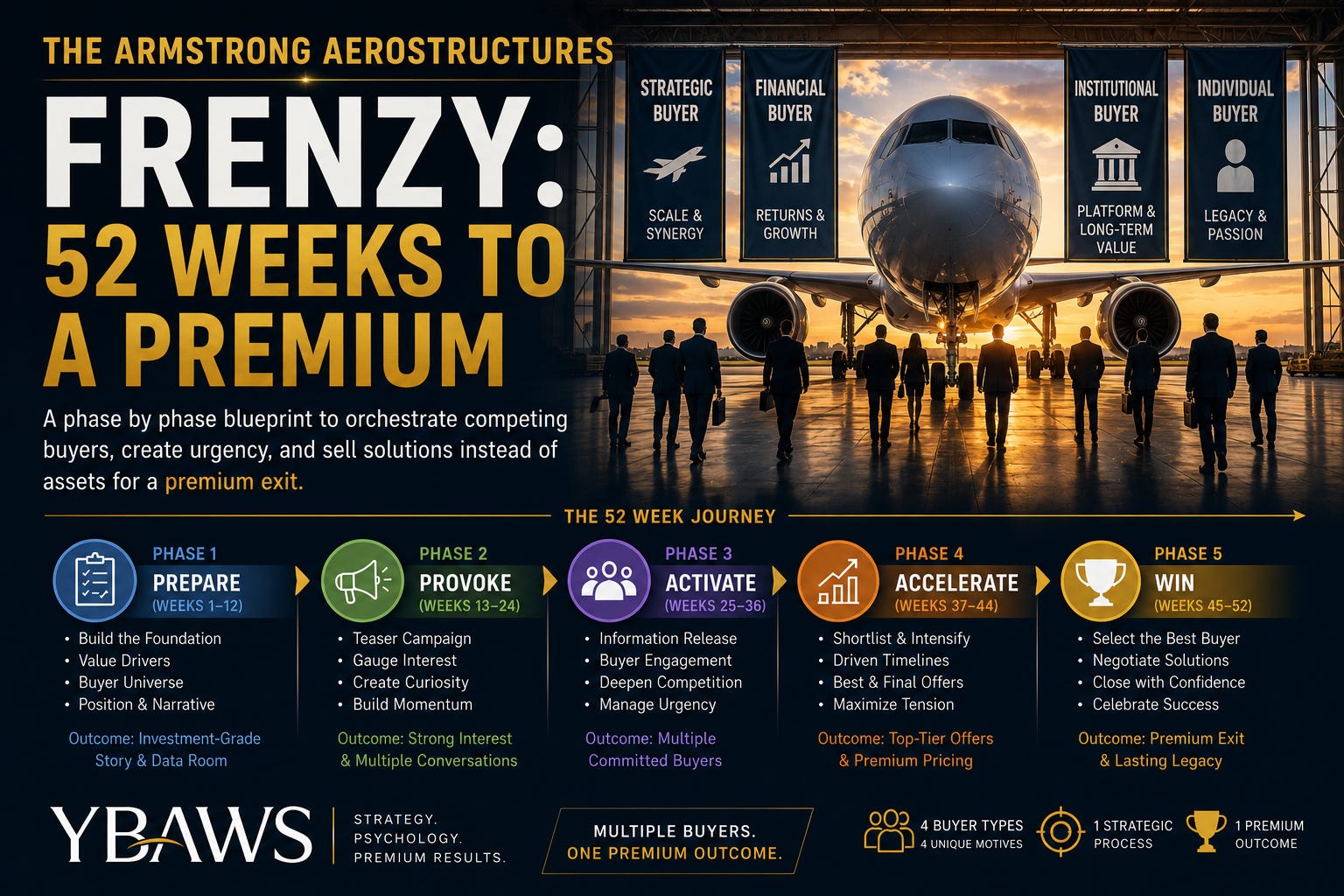
Neil Armstrong Aerostructures, a fictional Ohio based maker of lightweight composite panels for satellites and launch vehicles, had reached 16 million dollars in revenue and 2.9 million in EBITDA. Founder Buzz Armstrong, 63, was ready to retire. An early estimate pinned the company at a 5x multiple, around 14.5 million dollars. Buzz wanted more, and rather than chase one buyer, he committed to the full 52 week blueprint.
Weeks 1 to 8: Intelligence
Buzz’s team mapped 53 potential buyers across strategic, financial, institutional, and individual categories. They profiled the most promising names, a defense prime contractor needing space qualified suppliers, two private equity firms building aerospace platforms, a European launch company seeking United States presence, and a domestic composites maker hungry for scale. They assembled a transaction specialist with deep aerospace relationships, plus legal and valuation experts. An internal audit flagged one risk, heavy reliance on a single anchor customer.
Weeks 9 to 20: Value Engineering
Instead of listing immediately, Buzz fixed the weakness. He diversified the customer base by closing two new contracts, documented proprietary manufacturing processes, and secured an additional space qualification certification that created a real barrier to entry. He then built a professional marketing package and, importantly, wrote a different value story for each buyer type, supply security for the prime, platform completion for the funds, market entry for the European, and scale for the domestic rival.
Weeks 21 to 28: Teasing
The team tested positioning with a few trusted contacts, refined the pitch, and narrowed to 27 serious prospects. Quiet industry networking planted the idea that Armstrong Aerostructures might soon be available, building anticipation without a formal announcement.
Weeks 29 to 36: The Launch
Buzz launched a controlled auction. Twenty seven qualified buyers received teasers and signed confidentiality agreements. Management presentations were staged to highlight scarcity, a rare space qualified supplier with proprietary processes. First round bids established a floor well above the original estimate, and six finalists advanced.
Weeks 37 to 44: The Feeding Frenzy
Now the pressure built. Finalists received exclusive but time limited due diligence windows. Without breaching confidence, each learned that serious strategic and financial rivals remained in the hunt. The defense prime, terrified that a competitor or a foreign buyer might capture its only space qualified panel source, moved aggressively. The European launch company, desperate for United States manufacturing presence, refused to be outbid. Fear of missing out took over.
The Bids
Domestic composites rival: 18.0 million dollars
Private equity platform: 19.5 million dollars
European launch company: 21.0 million dollars
Defense prime contractor: 22.4 million dollars, the winner
