

The headlines scream record venture funding, and they are technically true. They are also a magic trick. A handful of enormous AI deals inflate every average into fiction, so a founder benchmarking against the number feels like a failure or prices a fantasy. The typical deal was a small fraction of what you were told.
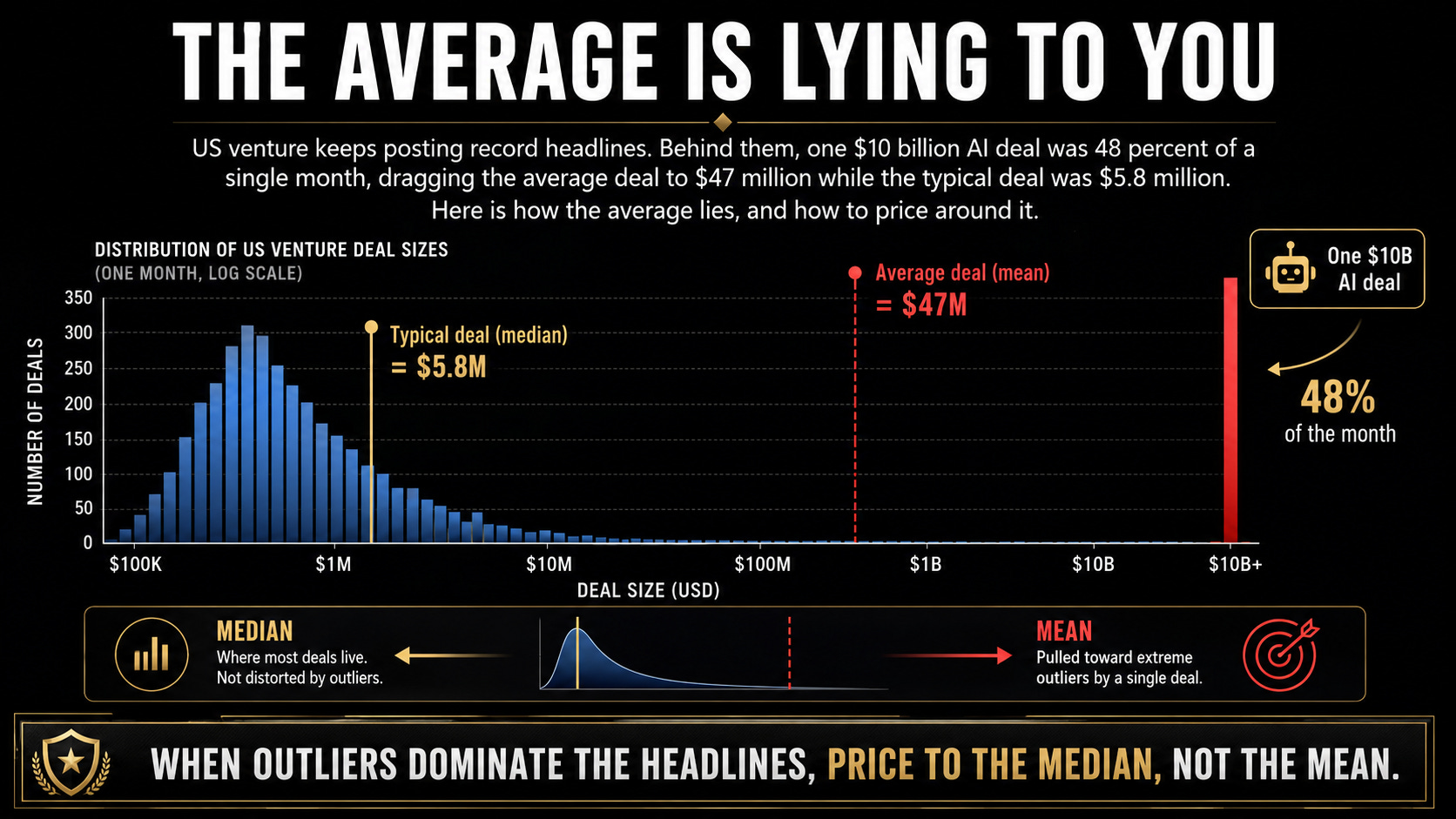
[Suggested image: a histogram with a giant spike far to the right, one $10B deal, pulling a red average line high above the tall cluster of small deals where the median line sits. Alternative: two arrows, mean and median, pointing to wildly different places.]
When One Deal Is Half the Market
Open any venture headline in 2026 and you will read some version of the word record. US venture deal value hit $412.7 billion in the first half of the year, nearly thirty percent more than all of the year before, and the number is real. What the headline buries is that a small cluster of giant AI rounds accounted for almost the entire jump, with AI taking $355.9 billion, about 86 percent of every venture dollar. The record is not a rising tide. It is a few enormous ships.
Zoom into a single month and the distortion turns almost comic. In April 2026, one deal, a ten billion dollar round for a foundational AI company called Project Prometheus, accounted for 48.1 percent of all venture capital deployed in the entire United States. One company. Nearly half of the country’s venture money. Strip that single deal out and the underlying market was a perfectly ordinary $10.8 billion across 441 deals.
This is exactly why the word average quietly becomes a lie. In that same April, the average deal size was $47.1 million while the median deal size was $5.8 million. The average deal, the one every headline implies is normal, describes almost no real company at all. Half of every deal that month came in under $5.8 million. The average was a number almost nobody actually got.
You can watch the swing happen in real time. February 2026 came in at $62.5 billion, anchored almost entirely by Anthropic’s thirty billion and Waymo’s sixteen, then March fell 69.5 percent to about $19 billion, a figure that sat comfortably inside the ordinary range of the prior two years. Nothing structural changed between the two months. A couple of mega rounds simply arrived, and then did not.
How the Average Fools You
The mechanism is plain arithmetic that headlines love to ignore. An average is wrecked by outliers, a median is not. Line every deal up from smallest to largest, and the median is simply whichever one sits in the exact middle, completely immune to how enormous the biggest deal happens to be. The average, by contrast, gets yanked upward by a single ten billion dollar giant until it floats far above where any typical company actually lives. Report the average and you flatter the market. Report the median and you describe it. Guess which one the headlines print.
So a founder reads record funding, a $47 million average deal, a $24 million seed, and reacts in one of two expensive ways. Despair, deciding they are hopelessly behind. Or delusion, deciding they should be able to raise the very same. Both are traps built out of a distorted number. Even Carta, whose data produces the famous $24 million seed median, warns the figure is real but skewed, dragged up by AI mega rounds most companies will never touch.
It fools the optimists too. Crunchbase reported seed funding up more than thirty percent year over year and early stage up more than forty percent, numbers that sound like a genuine thaw. Dig one level down and the texture changes: investors are doing fewer deals and writing bigger checks to the ones they pick, a selectivity shift dressed up as a recovery. The dollars rose. The number of companies sharing them did not.
And record can sit right beside brutal with no contradiction at all. Beneath the record headline numbers lies extreme concentration at the top and fragile breadth underneath, so a record quarter coexists with real hardship for any founder outside the main AI corridors. The number of active investors writing early checks into companies outside AI was, by one count, the lowest since 2016. Record money, historically few open doors.
Know Which Number Is Yours
The answer is not to ignore the data. It is to read the slice that describes you instead of the slice that describes a ten billion dollar outlier. Strip the mega deals out and the real market becomes legible again. That same April, minus Prometheus, was a healthy $10.8 billion across 441 deals, with genuine breadth across defense, energy, and advanced manufacturing. The typical deal was alive and well. It was just standing invisible behind one giant.
The practical move is to benchmark against your own bucket, not the headline. As Carta’s guidance puts it, if you have genuine AI defensibility, measure yourself against the AI numbers and do not undersell, but if you are a strong company outside AI, benchmark against the broader, lower medians and do not get discouraged by headlines built on foundation model mega rounds you will never compete with. Positioning yourself in the wrong bucket, in either direction, quietly costs you money.
There is one more twist to stay honest about. Even the median is not neutral anymore. At Series A, median valuations for AI companies carry an 84 percent premium over their non AI peers. So the very middle of the distribution has an AI thumb pressing on the scale. When even the median is tilted, a founder outside AI is negotiating against a benchmark that was quietly rigged before anyone sat down.
The same illusion haunts the far end of the journey. When these companies finally exit, the gaudy gains tend to evaporate: most IPOs are now pricing at a median step up of just 1.1x over their last private round, and nearly 87 percent of acquisitions close at undisclosed valuations, the polite signal of a markdown nobody wants printed. The averages that flatter the funding headlines quietly do not survive contact with a real exit.
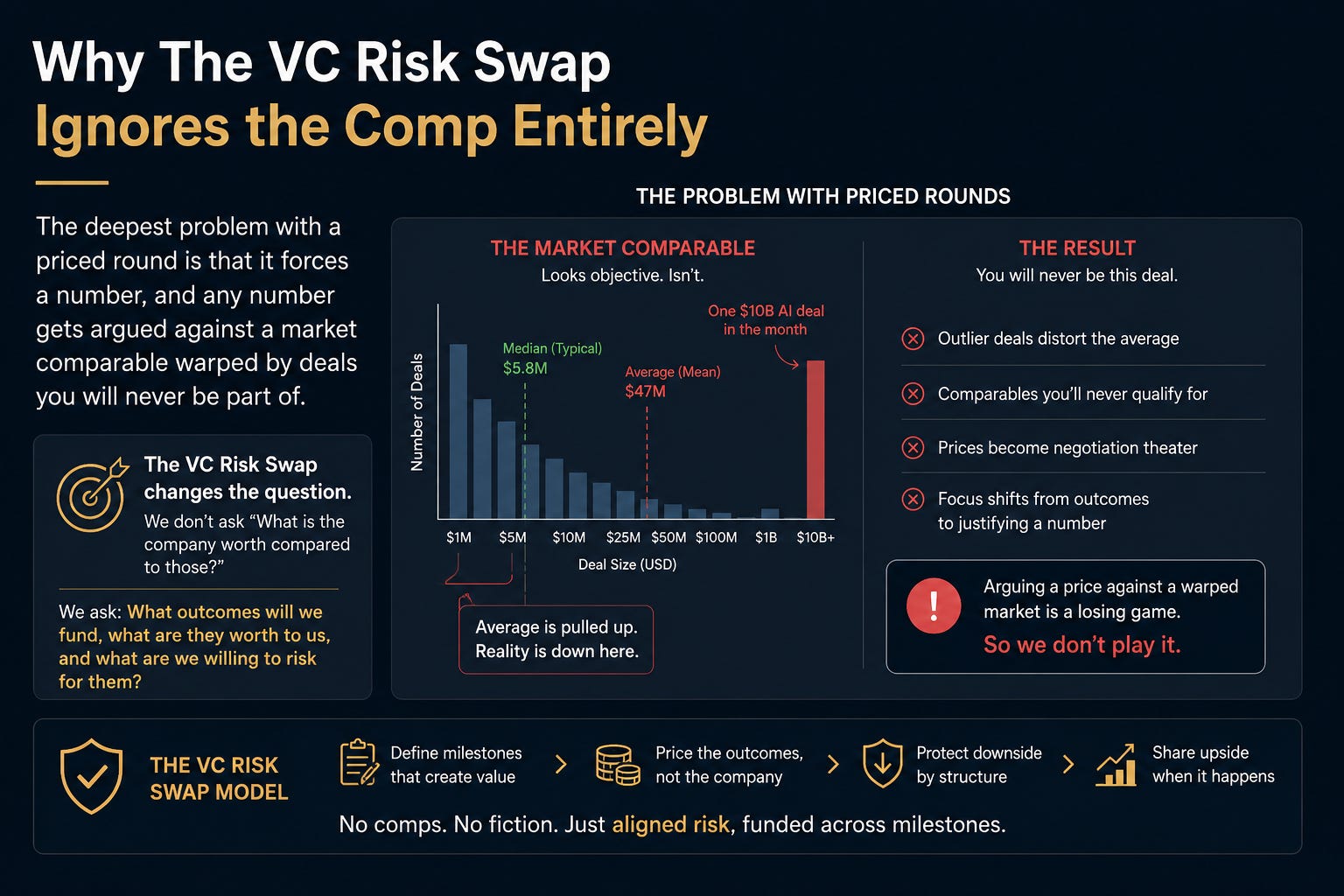
Why The VC Risk Swap Ignores the Comp Entirely
The deepest problem with a priced round is that it forces a number, and any number gets argued against a market comparable warped by deals you will never be part of. The VC Risk Swap does not price against the market at all. It carries no valuation to benchmark, so a distorted average cannot be used to mark you down. The funder is protected by a milestone based revenue guarantee tied to what the company actually does, and the founder is measured against real performance, not a mean inflated by a ten billion dollar outlier. Both escape the comp entirely.
Subscribe to SaferWealth for more field notes from the part of the funding world the venture market overlooks, plus the structures that fund good companies on their own terms.
Questions about your specific situation? Reach out directly at riskswap@saferwealth.com.
CONNECT WITH SAFERWEALTH
Expand your learning beyond this post:
1. Web: SaferWealth.com, alternative startup funding structures.
2. YouTube: The Capital ToolKit, funding strategy and structure breakdowns.
3. Rumble: @SaferWealth.
4. Contact: riskswap@saferwealth.com.
ABOUT THE AUTHOR
Sean Cavanagh (BAS, CPA, CA, CF, CBV) is the founder of SaferWealth and creator of the VC Risk Swap, an alternative startup funding structure that preserves founder equity and control through milestone based, downside protected capital. With over three decades in business valuation, M&A advisory, and structuring, Sean writes about funding the businesses the venture market overlooks.
DO YOUR OWN RESEARCH
Sources referenced in this post:
• AlleyWatch, April 2026 US venture report, the $10B Prometheus deal at 48 percent, average $47.1M versus median $5.8M.
• AlleyWatch, March 2026 US venture report, the February to March swing driven by two mega rounds.
• SiliconANGLE on the PitchBook H1 2026 monitor, $412.7B with AI taking 86 percent.
• Flowjam on Carta seed data, why the $24M seed median is real but skewed, and how to benchmark your bucket.
• PitchBook Q1 2026 valuations and returns, the 84 percent Series A AI premium and the 1.1x IPO step up.
• Angel Investors Network, what $300B really means, the selectivity shift behind the seed numbers.
• Insights4VC, AI captured 80 percent of funding, concentration at the top, fragile breadth underneath.
📖 RELATED READING
• AlleyWatch: The April 2026 US Venture Capital Funding Report: one deal, half the market, in full detail.
• Flowjam: Seed Valuation in 2026, Carta Data: how to find the number that is actually yours.
• PitchBook: Q1 2026 US VC Valuations and Returns: where the AI premium sits, and where returns do not.
Educational disclaimer: This content is for educational purposes only and does not constitute legal, tax, financial, or investment advice. The VC Risk Swap is a sophisticated structure that must be implemented with independent professional advisors for your specific situation. All examples are illustrative. Neither the author nor SaferWealth accepts liability for actions based on this content. This material supplements but never replaces proper professional consultation and judgment.
© 2026 SaferWealth. All rights reserved.