

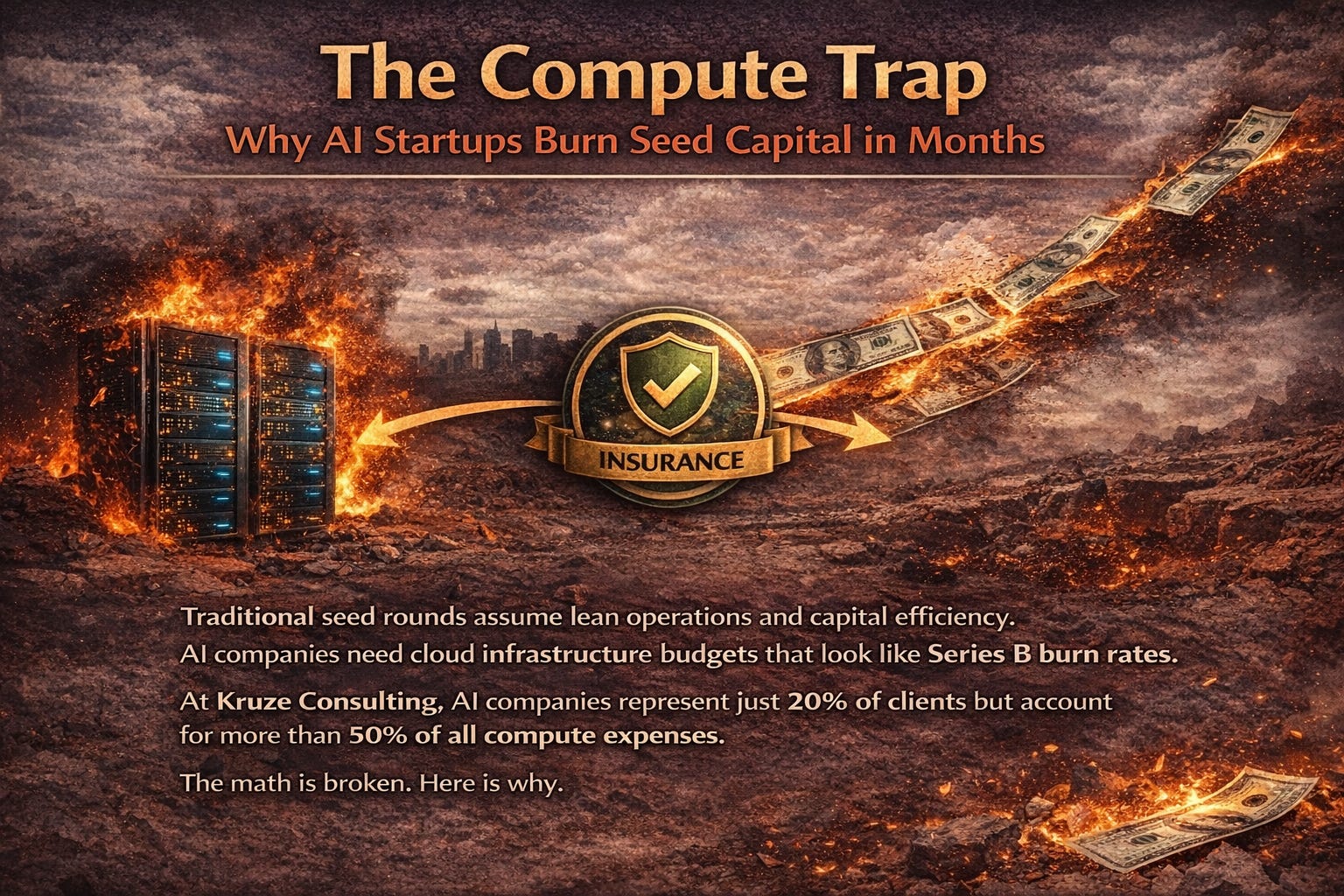
Traditional seed rounds assume lean operations and capital efficiency. AI companies need cloud infrastructure budgets that look like Series B burn rates. At Kruze Consulting, AI companies represent just 20% of clients but account for more than 50% of all compute expenses. The math is broken. Here is why.
10 KEY TAKEAWAYS - AI COMPUTE ECONOMICS
1. Infrastructure costs dominate AI burn: 40-60% of capital goes to compute versus 5-10% for traditional startups.
2. Each iteration costs exponentially more: Training runs cost $5K-$50K versus effectively zero for software iteration.
3. Free cloud credits create toxic dependencies: Companies optimize for unlimited compute, then face burn explosions when credits expire.
4. The subsidy trap delays reckoning: Hyperscaler credits subsidize discovery but not sustainable business building.
5. Capital efficiency becomes product constraint: Companies that optimize for cost often build less defensible products.
6. Typical trajectory burns seed in 8-12 months: Infrastructure costs spike to $80K-$150K monthly during model development.
7. Three paths emerge, none ideal: Hyperscaler credits, capital-efficient architecture, or revenue-first development.
8. Unit economics require full pricing analysis: Calculate compute costs at market rates, not subsidized credits.
9. Revenue guarantees stabilize compute funding: The VC Risk Swap provides capital access without equity dilution during infrastructure buildout.
10. Compute constraints equal product constraints: If you can only afford limited training, you build limited products.
📚 READING PREREQUISITES
This post builds on the temporal mismatch and AI taxonomy concepts from earlier posts. Understanding why AI companies need longer validation timelines and how category affects risk profile provides essential context for evaluating compute economics.
Recommended Prior Reading:
• Post 1: The AI Valley of Death - Why Seed Funding Timelines Are Broken
• Post 2: Pure AI vs. AI-Enabled - The Taxonomy That Determines Fundability
• Series overview available at SaferWealth.com
The Brutal Mathematics of AI Infrastructure Costs
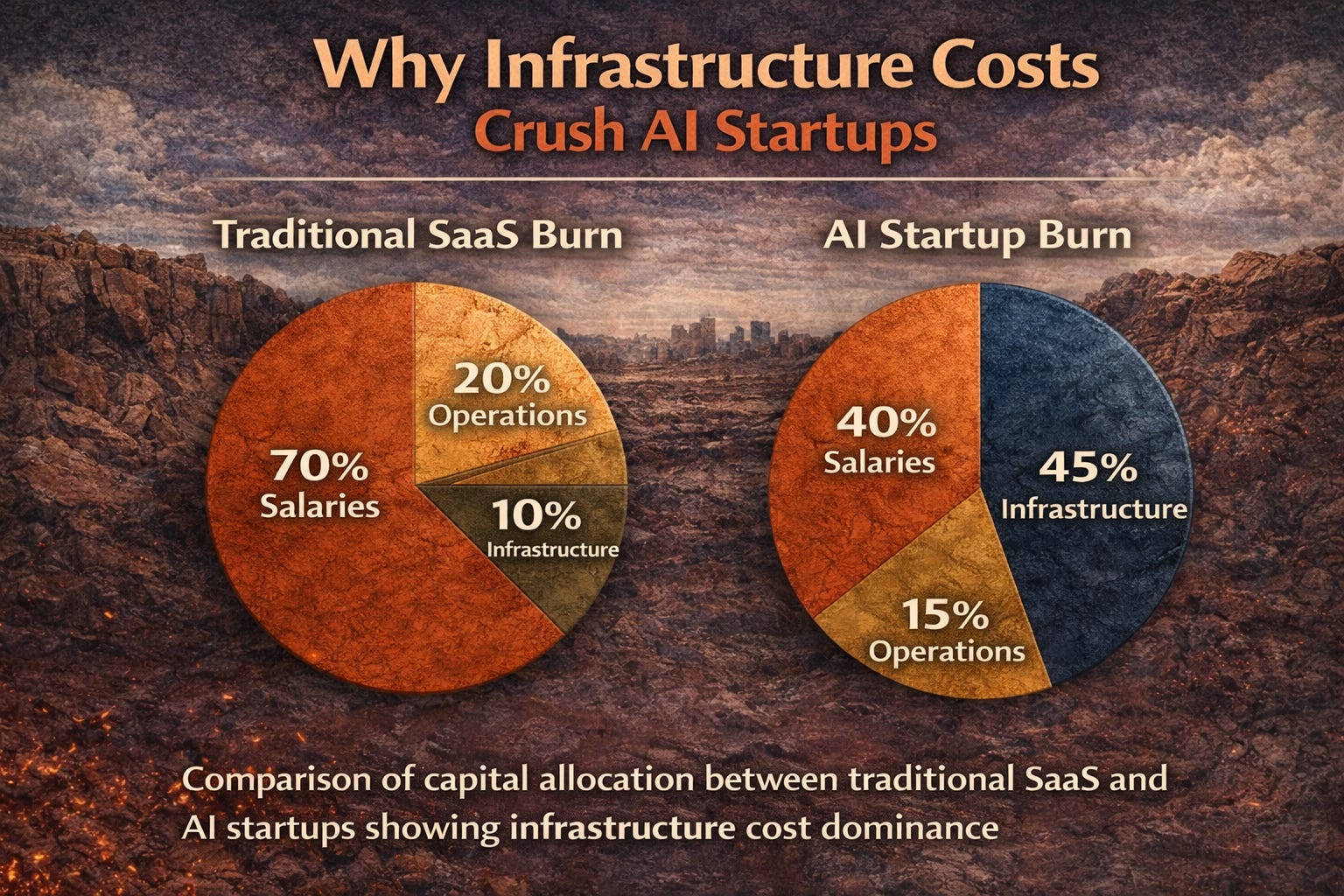
A typical seed-stage startup allocates 60-70% of capital to salaries, 20-30% to operations and growth, and 5-10% to infrastructure. That works when your product runs on AWS instances costing a few thousand dollars per month. Your biggest expense is people, and you can control hiring velocity to manage burn.
Now consider an AI startup training and iterating on models. Suddenly, your infrastructure costs are not 10% of burn. They are 40-60%. Every training run that fails is $5K-$50K down the drain. Every A/B test of a model variant requires compute resources that would fund multiple engineering salaries. According to Kruze Consulting data from 800+ startups, AI companies represent just 20% of clients but account for more than 50% of all compute and hosting expenses.
The Temporal Dynamics Create a Deadly Trap:
Traditional software companies can iterate quickly and cheaply. Change some code, deploy, test with users, iterate again. Total cost per iteration: effectively zero beyond engineering time. AI companies need to retrain or fine-tune models for each meaningful iteration. Cost per iteration: $10K-$100K depending on model size. Time per iteration: days to weeks, not minutes.
This creates three impossible constraints:
• You need to iterate quickly to find product-market fit, standard startup advice
• Each iteration costs exponentially more than traditional product development
• You cannot afford to iterate slowly because you are racing against a 12-18 month seed runway
The Typical AI Startup Burn Trajectory
Consider the typical trajectory that burns through seed capital:
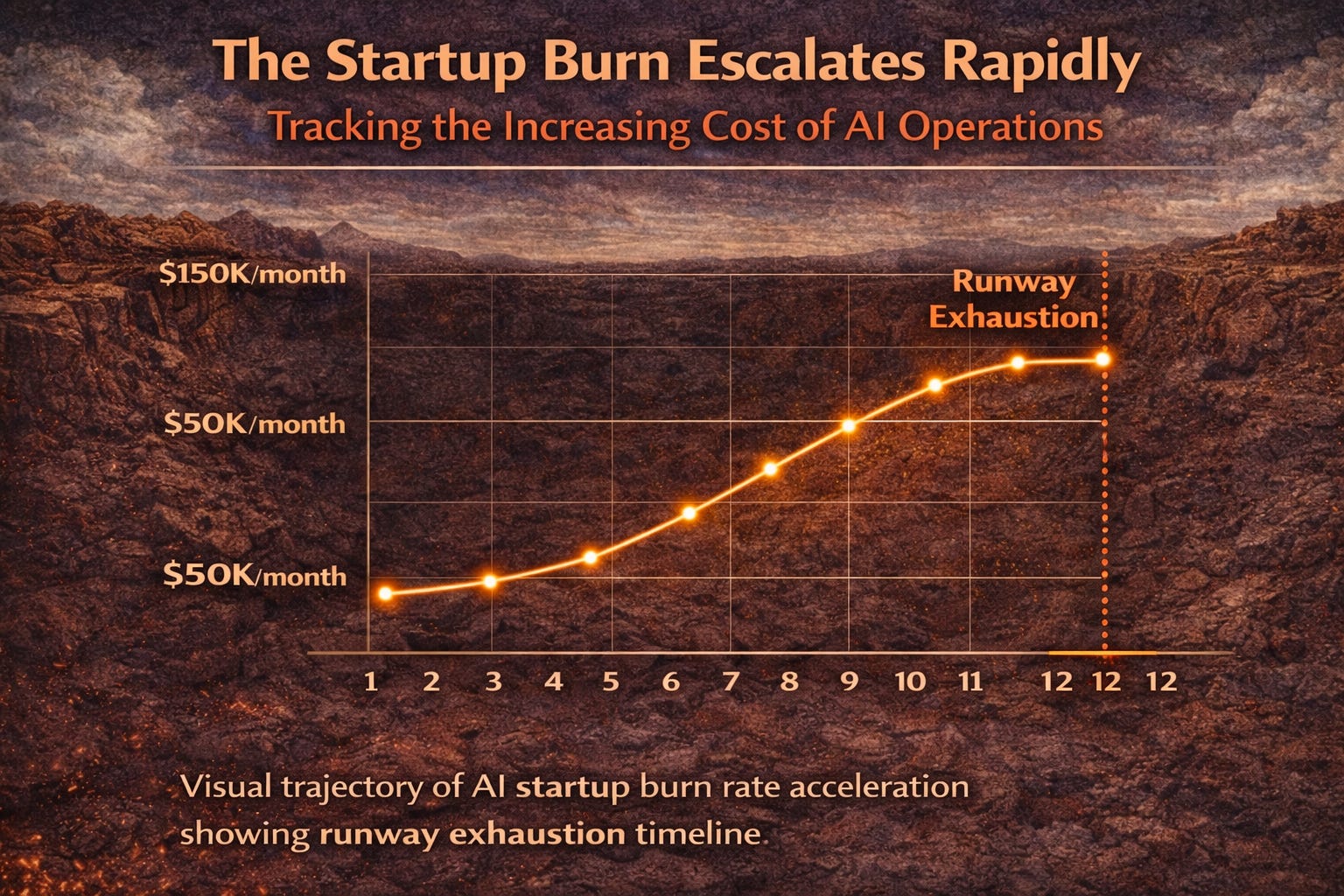
Months 1-2: Experimentation and architecture decisions. Relatively low compute costs of $5K-$10K monthly as you explore approaches and validate technical feasibility.
Months 3-6: Initial training runs and model development. Costs spike to $30K-$80K monthly as you begin serious model training and iteration cycles.
Months 7-12: Iteration, improvement, and scaling. Costs hit $80K-$150K monthly as you refine models, scale infrastructure, and prepare for production deployment.
Month 13+: Either you have found investors willing to bridge, or you are dead.
On a $2M seed round, spending $50K-$100K monthly on infrastructure means you have 10-15 months of runway before compute costs alone consume half your capital. Add in salaries for ML engineers commanding expensive compensation packages, office costs, legal, and other operations, and you are looking at 8-12 months total runway. That is not enough time to validate an AI product.
Three Paths Through the Compute Trap
Three paths emerge for AI startups facing compute constraints. None of them are ideal.
Path 1: Hyperscaler Credits
The golden ticket. If Google Cloud, Microsoft Azure, or AWS gives you significant compute credits, you have just extended your runway by 12-18 months. But these programs are competitive, require deep technical validation, and often come with strings attached.
The hidden trap: The hyperscaler that gives you free compute is also the hyperscaler most likely to acqui-hire your team later. You are trading short-term runway for long-term dependence.
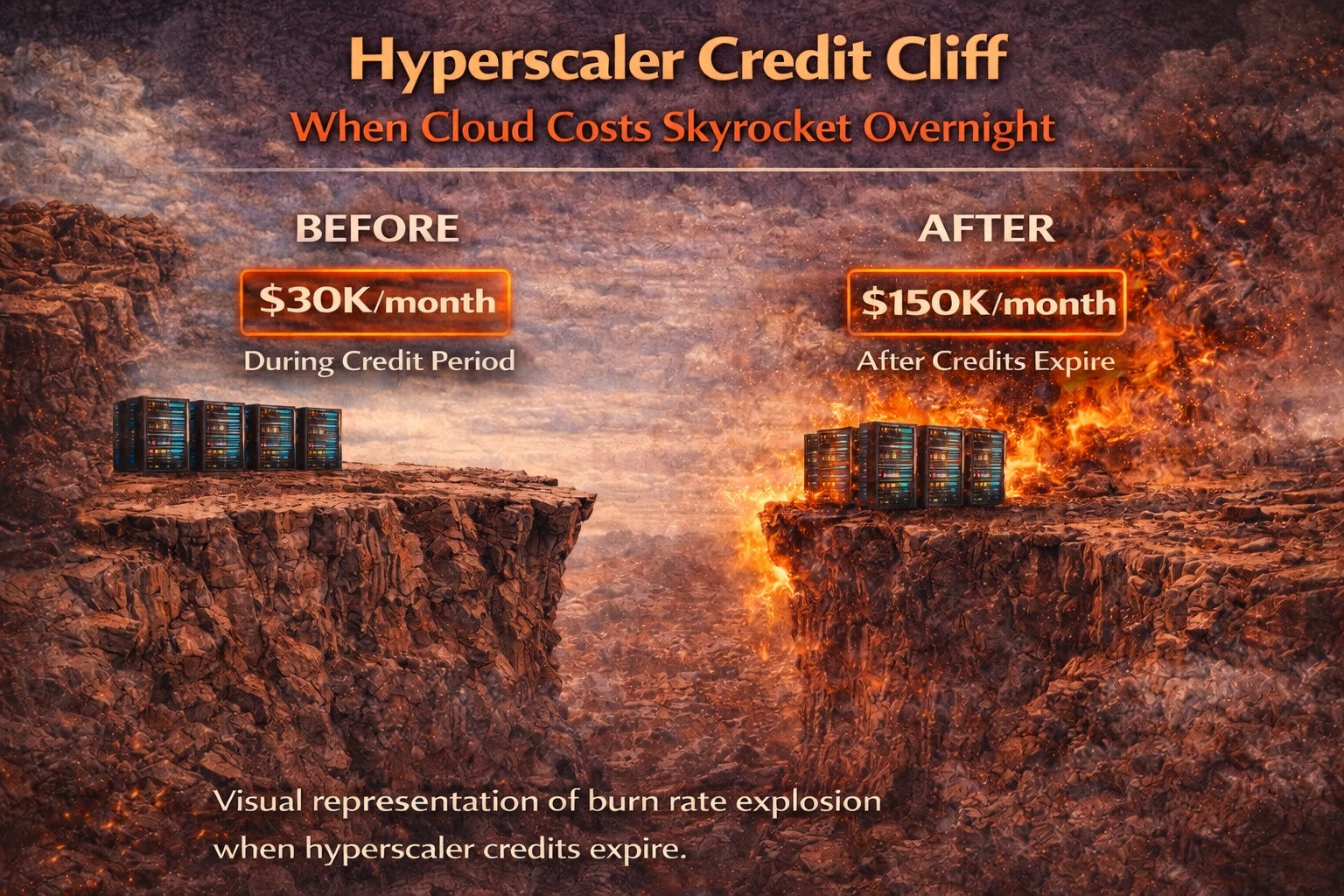
The credits eventually expire, typically 12-24 months. That sounds generous until you realize training cycles take 6-12 months to show meaningful results. You build your entire infrastructure assuming unlimited compute, optimize for model quality rather than cost efficiency, and then the credits end. Your burn rate explodes from $30K monthly to $150K monthly overnight. Now you need emergency bridge financing, and you are negotiating from weakness.
Path 2: Capital-Efficient Architecture
Some teams get creative: using smaller models, fine-tuning instead of training from scratch, implementing clever caching and inference optimization. This works if your differentiation does not require massive compute.
The honest assessment: If you can build your product on $10K monthly compute budgets, you are probably not building something defensible. Real AI innovation requires real compute. Companies that win by being capital-efficient on compute are often companies that are not actually doing novel AI work. They are wrapping existing models with good UX.
Path 3: Revenue-First Development
Launch with pre-trained models and minimal customization to generate early revenue. Use that revenue to fund better infrastructure. This is the lean startup playbook adapted for AI, but it only works if customers will pay for good enough before you have built great.
The problem: Good enough AI often is not good enough. Customers expect ChatGPT-quality or better. If your product delivers mediocre AI because you could not afford proper model development, customers churn before you generate the revenue needed to improve the models. You are stuck in a local minimum: not good enough to retain customers, not generating enough revenue to get better.
The paradox intensifies: The best way to reduce compute costs is to get really good at model optimization, efficient architectures, and inference optimization. But getting good at these things requires expensive experimentation that burns through compute budgets. You need to spend money to learn how to spend less money, but you do not have the money to spend on learning.
The Subsidy Trap: When Free Credits Become Toxic Dependencies
The subsidy trap makes everything worse. Companies that get free compute credits optimize for the wrong things. They run massive experiments, build inefficient architectures, and do not think about cost because costs are zero. Then credits expire and they face a burn rate they cannot sustain.
Smart Teams Treat Free Credits as Temporary Learning Opportunities:
• Calculate what your infrastructure would cost at full pricing from day one
• Track compute costs religiously even when they are subsidized
• Build cost-optimization into your culture before you are forced to
• Negotiate extensions or ongoing discounts six months before credits expire
The reality check: If your company only works because cloud costs are subsidized, you do not have a sustainable company. You have a research project. The path to fundability requires proving you can operate at full compute pricing and still maintain acceptable unit economics.
The VC Risk Swap: Stabilizing Compute Funding
Traditional equity financing fails AI companies during the compute-intensive phase. Investors want to see traction before committing capital, but generating traction requires compute infrastructure that burns through seed rounds. The VC Risk Swap offers an alternative that stabilizes compute funding without massive equity dilution.
How the VC Risk Swap Addresses Compute Economics:
Milestone-based capital deployment: Instead of receiving a lump sum that burns through compute costs unpredictably, the VC Risk Swap provides milestone-based revenue guarantees. The company uses these guarantees to access growth capital as needed, matching capital deployment to actual infrastructure requirements rather than arbitrary timelines.
Preserved equity during infrastructure buildout: Traditional equity financing requires founders to dilute ownership before proving their compute investments generate returns. The VC Risk Swap preserves founder equity during the highest-uncertainty infrastructure phase, deferring equity decisions until business value becomes clearer.
Insurance-backed downside protection: The structure includes life insurance on the Funder, owned by the company. This provides downside protection if the funding relationship is disrupted during critical infrastructure development. Funders participate in upside through revenue share rather than requiring equity that pressures companies to show premature results.
Why This Works for Compute-Intensive Companies:
• Aligns capital with compute needs: Milestone funding matches the actual trajectory of infrastructure spending
• Reduces credit dependency: Revenue guarantees provide capital access independent of hyperscaler programs
• Enables sustainable scaling: Companies can plan infrastructure growth without emergency bridge rounds
• Protects both parties: Founders retain equity; funders receive downside protection through insurance
• Creates realistic timelines: Five-year structure matches AI development cycles rather than forcing SaaS assumptions
The VC Risk Swap does not eliminate compute costs. It stabilizes the funding mechanism so companies can invest in infrastructure without the pressure that drives premature product launches, desperate bridge rounds, or toxic hyperscaler dependencies.
What Founders Must Understand About Compute Economics
Compute costs are not like other startup expenses. You can freeze hiring to extend runway. You cannot freeze model training because the market moves too fast. Competitors with more compute capital will simply build better products. In traditional startups, capital efficiency is a virtue. In AI startups, compute constraints often mean product quality constraints, which means you lose to better-funded competitors.
For Investors Evaluating AI Seed-Stage Companies:
• Ask about compute budgets early. How much are they spending monthly?
• What happens when credits expire? Do they have a plan?
• What is their strategy for cost optimization?
• If founders cannot answer these questions precisely, they do not understand their own business model
For Founders Raising Capital:
• Be brutally honest about compute requirements
• If you need $5M seed instead of $2M because compute costs $100K monthly, say that upfront
• Investors who understand AI will respect the honesty
• Investors who do not understand were not going to be helpful partners anyway
The compute trap is not a failure of execution. It is a structural mismatch between traditional seed funding assumptions and AI company capital requirements. Until this mismatch gets resolved through larger seed rounds, alternative funding structures like the VC Risk Swap, or fundamental breakthroughs in compute efficiency, the trap will keep claiming promising AI startups that simply could not afford to iterate their way to product-market fit.
💡 KEY TAKEAWAYS
Remember These Core Principles:
• Calculate true burn at market rates: Know what compute costs without subsidies from day one
• Plan for credit expiration: Start negotiating extensions six months before credits end
• Build cost optimization into culture: Do not wait until you are forced to think about efficiency
• Consider alternative structures: The VC Risk Swap provides milestone-based capital that matches compute needs
• Be honest with investors: If you need more capital for compute, communicate that upfront
❓ FREQUENTLY ASKED QUESTIONS
Q: How much do AI startups typically spend on compute infrastructure?
A: AI startups allocate 40-60% of burn to compute infrastructure versus 5-10% for traditional SaaS companies. Monthly infrastructure costs typically range from $30K-$80K during initial development, spiking to $80K-$150K during intensive training and scaling phases. This represents a fundamental shift from traditional startup economics.
Q: Are hyperscaler compute credits a reliable funding strategy?
A: Hyperscaler credits provide temporary relief but create dangerous dependencies. Companies optimize for unlimited compute during the credit period, then face burn rate explosions of 3-5x when credits expire. Additionally, the hyperscaler providing credits is often the entity most likely to acqui-hire your team later, creating strategic conflicts.
Q: Can capital-efficient architecture solve the compute trap?
A: Capital-efficient architecture works only if your differentiation does not require significant compute. The honest assessment: if you can build your product on $10K monthly compute budgets, you are probably not building something defensible. Real AI innovation typically requires real compute investment. Efficiency helps but rarely eliminates the fundamental capital requirement.
Q: How does the VC Risk Swap address compute funding challenges?
A: The VC Risk Swap provides milestone-based revenue guarantees that companies use to access growth capital matching their infrastructure needs. This stabilizes compute funding without requiring massive upfront equity dilution. The five-year structure aligns with AI development timelines, and insurance components provide downside protection for funders.
Q: What should founders tell investors about compute costs?
A: Be brutally honest. If you need $5M seed instead of $2M because compute will cost $100K monthly, communicate that upfront. Provide detailed projections of infrastructure spending by development phase. Show you understand unit economics at full cloud pricing, not subsidized rates. Investors who understand AI will respect the transparency.
🎯 READY TO ESCAPE THE COMPUTE TRAP?
Understanding compute economics is essential for AI startup survival. The structural mismatch between traditional seed funding and AI infrastructure requirements demands new approaches to capital access and deployment.
Subscribe to SaferWealth for insights on alternative startup funding structures, AI commercialization strategies, and the VC Risk Swap framework. Join founders and funders who are building better capital structures for the AI era.
Have questions about your specific situation? Drop a comment below or reach out directly. I respond to every message.
📖 RELATED READING
Continue Your Learning:
• Kruze Consulting AI Startup Benchmarks: Industry data showing AI companies represent 20% of clients but 50%+ of compute expenses.
• Google Cloud Startup Program: Overview of hyperscaler credit programs and eligibility requirements.
• AWS Activate Program: Amazon’s startup compute credit program details and application process.
CONNECT WITH SAFERWEALTH
Expand Your Learning Beyond This Post:
1. Web: SaferWealth.com - Alternative Startup Funding Structures
2. YouTube: TheCapitalToolkit - VC Risk Swap Educational Content
3. LinkedIn: LinkedIn @SaferWealth - Startup Finance Innovation
4. Rumble: @saferwealth - Educational video content on alternative funding
5. Instagram: @saferwealth - Quick insights and updates
👤 ABOUT THE AUTHOR
Sean Cavanagh, BAS, CPA, CA, CF, CBV
With over three decades in business valuations, M&A advisory, and tax structuring, Sean delivers unvarnished truth about startup funding challenges. Starting at Deloitte and Canada Revenue Agency, he now advises founders and funders on alternative capital structures through SaferWealth.com. The VC Risk Swap framework reflects his frustration with funding structures that consistently fail AI startups.
Connect with Sean:
• 🌐 SaferWealth.com
📚 DO YOUR OWN RESEARCH
The concepts discussed in this article are grounded in industry data and market analysis. Below are authoritative sources for readers who want to dive deeper:
Industry Data & Research:
• Kruze Consulting - Startup Benchmarks
• CB Insights - AI Infrastructure Analysis
• Andreessen Horowitz - AI Infrastructure Cost Analysis
Cloud Provider Programs:
Key Terms & Definitions:
• Investopedia - Unit Economics
• OpenAI - Fine-Tuning Documentation
This section empowers readers to verify information, explore topics deeper, and develop their own informed perspectives on AI startup compute economics.
⚖️ EDUCATIONAL DISCLAIMER
This guide provides information only, not professional advice. Consult qualified advisors for your specific situation. All cases are fictional, created for educational purposes from collective industry experience. Neither the author nor SaferWealth accepts liability for actions based on this content. This material supplements but never replaces proper professional consultation and judgment.
SaferWealth is an educational platform dedicated to helping founders and funders understand alternative capital structures for AI startups.
© 2026 SaferWealth. All rights reserved.
