

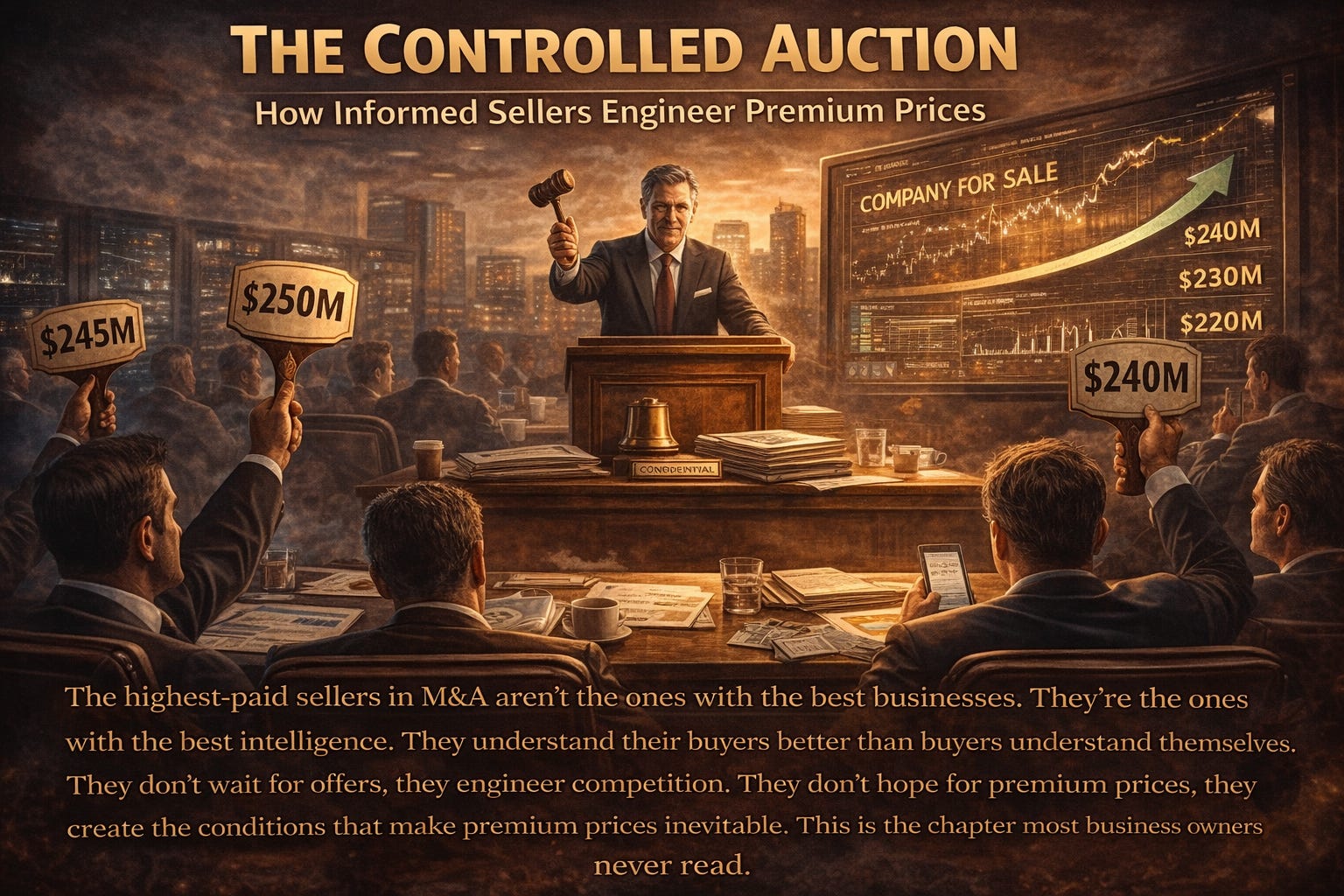
The highest-paid sellers in M&A aren’t the ones with the best businesses. They’re the ones with the best intelligence. They understand their buyers better than buyers understand themselves. They don’t wait for offers, they engineer competition. They don’t hope for premium prices, they create the conditions that make premium prices inevitable. This is the chapter most business owners never read.
10 KEY TAKEAWAYS, THE CONTROLLED AUCTION PROCESS
Orchestrate, don’t participate: Elite sellers control the entire transaction process. They set the timeline, the information flow, the competitive dynamics, and the final decision framework.
Buyer motivation determines pricing ceiling: A buyer who needs your business for strategic survival will pay fundamentally more than one who merely wants it. Your job is to find that buyer before going to market.
Playing multiple boards is legal and ethical: Using knowledge of one buyer’s motivation to create urgency with another is standard professional M&A practice, not manipulation.
Tailored narratives maximize each buyer’s offer: The same business presented through a strategic lens to a corporate buyer and an operational lens to a financial buyer extracts maximum value from each party.
Competitive tension is engineered, not discovered: You don’t wait for multiple buyers to show up simultaneously. You sequence your outreach and information release to create artificial urgency and visible competition.
The 48-hour deadline is a precision weapon: When you know a buyer’s reporting timeline, board meeting schedule, or fund deployment pressure, a deadline tied to those constraints creates maximum urgency.
Intelligence converts urgency to premium pricing: Knowing a buyer has budgeted up to $35M for acquisitions allows you to structure your counter-offer at their ceiling rather than anchoring at their opening bid.
Customized positioning is not deception: Emphasizing different, genuine aspects of your business for different buyer types is strategic communication, not misrepresentation.
The controlled auction requires preparation months in advance: You cannot engineer competition in real time. The intelligence, positioning, and buyer development work happens long before formal process launch.
Valuation formula improvement through intelligence: Better intelligence reduces buyers’ required rate of return, directly improving your valuation multiple without changing underlying earnings.
📚 READING PREREQUISITES
Each post in this series builds on the technical groundwork laid in earlier entries. Key valuation concepts are intentionally revisited and reinforced across multiple posts to ensure retention and to demonstrate how foundational ideas interconnect and remain central to every subsequent analysis.
Recommended Prior Reading:
Chapter 6: The Core Valuation Formula, Value = Income ÷ Rate
Chapter 7: Fair Market Value and the Transaction Environment
Moving from Seller to Strategist
There is a profound difference between selling your business and engineering its sale. The first is a reactive process. You prepare materials, accept buyer meetings, respond to due diligence requests, and eventually negotiate from a position shaped by whoever showed up and what they decided to offer. The second is an active, intelligence-driven process where you understand the market, identify the highest-value buyers, build competitive tension deliberately, and extract maximum value by controlling every variable within your reach.
