

Disclaimer: The following case study is entirely fictional. The character name is inspired by a legendary maritime explorer but represents a fictional individual with no connection to that real person, their family, or their estate. Financial figures are illustrative only.
James Cook Ferraro built Ferraro Marine Fabrication over eighteen years into a respected builder of custom aluminum work boats and barges for commercial operators. By the time he considered an exit, the company generated $16 million in revenue and $2 million in EBITDA. James was the classic indispensable founder. He quoted every major project personally, held every key customer relationship, approved every design change, and carried the shop’s hard won fabrication knowledge in his own head. His employees respected him, and that was precisely the problem.
When James asked his advisor what the business was worth, she did not start with a number. She asked him the one year vacation question. What would happen to Ferraro Marine Fabrication if he sailed away for a year starting tomorrow? James laughed, then stopped laughing when he realized the honest answer was that it would run aground within months.
Reading the Chart
The advisor priced his risk before any buyer could. With James as the sole decision maker, a top customer at 52% of revenue, undocumented fabrication processes, and reactive financial reporting, the company specific premium stacked to roughly 23%. Added to a 10% market baseline, the required return reached 33%, producing a multiple near 3x. On $2 million EBITDA, that implied a value around $6 million, not the $14 million James had assumed based on a shipyard he had heard “sold for 7x.”
“You have not built a business,” she told him. “You have built a very demanding job with a fabrication shop attached. A buyer is not purchasing your skill, because your skill walks out the door the day you retire. They are purchasing a system, and right now the system is you.”
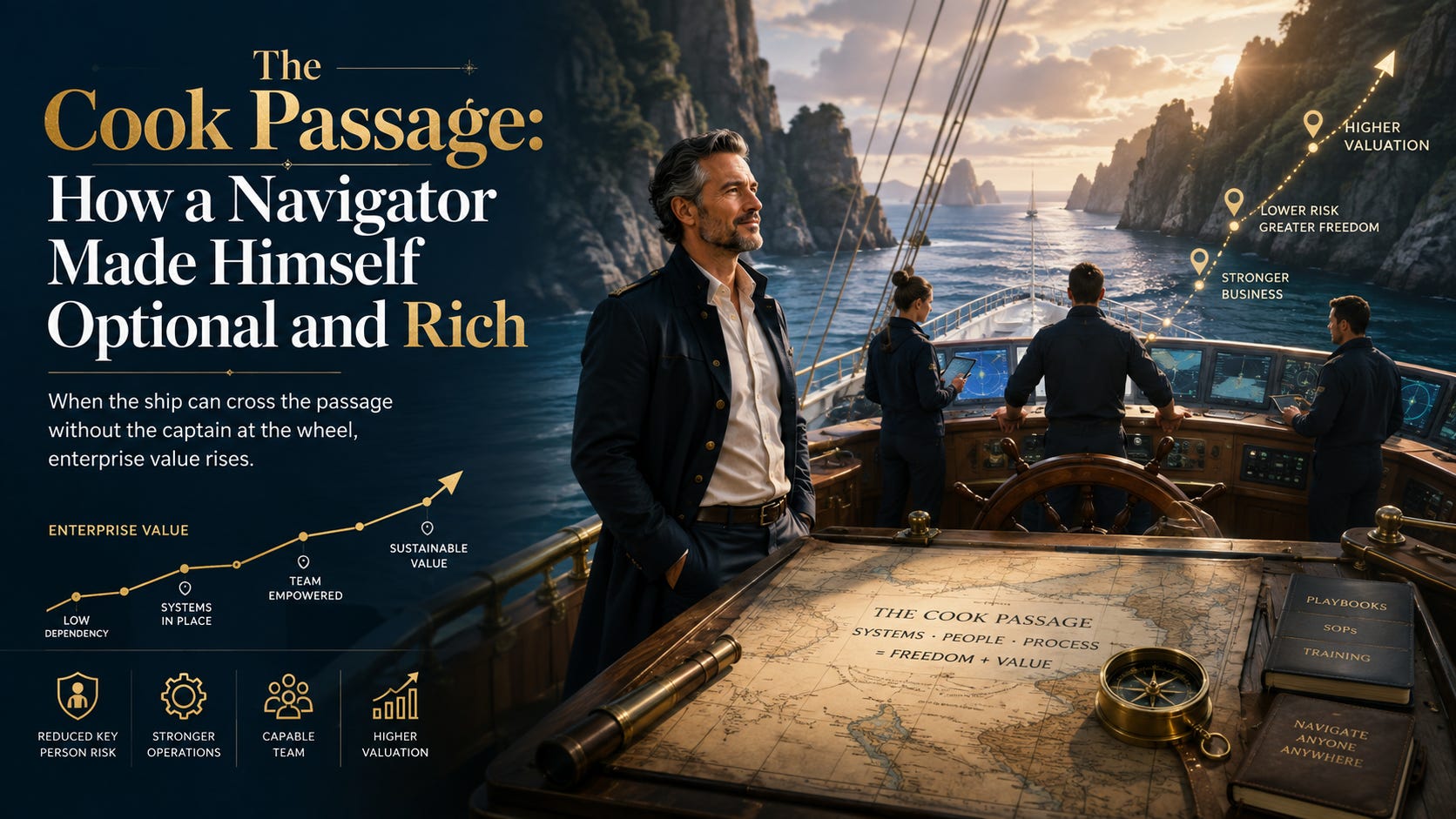
James, a navigator by nature, understood that a good passage is planned, not improvised. He decided to chart a course that made himself optional.
Charting a Course to Optional
Over twenty months, Ferraro Marine executed a disciplined program. James hired a general manager with commercial fabrication experience and promoted two lead fabricators into supervisory roles with documented responsibilities. He built a complete operations manual capturing weld procedures, design standards, quality checkpoints, and vendor specifications, converting the knowledge in his head into transferable systems. He created a formal estimating process so quotes no longer required his personal sign off, and he diversified the customer base, adding nine new commercial accounts and capping any single customer at 20% of revenue. To professionalize the financials, he engaged a fractional controller who delivered monthly statements, backlog reporting, and cash flow forecasts.
The investment across personnel, systems, and advisory support totaled roughly $400,000 over twenty months. Critically, James also began stepping back deliberately, taking a two week absence at month twelve as a live test. The shop delivered three projects on time without him. The vacation test, once a threat, was becoming a proof point.
The Math That Made James Rich
When the advisor reassessed, the transformation showed up in the premium. Management and key person risk fell as the leadership team decided without James. Operational risk fell as documentation and cross training took hold. Customer concentration risk fell as the base diversified, and financial risk fell with professional reporting. For illustration, the company specific premium dropped from 23% to 8%, pulling the required return from 33% to 18% and lifting the multiple from about 3x to about 5.5x, since 1 divided by 0.18 is about 5.5.
EBITDA had grown modestly to $2.3 million as the tighter operation improved throughput and reduced rework. The new indicative value reached $2.3 million multiplied by 5.5x, roughly $12.65 million, against the earlier $6 million.
The Payoff
James had more than doubled his company’s value, moving from roughly $6 million to roughly $12.65 million, on a $400,000 investment. That value lift of about $6.65 million represented a return of roughly 1,660%. The largest single driver was the reduction in key person and operational risk, because making the founder optional is what converts a job into a sellable, transferable business.
When a marine services group entered a competitive process, its diligence team cited Ferraro’s “documented fabrication systems and management depth” as the reason it could integrate the shop without disruption, and paid a premium multiple accordingly. The buyer was not paying for James’s decades at the welding table. It was paying for a system that produced predictable output without him. James had become the vision and the navigator, not the engine, and in doing so he made himself both optional and wealthy. For the professional grounding, Finerva on key person dependency and Class VI Partners on owner dependence mirror the mechanics James navigated.
CONNECT WITH SAFERWEALTH
Web: SaferWealth.com, Alternative Startup Funding Structures
YouTube: @CapitalToolKit, Business valuation and M&A education
LinkedIn: LinkedIn @SaferWealth, Startup Finance Innovation
Rumble: @saferwealth, Educational video content
Instagram: @saferwealth, Quick insights and updates
👤 ABOUT THE AUTHOR
Sean Cavanagh, BAS, CPA, CA, CF, CBV
With over three decades negotiating business sales and conducting valuations, Sean delivers unvarnished truth about business exits. Starting at Deloitte and Canada Revenue Agency, he now advises business owners through his M&A practice. YBAWS! reflects his frustration with owners who consistently overvalue their companies.
Connect with Sean:
📚 DO YOUR OWN RESEARCH
Professional Standards & Organizations:
Key Person Risk & Founder Dependency:
Key Terms & Definitions:
This section empowers readers to verify information, explore topics deeper, and develop their own informed perspectives on business valuation principles.
⚖️ EDUCATIONAL DISCLAIMER
This guide provides information only, not professional advice. Consult qualified advisors for your specific situation. All cases are fictional, created for educational purposes from collective industry experience. Neither the author nor YBAWS! accepts liability for actions based on this content. This material supplements but never replaces proper professional consultation and judgment.
YBAWS! (Your Business Ain’t Worth Sh*t!) is a trademark and educational platform dedicated to helping business owners understand corporate value and marketability.
© 2026 YBAWS! All rights reserved.