

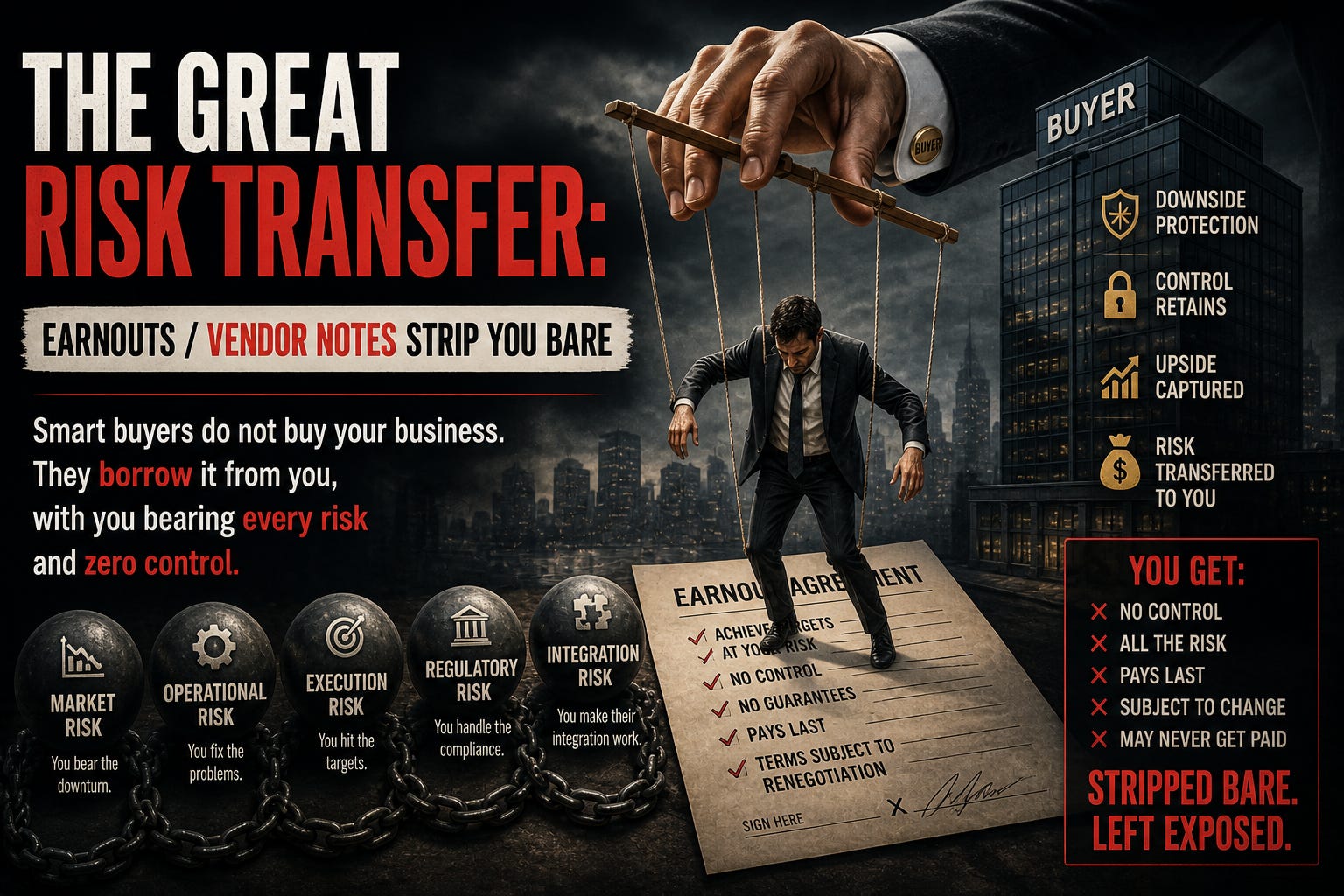
You sell your business. You stay on as “advisor.” Six months later, the buyer freezes hiring, delays the product launch, and reassigns your best engineers. Your earnout evaporates. Your vendor note gets subordinated. You watch your life’s work decay from the sidelines. This is not bad luck. This is the design.
10 KEY TAKEAWAYS, RISK TRANSFER MECHANICS
Earnouts shift every operational risk to the seller: Market risk, execution risk, integration risk, all yours.
The control paradox is the trap: You bear the consequences while the buyer holds every lever.
Vendor financing makes you a creditor of your own former business: You sold it, then loaned them the money to buy it.
Subordination kills vendor notes: Banks, institutional lenders, and trade creditors all stand in front of you.
Below market interest rates compound the injury: Vendor note rates rarely compensate for the actual unsecured credit risk.
Buyers exploit founder’s optimism: Your confidence in your business becomes the buyer’s negotiation lever.
COVID exposed the structure: Earnouts negotiated in 2019 collapsed in 2020 through no fault of the sellers.
You have no recourse against operational decisions: Lawyers will tell you, technically, the buyer breached nothing.
The fear of walking away is engineered: Buyers count on it to pull sellers across the line on bad terms.
Cash is king, everything else is expensive wallpaper: Hang it on the wall, but do not confuse it with money.
📚 READING PREREQUISITES
This post extends Post 1’s earnout math into the structural mechanics of risk transfer. Read it after Post 1 for full context.
Recommended Prior Reading:
The Control Paradox, Where Sellers Become Spectators
When you sign an earnout, you sign something that has never made sense in any other commercial context. You agree to be financially responsible for outcomes you do not control. You agree to be measured against targets you cannot influence. You agree that someone else gets to decide whether your retirement happens.
The buyer’s toolbox of legal but devastating moves includes the following:
Redirecting resources to other portfolio companies that compete for capital.
Delaying product launches whose timing affects your earnout calculation.
Implementing hiring freezes that prevent the sales team from meeting growth targets.
Reassigning your best engineers to “urgent strategic projects” elsewhere in the buyer’s portfolio.
Pivoting the business model mid earnout because the strategic narrative demands it.
Implementing cost saving measures that sacrifice short term revenue.
Changing accounting policies that quietly redefine “earnout achievement.”
Each of these decisions is, in isolation, defensible business judgment. Collectively, they constitute what experienced M&A attorneys call a “soft default.” The buyer never breaches the contract. They simply manage the business in ways that ensure the contractual targets are not met.
The seller’s recourse? Effectively none. You cannot sue someone for making business decisions that happen to also reduce your earnout. The contract you signed gave them that authority. That is what “the sale” actually transferred.
The COVID Stress Test
The 2020 to 2021 period exposed earnout structures with brutal clarity. Sellers who had signed deals in 2019 with ambitious 2020 to 2024 earnout targets watched their entire structure evaporate through no fault of their own. The economic shutdown was not a buyer breach. It was not a seller breach. It was a market event that happened to fall entirely into the seller’s lap because the contract had transferred market risk to the seller.
The lesson generalizes. Whatever the specific shock, recession, supply chain disruption, regulatory change, technology disruption, the earnout structure ensures that exogenous risks land on the seller. The buyer’s only exposure is the discounted present value of payments they were never going to make in full anyway.

The Vendor Financing Double-Edged Chainsaw
If earnouts are bad, vendor financing is worse. Vendor financing is the structure where the seller loans money to the buyer to purchase the seller’s own business. It is sold as “sophisticated” and “tax efficient” and “flexible.” It is, in practice, a mechanism for compounding seller risk at below market interest rates.
You become a creditor of your former business. Congratulations, you are now both the seller and the lender. If the business struggles under new ownership, you watch your life’s work deteriorate while potentially losing your vendor note. It is a front row seat to your own financial execution.
Subordination nation. Your vendor note typically gets subordinated to everyone else’s debt. Banks get paid first. Institutional lenders get paid second. Trade creditors get paid third. You get whatever is left, which is often nothing but experience and regret. The order of priority depends on who holds first security, but the structural reality is that you are at the bottom of the queue.
Below market interest rates. Vendor financing rates are usually laughably low compared to the actual credit risk. Five or six percent on an unsecured note to a leveraged acquirer is not credit risk pricing, it is charity pricing. You are taking on unsecured debt risk and getting paid like it is a government bond. You would not lend at those rates to anyone else. Why are you lending at those rates to the person who just bought your business?
The renegotiation trap. Even when the business performs well and the buyer has the money, they often find a way to renegotiate the note. “We need the funds for working capital.” “Market conditions require restructuring.” “We are willing to give you a discount for early payment of a smaller amount.” The vendor note is the easiest debt for an acquirer to attack because the creditor, you, is emotionally compromised. You want the deal to work. The buyer knows it.
Case Study Coming in This Post: Albert “Slide” Collins and the $14 Million That Wasn’t
(See full case study at the end of this post.)
The Psychology of Getting Played
Buyers who structure these deals are not villains. They are professionals. Their job is to maximize buyer returns, and risk transfer to the seller is a textbook tactic. The reason it works so consistently is that sellers are emotionally compromised in ways that even smart sellers underestimate.
Anchoring with big numbers. The buyer leads with a headline that creates a psychological anchor. Twenty million. Thirty million. Whatever the number, it warps the seller’s processing of every subsequent term.
Exploiting entrepreneur optimism. You built a successful business, so you believe you can navigate the earnout period and hit the targets. This overconfidence bias leads sellers to accept terms that a dispassionate analyst would reject in five minutes.
Fear of walking away. The fear of “leaving money on the table” drives sellers to accept risky structures rather than take a lower cash offer. But the money on the table is hypothetical. The risk is real.
Sunk cost commitment. By the time the structure is on the table, the seller has spent months in due diligence, paid hundreds of thousands in legal and advisory fees, and emotionally committed to the exit. Walking away feels like throwing it all away. Buyers know this and time their structure proposals accordingly.
The discipline that defeats these tactics is dispassion. Run the math. Run it twice. Compare to alternatives. If the cash equivalent number is not better than the next best offer, walk. The buyer who refuses to improve the structure is telling you exactly how they intend to behave during the earnout.
