

The following is a fictional case study created for educational purposes. Names, characters, businesses, and events are invented, and any resemblance to real people or companies is coincidental.
The Setup
Wayne Gretzky Logistics, a fictional Winnipeg based cold chain trucking company, hauled temperature controlled freight for food and pharmaceutical clients across the prairies. Founder Dorothy Gretzky had grown it to 14 million dollars in revenue and 2.1 million in EBITDA. A standalone valuation at a 4.5x multiple pointed to roughly 9.5 million dollars. Dorothy’s advisor told her the real number depended entirely on which buyer they put in the room.
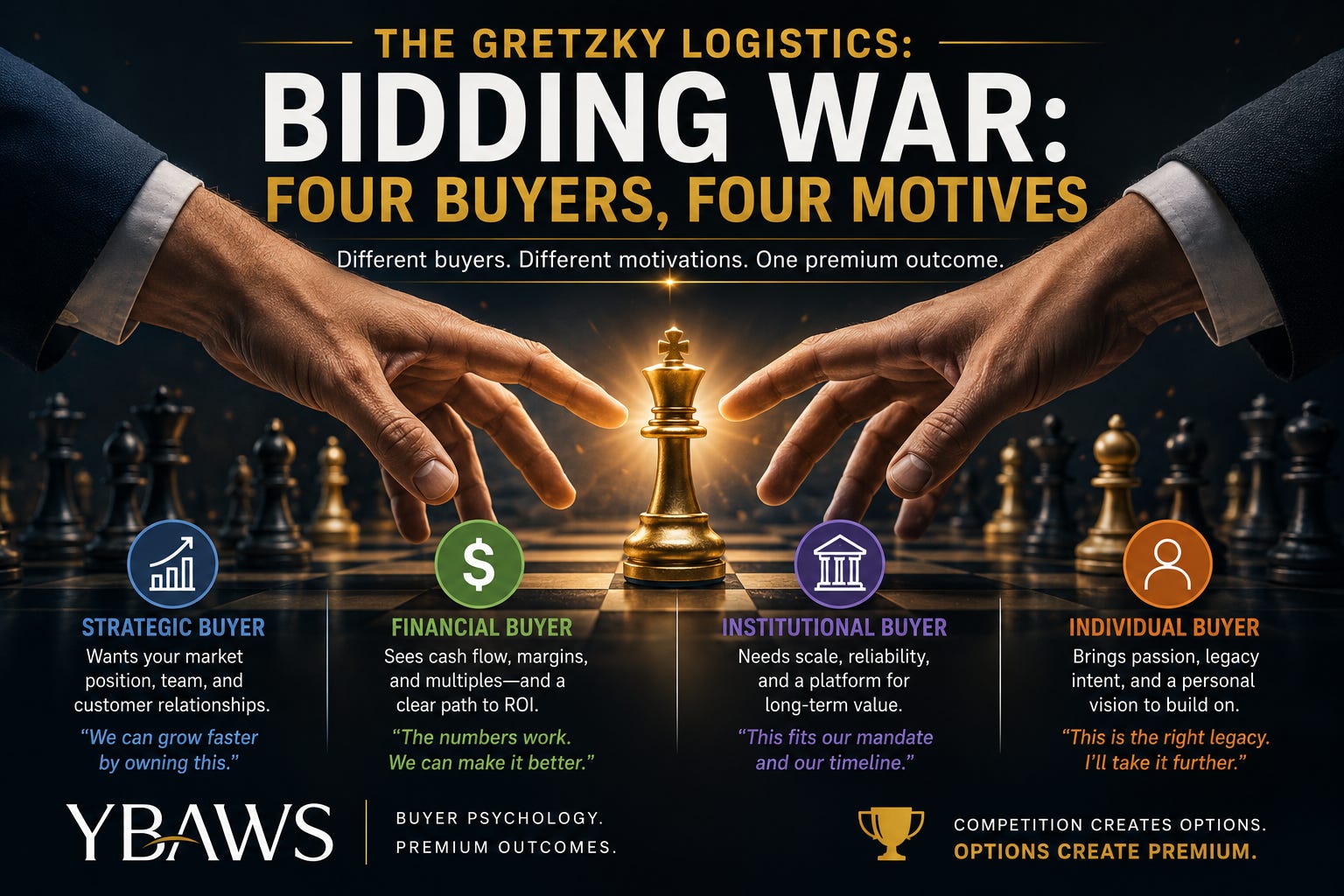
So they put four very different buyers in the room, each for a different reason.
Buyer One: The Competitor Who Feared Loss
Howe Freight Systems was Dorothy’s largest regional rival. For Howe, the threat was not Gretzky Logistics itself, it was the idea of a national carrier acquiring Gretzky and gaining instant prairie density. Howe was not buying trucks, it was buying the elimination of a future competitor on its home turf. Howe opened at 10.5 million, already above the standalone figure, driven by fear of what losing the deal would mean.
Buyer Two: The Customer Securing Supply
Orr Foods, a fast growing frozen meals producer, was one of Dorothy’s biggest clients. A supply disruption during peak season would be catastrophic for Orr. By acquiring Gretzky, Orr would lock in guaranteed cold chain capacity and remove the margin it currently paid out. The synergy math was simple: owning the carrier removed a cost Orr was already absorbing. Orr bid 11.8 million, justified entirely by internal savings invisible to anyone outside its books.
Buyer Three: The Private Equity Roll Up
Lemieux Capital was assembling a regional logistics platform and had raised a fund now in its fourth year. The clock was ticking. Gretzky Logistics was the missing prairie piece in a coverage map Lemieux planned to sell as a national network within 18 months. With 70 percent debt financing, Lemieux’s equity return math turned a fair price into an attractive one. The deployment deadline added urgency. Lemieux bid 12.5 million, valuing Gretzky not standalone but as the final component of a much larger exit.
Buyer Four: The Strategic National Carrier
Richard National Transport wanted prairie density without spending three years building terminals and recruiting drivers. Buying Gretzky compressed years of expansion into a single transaction. For Richard, the premium was the price of time. It bid 13.2 million dollars.
Becoming Informed
Dorothy did not sit back and collect offers. She researched each bidder’s motive in advance. She knew Howe feared a national entrant, knew Orr’s peak season exposure, knew Lemieux’s fund timeline, and knew Richard’s build versus buy calculation. Armed with that knowledge, she positioned Gretzky Logistics to each buyer as the specific solution to their specific problem, not as a generic trucking company.
The Squeeze
With four motivated buyers, Dorothy’s advisor ran a disciplined competitive process. Each finalist learned, without breaching confidence, that serious rivals were at the table. Richard National, unwilling to let a competitor gain prairie density and facing genuine fear of missing out, raised its final offer to 14.6 million dollars in cash.
The Result
Gretzky Logistics sold for 14.6 million, a multiple near 7x EBITDA and roughly 54 percent above the standalone estimate. The revenue and income never moved. What moved was the room. Four buyers, each chasing a different prize, turned a fair price into a premium.
The Lesson
