

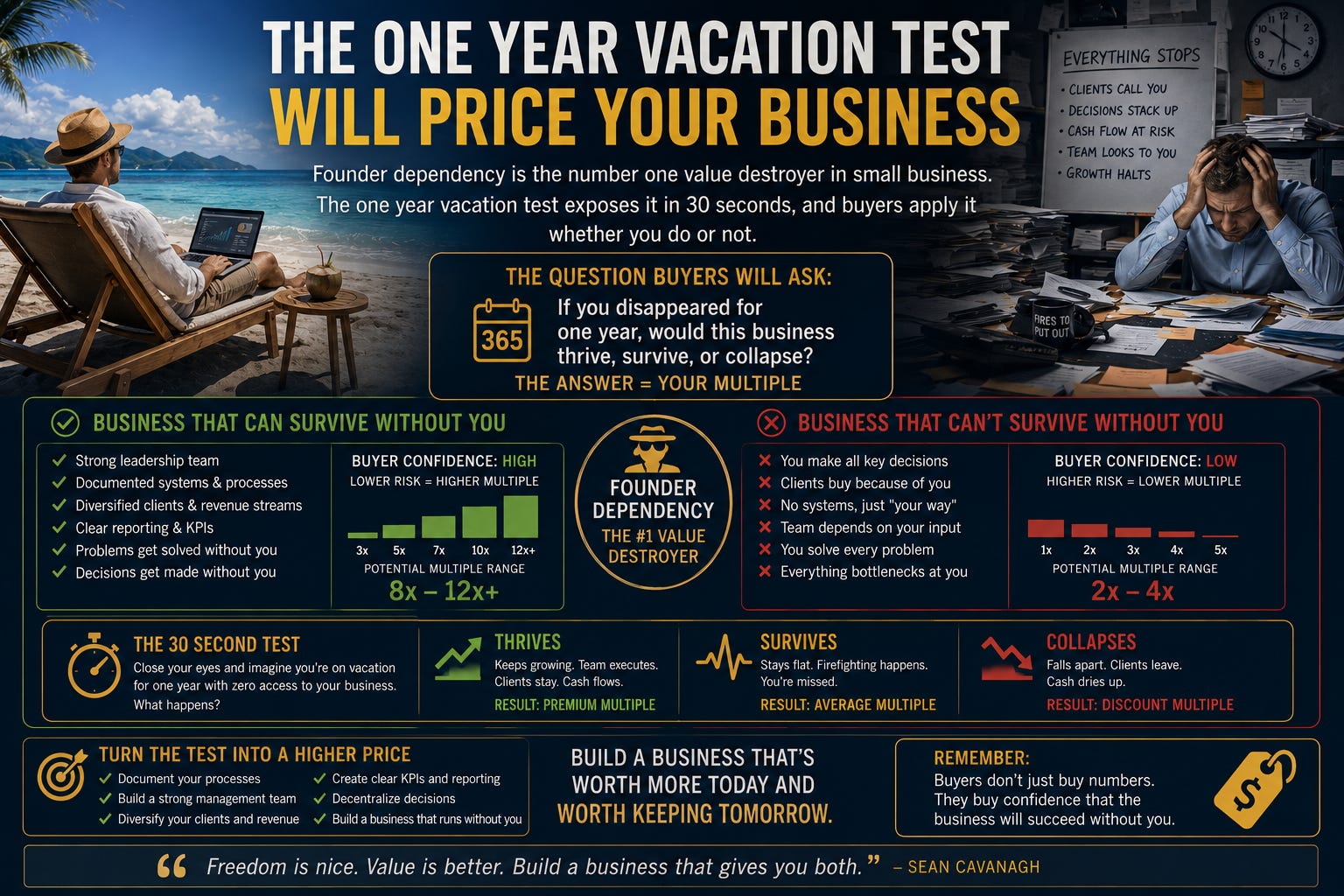
Founder dependency is the number one value destroyer in small business, and it hides behind praise. Here is the test. You leave tomorrow for one year. No calls, no email, no exceptions. What is left when you get back? If the honest answer is wreckage, you do not own a business.
10 KEY TAKEAWAYS, FOUNDER DEPENDENCY AND VALUE
The test is one sentence: Could the business run for one year without you, starting tomorrow?
A job with inventory: If the answer is no, you own employment with complicated accounting.
Indispensable is an insult: Being essential to operations is the most expensive compliment you will ever accept.
Buyers test this before you do: Due diligence is largely an exercise in finding out what depends on the owner.
The multiplier collapses on discovery: Founder dependency does not shave the price, it re prices the deal.
Vision is not operations: Jobs mattered to Apple’s vision, not to whether the line ran on Tuesday.
Documentation converts risk to asset: Written process is the cheapest premium reduction available.
Cross training is insurance you get paid for: It lowers key person premium and raises retention.
Deal structure follows dependency: Owner dependent sellers get earnouts, systems dependent sellers get cash.
Below, the full case: Two manufacturers, identical earnings, a seventy seven million dollar difference.
📚 READING PREREQUISITES
Each post in this series builds on technical groundwork laid in earlier entries. The content progresses in depth and complexity, so prior understanding matters. Key valuation concepts, models, and metrics are revisited across multiple posts on purpose. Repetition is deliberate, not filler, because these foundations stay central to every later analysis.
Recommended Prior Reading:
The Question That Ends Most Valuation Meetings
Here is my favourite question for business owners. What would happen to your business if you took a one year vacation starting tomorrow?
If your honest answer is anything other than “it would operate perfectly without me,” then you do not own a business. You own a job with inventory and receivables.
I watch faces when I ask this. The confident ones laugh and say the place would fall apart in a week, as though that were a credential. It is the opposite. They have just told me their enterprise value is contingent on a human being who intends to leave.
Does Richard Branson run Virgin day to day? No. Did Microsoft collapse when Bill Gates retired? No. Did Apple fail when Steve Jobs died? No. Does Warren Buffett manage Berkshire’s subsidiaries? Not likely.
THESE ARE NOT BUSINESSES THAT DEPEND ON THEIR FOUNDERS. THEY ARE SYSTEMS THAT OPERATE INDEPENDENTLY.
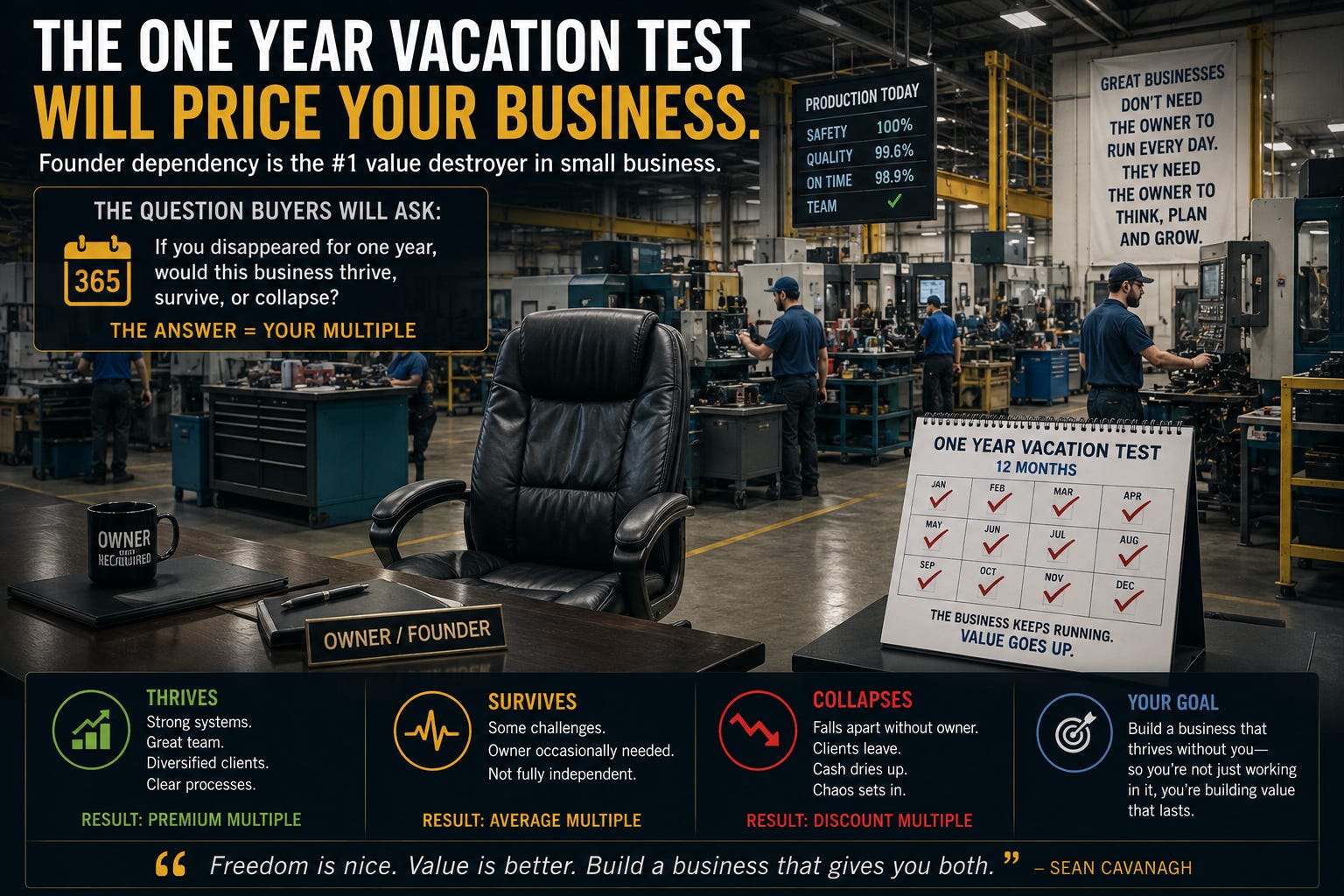
Key person dependency is not an abstract concern. It is a line item. Buyers and their advisers actively hunt for it during due diligence, because it is the fastest way to find out whether the cash flow they are buying will still exist in eighteen months.
What they look for:
Whether customer relationships sit with the company or with you personally
Whether pricing decisions require your approval
Whether anyone else can sign, hire, fire, or commit the business
Whether the operating knowledge is written anywhere at all
Whether your compensation is a real market salary or a distribution in disguise
When buyers figure this out, and they will, your valuation multiplier collapses. Not softens. Collapses. Research from Class VI Partners and Nash Advisory on key man risk makes the same point from the buy side that I make from the sell side.
And it does not stop at price. Dependency drives structure. The buyer who pays a premium multiple is the one who sees a low risk, systems dependent operation. The buyer who structures a deal that hurts you is the one who sees a high risk, founder dependent operation, and who therefore needs an earnout to transfer the risk back onto you. Read that again. Dependency does not just lower your number, it keeps you working for the buyer.
Be the Vision, Not the Ego
Handing over operations does not mean handing over the company. It means you keep the part that only you can do.
Apple was created in a garage on April 1, 1976, in Cupertino, California by three men.
Steve Jobs, the visionary and driving force for design, branding, and consumer focus
Steve Wozniak, the engineering genius who designed the first Apple computer
Ronald Wayne, who drafted the original partnership agreement and the logo
I would bet you have only heard of the visionary. Not the creator, and certainly not the lawyer. Vision is where the fame comes from. Jobs is gone and his legacy is intact, and almost nobody knows the operating details of what he built.
Fun fact worth sitting with. Ronald Wayne sold his 10 percent stake twelve days later for $800. He retired to a mobile home in Pahrump, Nevada, collects stamps and rare coins, and lives modestly. I admire him most of the three, for not spending forty years destroying himself over it. Gold medal character.
I admire Wozniak for cashing out when Jobs dropped the ball on the Apple II and started a public knife fight with John Sculley, the CEO Jobs had hired himself. And I admire Jobs for the vision, while noting that his micromanagement destroyed Apple the first time, which is precisely what YBAWS! warns about. When Bill Gates had to bail out Apple for antitrust reasons, Jobs picked the wand back up with the iPod, the iPad, and the iPhone. Pixar was cool too.
THE TAKEAWAY:
Know when you have value, then step away when you do not.
Keep your eye on your value, do not stray from your expertise.
Keep some skin in the game, you never know what will happen.
BE THE VISION, NOT THE EGO, AND YOU CAN HAVE BOTH.
[IMAGE 2: ybaws16b-vision-vs-operations.png, a split panel, left side labelled VISION with a founder sketching, right side labelled OPERATIONS with a team running a documented process. Alt text: “Founder vision versus operations diagram showing why owners should retain vision and delegate daily operations.”]
The Work That Passes the Test
Founder dependency is the number one value destroyer in small businesses. It is also the most fixable, if you have the discipline to do the work.
Write down what only you know. Start with the twenty decisions you make weekly. Turn each into a rule somebody else can apply. This is the single highest return hour in your week.
Move relationships to the company. Introduce a second face to every major account, put contacts in a shared system, and stop being the only phone number a customer has.
Hire or promote a real second in command. Someone with authority to be wrong. If they must check with you, you have hired an assistant, not a manager.
Cross train against the documents. Two people deep on every critical function, tested by actually rotating them, not by intending to.
Take the test in miniature. Leave for two weeks with your phone off. Whatever breaks is your project list. Then try a month. Then a quarter.
Pay yourself a market salary. Buyers normalize your compensation anyway. Doing it yourself proves the earnings survive replacing you.
Every one of these converts a key person risk premium into documented, transferable capability. That is not defensive housekeeping. That is the highest return capital project available to you, and it is described well by Finerva’s work on exit valuation.
YOUR BUSINESS IS ONLY AS VALUABLE AS ITS ABILITY TO SURVIVE WITHOUT YOU.
💡 KEY TAKEAWAYS
Remember These Core Principles:
Take the test honestly: Answer for one year starting tomorrow, not for a good week in July.
Indispensable equals unmarketable: The praise you enjoy is the premium a buyer will charge you.
Document before you delegate: Delegation without written process just moves the dependency.
Structure follows dependency: Owner dependent sellers get earnouts, systems dependent sellers get cash at closing.
Start with a two week trial: Whatever breaks while you are gone is your value creation plan.
❓ FREQUENTLY ASKED QUESTIONS
Q: What is the one year vacation test in business valuation?
A: It asks what would happen to your company if you left for a full year starting tomorrow. If operations, customers, or cash flow degrade, the business carries key person risk, which raises the buyer’s required return and lowers the valuation multiple.
Q: How much does founder dependency reduce business value?
A: It varies by severity, but a heavy key person premium commonly adds five to ten points to a buyer’s required return. On an otherwise 16 percent return, adding seven points moves a 6.3 times multiple to roughly 4.3 times, cutting value by about a third.
Q: I am the best salesperson in my company. Is that founder dependency?
A: Yes, and it is the most common form. If revenue requires your personal relationships, a buyer is purchasing a business that walks out the door with you. Build a second seller and shift accounts to the company before you go to market.
Q: Will a buyer accept an employment agreement instead?
A: Sometimes, and it usually costs you. Transition agreements and earnouts shift risk back to the seller, tie your money to performance you no longer fully control, and delay your exit by one to three years.
Q: How long does it take to fix founder dependency?
A: Plan on 24 to 36 months. Documentation takes weeks, but buyers pay for evidence, meaning a management team with a track record of operating while you were genuinely absent.
🎯 READY TO BUILD A BUSINESS THAT DOES NOT NEED YOU?
Understanding founder dependency is one piece of building a valuable, marketable business.
Subscribe to YBAWS! for weekly insights on business valuation, M&A strategy, and maximizing your company’s worth. Join business owners who are building more valuable, marketable businesses through unvarnished truth about business exits.
Have questions about your specific situation? Drop a comment below or reach out directly, I respond to every message.
📖 RELATED READING
Calder Capital, The Effects of Owner Dependence on Business Valuation: Quantifies how owner involvement shows up in transaction pricing.
Class VI Partners, Business Owner Dependence: Explains why the risk hides in middle market companies that look healthy.
Nash Advisory, Understanding Key Man Risk: A practical checklist of what acquirers look for during diligence.