

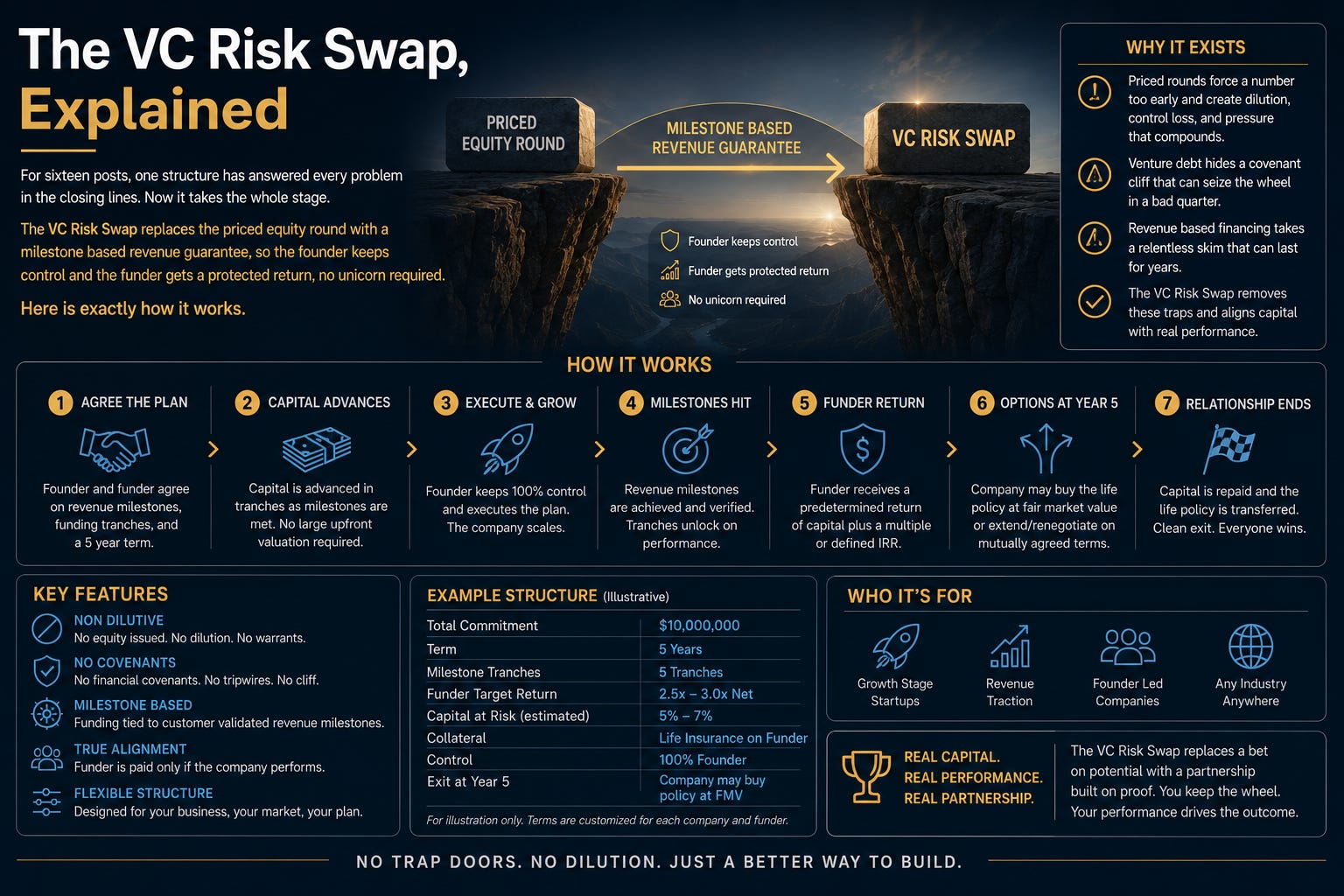
Every post in this series ended the same way, with a structure that quietly solved the problem the post had just described. It is time it stepped out of the footnotes. The VC Risk Swap is a simple idea with a radical consequence: funding that finally works for the founder and the funder at the same time.
What the VC Risk Swap Actually Is
Strip it to the studs and the VC Risk Swap is a swap of one thing for another. Instead of a priced equity round, where a founder sells shares at a valuation both sides have to fight over, the company and the funder agree to a milestone based revenue guarantee that plays out across several periods. The funder provides capital now. The company commits to delivering a defined, protected return over time, measured against milestones the business actually reaches rather than a number negotiated in a conference room.
The whole arrangement is backstopped by company owned coverage for business continuity, so that if the plan runs into trouble, the funder’s return has a cushion underneath it, without anyone having to seize the company to collect. That backstop is what lets the funder relax and the founder breathe at the same time.
The word swap earns its place here. A traditional round asks the funder to swap cash for a slice of ownership and a bet on a distant exit. This structure swaps that bet for something far more grounded, a defined return tied to the company’s own performance over time. Same capital going in, a completely different promise coming back, and a completely different relationship in between.
Notice what never happens. No shares change hands. No valuation is set. No board seat is created. No exit is required. It is capital that behaves like a partnership built around real performance, not a bet placed on a lottery ticket, and that single design choice is what quietly dismantles every problem the last sixteen posts described.
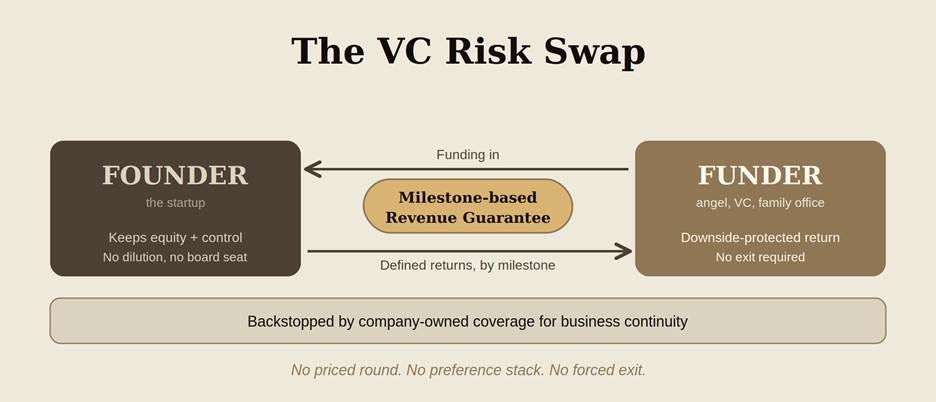
The VC Risk Swap, at a glance.
What the Founder Gets
Start with the side everyone worries about first. The founder keeps full equity and control straight through commercialization. There is no dilution, no board seat handed over, no veto to grant, and no distorted valuation to argue against a market warped by deals the company will never be part of. The ownership and the decisions both stay where they started.
From there the other pain points fall away in sequence. Because value returns through milestones rather than a sale, there is no exit treadmill, no forced initial public offering into a bricked shut exit market, no fire sale, and no seven to ten year clock ticking in the background. Because the funding is committed across periods rather than dripped out one round at a time, there is no perpetual twelve month fundraising scramble and no bridge to nowhere. And because the coverage backstop absorbs a rough patch, a bad quarter does not trip a covenant or hand anyone the wheel. Valuation, control, exit, and the endless raise, all four, answered by one structure.
What the Funder Gets
This is the half most people miss, and it is the reason the whole thing holds together. A structure that only helped founders would be charity, and charity does not scale. The VC Risk Swap gives the funder a defined, downside protected return, backed by the milestone structure and the company owned coverage, without ever needing the company to become a unicorn, go public, or get acquired
.For a funder in 2026, that is a profound relief. There is no dependence on the frozen exit market to see a dollar back. There is no need to be the one in ten fund returner that carries a whole portfolio, and no need to reserve endlessly for follow on rounds in a market where the funds that write them are vanishing. Instead the funder gets patient, protected exposure to a real business, on a schedule, with a cushion if the team walks or the plan stumbles.
In effect, the funder trades a lottery ticket for something closer to a bond that is tied to a living company. The ceiling is lower than a fantasy unicorn exit. The floor is dramatically higher. And in a market where the overwhelming majority of venture bets return nothing at all, a defined, protected, evidence based return is not a consolation prize. It is the smarter side of the table.
Why It Works When Nothing Else Does
The quiet genius of the VC Risk Swap is that it aligns two parties who are normally at war. A priced equity round is a tug of war over a single number: every point of valuation the founder wins, the funder loses, and every point the funder claws back, the founder resents. The Swap simply removes the rope. With no valuation to argue and no equity to divide, both sides suddenly want the exact same thing, for the company to hit its milestones and generate real revenue. When a market has split in two and abandoned everyone outside AI, a structure that makes funder and founder allies instead of adversaries is not a small improvement. It is a different game.
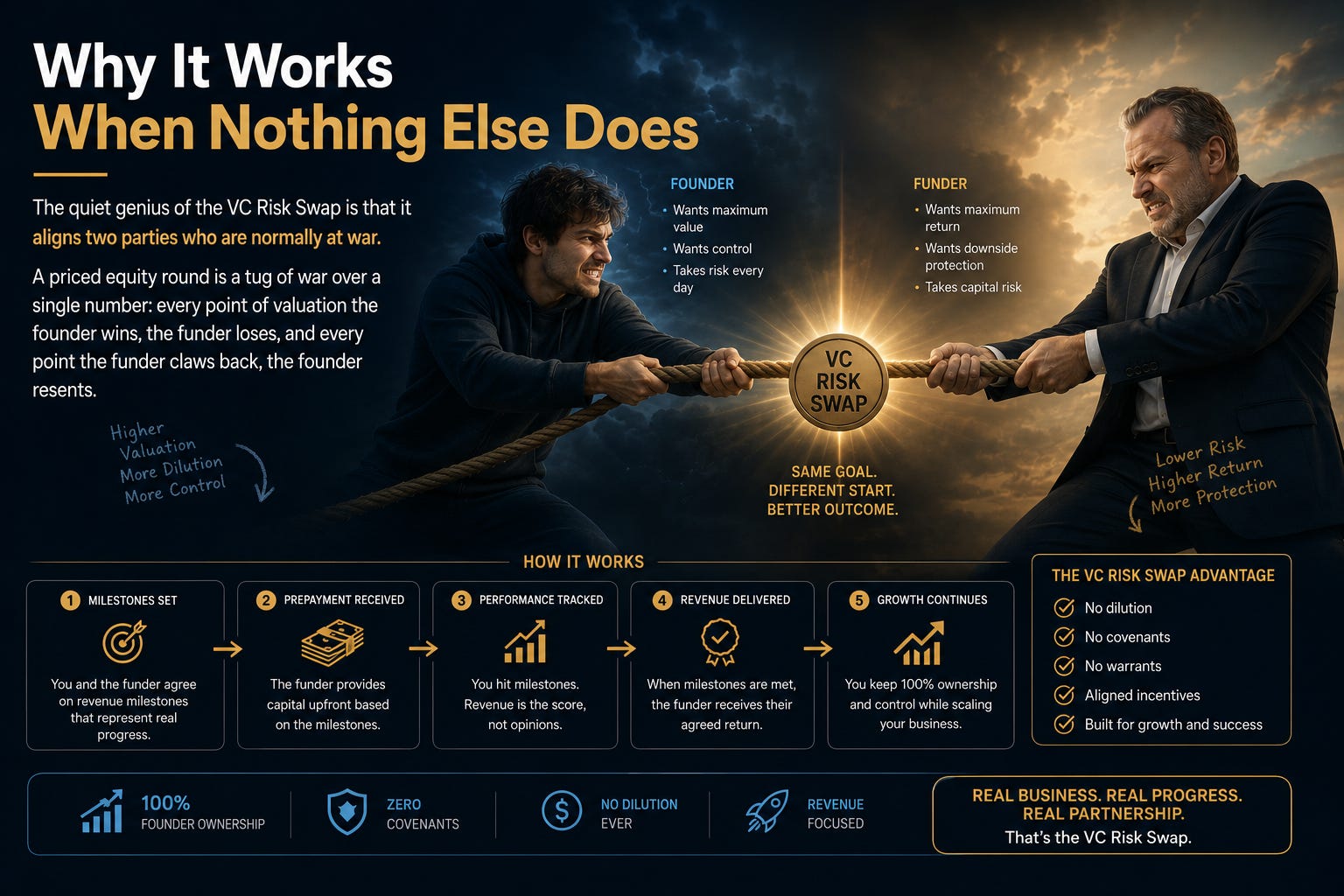
It also fills the one gap the new capital stack could not. Grants and credits fund the research. Customer cash proves the demand. But the growth scale cheque, the money that takes a proven business and lets it truly scale, had only one bad option left, the priced round and all its damage. The VC Risk Swap is that cheque without the round. It is the keystone the stack was missing, the piece that lets a founder fund a company from first prototype to real scale without ever walking into a valuation fight.
An honest word to close. The Swap is not for everyone. A pre revenue moonshot with no near term path to revenue still needs the deep patience that only equity provides, and that is exactly what traditional venture capital was built to do well. The VC Risk Swap is built for the other company, the real business with real or approaching revenue that the venture market has spent this entire series abandoning. For that founder, and for the funder willing to back them, it is not merely an alternative. It is the structure that should have existed all along, and the reason every post in this series ended where it did.
Subscribe to SaferWealth for more field notes from the part of the funding world the venture market overlooks, plus the structures that fund good companies on their own terms.
Questions about your specific situation? Reach out directly at riskswap@saferwealth.com.
CONNECT WITH SAFERWEALTH
