

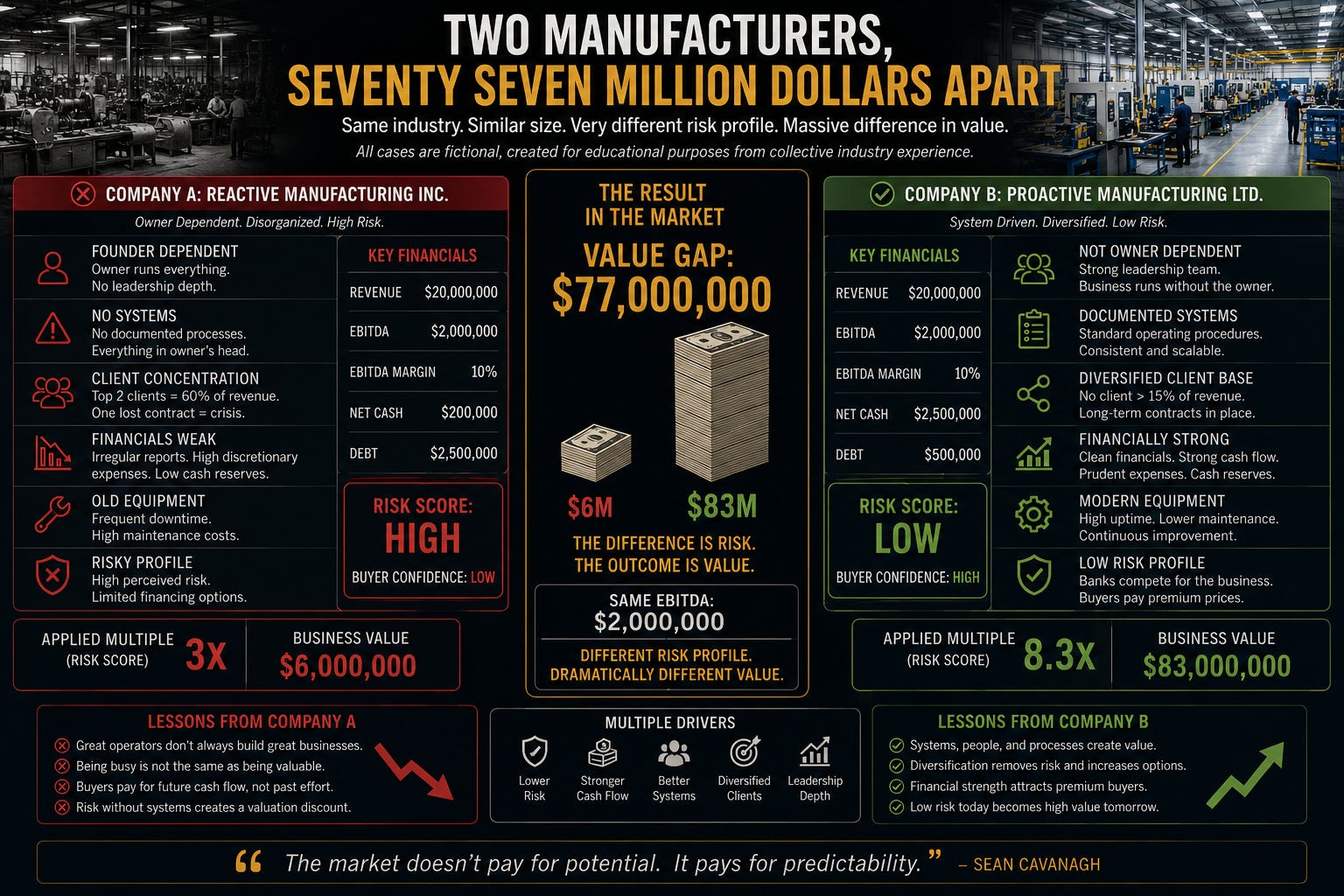
All cases are fictional, created for educational purposes from collective industry experience.
The Setup
Two manufacturing companies. In 2019 both reported $25 million of revenue and $4 million of EBITDA. Same sector, same customer base profile, same regional economy. Three years later, one sold for $85 million and the other barely avoided bankruptcy.
The financial statements could not tell them apart. The one year vacation test could have told them apart in a single meeting.
MidState Manufacturing, The Sheep
Buddy Guy ran his company the way most entrepreneurs do, reactively and personally.
Customer concentration sat at 70 percent across the top three accounts. Buddy managed every one of those relationships himself, because “nobody understands this business like I do.” He was proud of that sentence. He used it as a closing argument.
There were no documented processes. Pricing, scheduling, quality escalation, and vendor selection all ran through his judgment, applied in the moment, recorded nowhere. There was no succession plan and no second in command with authority. Cash reserves did not exist beyond working capital, because retained cash felt like lazy money.
Nothing about this was unusual. That is the point. It is the default configuration of a profitable small manufacturer.
The Shock
COVID arrived. MidState’s largest customer cut orders by 60 percent and simultaneously extended payment terms from 30 days to 90. Revenue fell and the cash conversion cycle stretched at the same moment, which is the combination that kills companies.
Two weeks later, Buddy was hospitalized for three weeks.
That is the whole test, administered by reality instead of by me. With no documented processes and no trained management team, operations collapsed. Nobody could authorize a price concession. Nobody knew which vendor substitutions were acceptable. Nobody had the relationship equity to ask the largest customer for a conversation instead of a cancellation.
The Collapse
They burned through cash reserves in 60 days. Key employees, sensing the drift, left for competitors. The second largest customer quietly qualified an alternative supplier and never came back. The bank froze the credit line on covenant violations, which removed the last option.
Buddy came back from the hospital to find his life’s work in free fall. By late 2020 they sold to a competitor for $8 million, barely enough to cover the debts. Twenty years of building was destroyed in eight months.
YBAWS! THIS WAS COMPLETELY PREDICTABLE AND COMPLETELY PREVENTABLE.
Precision Components, The Wolf
T Bone Walker ran an identical business on paper and a completely different business underneath.
In 2018 he had the same problem Buddy had, a top customer at 50 percent of revenue. He treated it as an emergency rather than a testimonial. By 2019 he had brought it down to 25 percent, deliberately, by building service offerings that smaller accounts could buy.
He held $3 million in cash reserves plus established credit facilities he did not need, which is the only time you can get them.
More importantly for our purposes, he had documented every critical process and cross trained employees against those documents. He recruited a capable chief operating officer with real authority and implemented succession planning that named actual people. He invested in automation and redundant systems, so single points of failure did not exist on the floor.
T Bone could have taken a one year vacation. He never did, but the business did not know that.
The Same Shock, A Different Outcome
When COVID struck, Precision Components executed a predetermined crisis strategy rather than inventing one under stress. They drew on credit immediately, while lenders were still lending. They negotiated extended supplier terms from a position of visible strength. Instead of cutting staff, they retrained people and upgraded equipment during the slow period.
Then came the part that separates professionals from survivors. When competitors started failing, Precision Components had the capital and the management bandwidth to buy. They acquired equipment at 30 cents on the dollar and hired talent out of failing competitors, including people who had been unreachable at any price eighteen months earlier.
They emerged from the crisis with 40 percent more capacity and a genuinely diversified customer base. In 2022 they sold for $85 million.
The Tale of the Tape
MetricMidState ManufacturingPrecision Components2019 revenue$25 million$25 million2019 EBITDA$4 million$4 millionTop customer concentration70 percent top three25 percent top oneDocumented processesNoneCompleteManagement depthOwner onlyCOO plus cross trained staffCash reservesWorking capital only$3 million plus facilitiesOutcomeSold for $8 millionSold for $85 millionDifference$77 million
The Reading
Notice what did not differ. Not the industry. Not the earnings. Not the crisis, which hit both companies in the same quarter with the same force.
What differed was whether the business could function without one specific human being. Buddy’s hospitalization was not the cause of his collapse, it was the disclosure of a condition that already existed. If it had not been the hospital it would have been a divorce, a heart attack, a bad quarter, or simply an acquirer asking the right question in diligence.
T Bone’s advantage was not foresight about a pandemic. Nobody had that. His advantage was that he had already paid the price of independence, so when the shock arrived he was free to be opportunistic while his competitors were busy being present.
The $77 million valuation difference was not about luck. It was about systematic risk management and the discipline to become unnecessary.
Which business owner are you going to be
🎯 READY TO BE A BUYER IN THE NEXT DOWNTURN INSTEAD OF A SELLER?
Understanding how crises redistribute wealth is one piece of building a valuable, marketable business.
Subscribe to YBAWS! for weekly insights on business valuation, M&A strategy, and maximizing your company’s worth. Join business owners who are building more valuable, marketable businesses through unvarnished truth about business exits.
Have questions about your specific situation? Drop a comment below or reach out directly, I respond to every message.
📖 RELATED READING
Investopedia, Business Cycle: The mechanics of expansion and contraction, so you stop treating the turn as a surprise.
AuditBoard, Enterprise Risk Management Fundamentals: A practical framework for turning scenario planning into a repeatable process.
Investopedia, Stress Testing: How to model shocks against your own balance sheet before a lender does it for you.