

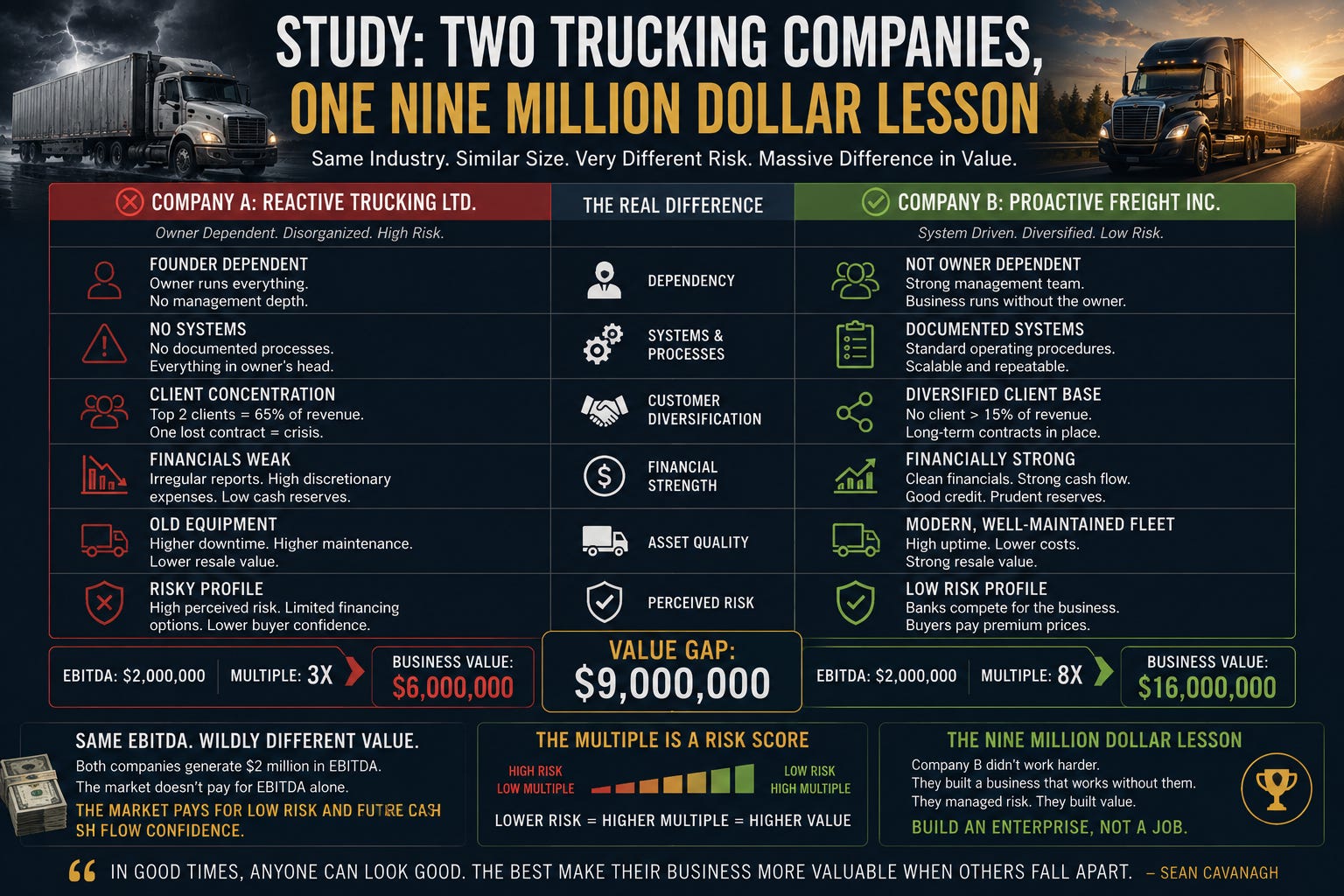
The Setup
Two regional trucking companies. I valued both within six months of each other. Superior Logistics, owned by Bessie Smith, ran $8.0 million of revenue and $1.6 million of EBITDA. Metro Freight, owned by Stevie Ray Vaughan, ran $8.2 million of revenue and $1.7 million of EBITDA. On the income statement, Metro Freight was the better company.
Five years earlier, both owners received the same harsh assessment from me. Both were told their businesses were unmarketable because of excessive risk. Bessie got to work. Stevie Ray got offended.
Bessie’s Four Workstreams
Customer diversification. Her top customer was 65 percent of revenue. She built standardized service packages for smaller accounts, put a formal sales process behind a CRM, and set a hard ceiling of 25 percent for any single customer. By year four the top account was 22 percent of revenue across 47 active accounts.
Operational risk reduction. Every driver was cross trained on multiple routes and equipment types. She contracted three separate maintenance providers instead of one. She installed GPS tracking and route optimization. She wrote detailed standard operating procedures for every critical function, so the business ran on documents rather than memory.
Financial risk management. She built $800,000 of cash reserves, roughly six months of operating expenses. She established a $1.2 million credit facility split across two banks. She moved to monthly financial reporting with variance analysis. She spread fuel purchasing across multiple suppliers with hedging contracts.
Management depth. She hired an experienced operations manager away from a competitor, promoted a senior driver into fleet manager with a written succession plan, funded training and retention, and published a formal organizational chart with clear authority.
Total invested over four years: $275,000.
The Premium by Premium Result
Risk CategoryYear 1 PremiumYear 4 PremiumCustomer concentration8 percent2 percentOperational6 percent1 percentManagement and key person7 percent2 percentFinancial4 percent1 percentTotal company specific premium25 percent6 percent
Total required return fell from 35 percent to 16 percent.
The Arithmetic
Year 1: $1.6 million divided by 35 percent equals $4.6 million, a 2.9 times multiple
Year 4: $1.6 million divided by 16 percent equals $10.1 million, a 6.3 times multiple
Value increase: $5.4 million
Investment: $275,000
Return on investment: 1,964 percent
EBITDA never moved. Not one dollar. The entire gain came out of the denominator.
Bessie sold Superior Logistics for $10.8 million to a strategic buyer who specifically cited exceptional operational systems and management depth as justification for the premium price. She got paid for the boring work.
Stevie Ray’s Five Years
Stevie Ray’s answer to the same assessment was memorable. “You do not understand my business. My customers have been with me for 15 years. I do not need your fancy risk management.”
Concentration got worse. His top customer grew from 60 percent to 78 percent of revenue. He read that as growth. “They are expanding, so we are growing with them.” No new account development. Every egg in one very large basket, and somebody else was carrying the basket.
Operations stayed in his head. He was the only person who knew the customer relationships. No cross training. The same maintenance shop for 20 years, owned by his brother in law. No backup systems, no contingency plans, no written procedures.
Finances stayed thin. $45,000 in the business checking account. No credit facility beyond equipment financing. Basic bookkeeping with annual tax preparation only. He extended 60 day terms to his largest customer without security.
Management stayed absent. He made every decision, signed every contract, held every relationship. No documented process, no succession plan. High turnover because there was nowhere to advance. His wife handled the office with no formal authority.
The Trigger
In March of year five, Metro Freight’s largest customer was acquired by a national competitor with its own logistics network. Contract terminated on 90 days notice. Seventy eight percent of revenue, gone with a quarter of warning.
The Collapse
Half a million dollars of monthly revenue disappeared at once. Fixed costs did not. Truck payments, insurance, and rent kept arriving. The bank called the equipment loans on revenue covenant violations. Employees left for competitors offering stability, and because nothing was documented, their knowledge left with them. Stevie Ray started selling equipment to make payroll and loan payments.
By September, Metro Freight was insolvent. He sold the remaining assets to a competitor for $1.8 million, barely enough to clear the debt. After payments, he netted roughly $200,000 for 20 years of work.
The Tale of the Tape
MetricSuperior LogisticsMetro FreightStarting valuation$4.6 million$4.8 millionExit price$10.8 million$1.8 millionValue changeplus $6.2 millionminus $3.0 millionRisk investment$275,000$0Net outcomeplus $5.9 millionminus $3.0 millionTotal difference$9.0 million
The Lesson
Metro Freight started with higher earnings and ended with almost nothing. Superior Logistics started with lower earnings and ended with a premium exit. The $9.0 million gap was not luck, not market conditions, not industry trends.
Bessie understood that every business faces a crisis eventually, so she built one that could survive without her. Stevie Ray believed relationships and experience made him invulnerable. He confused revenue with value and customer loyalty with business security.
Risk management is not paranoia. It is mathematics. Every risk you ignore becomes a value destroyer. Every risk you systematically address becomes a competitive advantage.
Which business owner are you going to be?Subscribe Now
Have questions about your specific situation? Drop a comment below or reach out directly, I respond to every message.
📖 RELATED READING
AICPA and CIMA, Strategic Value of Risk Management: How structured risk management creates measurable firm value.
Investopedia, Enterprise Risk Management: The framework connecting preparation to protected and created value.
Calder Capital, Effects of Owner Dependence: Why systems dependent businesses command premium multiples.
CONNECT WITH SAFERWEALTH
Web: SaferWealth.com, Alternative Startup Funding Structures
YouTube: @CapitalToolKit, Business valuation and M&A education
LinkedIn: LinkedIn @SaferWealth, Startup Finance Innovation
Rumble: @saferwealth, Educational video content
Instagram: @saferwealth, Quick insights and updates
👤 ABOUT THE AUTHOR
Sean Cavanagh, BAS, CPA, CA, CF, CBV
With over three decades negotiating business sales and conducting valuations, Sean delivers unvarnished truth about business exits. Starting at Deloitte and Canada Revenue Agency, he now advises business owners through his M&A practice. YBAWS! reflects his frustration with owners who consistently overvalue their companies.
Connect with Sean:
📚 DO YOUR OWN RESEARCH
Professional Standards & Organizations:
Risk Management Frameworks:
Key Terms & Definitions:
This section empowers readers to verify information, explore topics deeper, and develop their own informed perspectives on business valuation principles.
⚖️ EDUCATIONAL DISCLAIMER
This guide provides information only, not professional advice. Consult qualified advisors for your specific situation. All cases are fictional, created for educational purposes from collective industry experience. Neither the author nor YBAWS! accepts liability for actions based on this content. This material supplements but never replaces proper professional consultation and judgment.
YBAWS! (Your Business Ain’t Worth Sh*t!) is a trademark and educational platform dedicated to helping business owners understand corporate value and marketability.
© 2026 YBAWS! All rights reserved.