

Multiple Choice Questions
On $2 million EBITDA, a low risk business at an 8x multiple is worth:
a) $6 million b) $10 million c) $16 million d) $20 millionA 3x multiple represents what required rate of return?
a) 20% b) 25% c) 33% d) 50%The one year vacation test measures:
a) How profitable your business is
b) Whether your business can operate without you
c) Your customer satisfaction levels
d) Your market share positionWhat happens to valuation multiples when buyers discover founder dependency?
a) They increase b) They remain unchanged c) They collapse dramatically d) They become irrelevantTrue or False: Reducing risk can increase business value without increasing earnings.
According to the post, founder dependency is described as:
a) An unavoidable feature of small business
b) The number one value destroyer, and the most fixable
c) A benefit that buyers reward
d) Irrelevant to valuationTrue or False: A 20x multiple corresponds to a 5% required rate of return.
Which Apple founder sold his 10% stake twelve days in for $800?
a) Steve Jobs b) Steve Wozniak c) Ronald Wayne d) John SculleyThe difference in value between a $6 million and $16 million outcome on the same $2 million EBITDA is driven by:
a) Revenue growth b) Industry choice c) Risk profile d) Tax structureTrue or False: The post argues you should be the ego, not the vision, to maximize value.
Essay Questions
Explain how the same $2 million EBITDA can produce a $10 million range in value, using the multiplier math.
Describe the one year vacation test and what it reveals about owning a business versus a job.
Explain why founder dependency is the number one value destroyer and how it affects buyer perception.
Explain the “be the vision, not the ego” principle using the Apple founders example.
Using the Ferraro Marine Fabrication case, explain how James raised value by making himself optional.
SOLUTIONS, ASSESSMENT 2
Multiple Choice Answers
c) $16 million, since $2 million multiplied by 8 equals $16 million.
c) 33%, since 3x equals 1 divided by 0.33.
b) Whether your business can operate without you.
c) They collapse dramatically, once dependency is detected.
True, cutting risk raises the multiple on the same earnings.
b) The number one value destroyer, and the most fixable.
True, since 20x equals 1 divided by 0.05.
c) Ronald Wayne, who sold for $800.
c) Risk profile, since earnings and industry are held constant.
False, the post says be the vision, not the ego.
Essay Answers
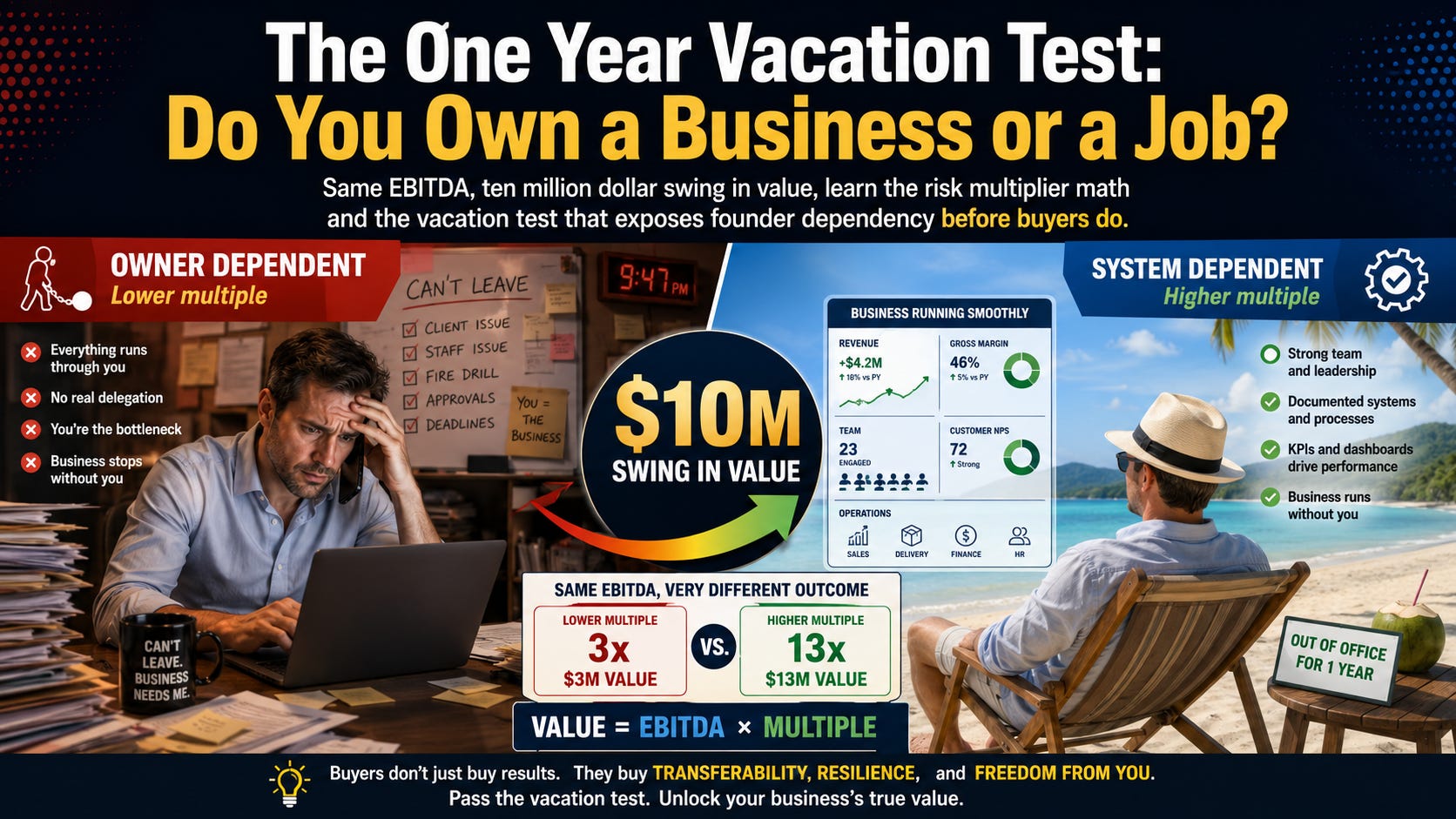
Value equals EBITDA multiplied by a risk based multiple, and the multiple is the inverse of the required return. On $2 million EBITDA, a high risk business at 3x is worth $6 million, a medium risk business at 5x is worth $10 million, and a low risk business at 8x is worth $16 million. Same earnings, same industry, yet a $10 million spread driven purely by risk. This shows that value can be created by lowering risk, not only by growing income.
The one year vacation test asks what would happen to the business if the owner left for a year starting tomorrow. If the honest answer is anything other than “it would run perfectly,” the owner has built a job with inventory and receivables rather than a business. It reveals whether the company is a system that operates independently, which buyers reward, or a founder dependent operation, which buyers heavily discount.
Founder dependency is the top value destroyer because the owner becomes a single point of failure whose knowledge and relationships do not transfer in a sale. When buyers detect it, they see risk they cannot insure against, and the multiple collapses. It is also the most fixable risk, because management depth, documentation, and delegation can convert a person dependent operation into a transferable system, which restores the multiple.
Apple was founded by Steve Jobs, Steve Wozniak, and Ronald Wayne, yet most people know only Jobs, the visionary. Vision is where fame and enduring legacy come from, while operational detail fades. The principle is that founders should own the vision and let capable people run operations, because clinging to operational control, as Jobs’s early micromanagement showed, can nearly destroy even a great company. Being the vision, not the ego, lets an owner have both influence and a transferable business.
James was the indispensable founder who quoted, designed, and decided everything. He hired a general manager, promoted supervisors, documented fabrication processes into an operations manual, formalized estimating, diversified customers to a 20% cap, and professionalized finance, investing about $400,000 over twenty months. He even tested the result with a two week absence that the shop handled well. His company specific premium fell from 23% to 8%, lifting the multiple from about 3x to about 5.5x, and combined with EBITDA growth to $2.3 million, value rose from roughly $6 million to roughly $12.65 million. Making himself optional was the primary driver.
⚖️ EDUCATIONAL DISCLAIMER
This assessment provides information only, not professional advice. All cases are fictional, created for educational purposes from collective industry experience. Consult qualified advisors for your specific situation. © 2026 YBAWS! All rights reserved.