

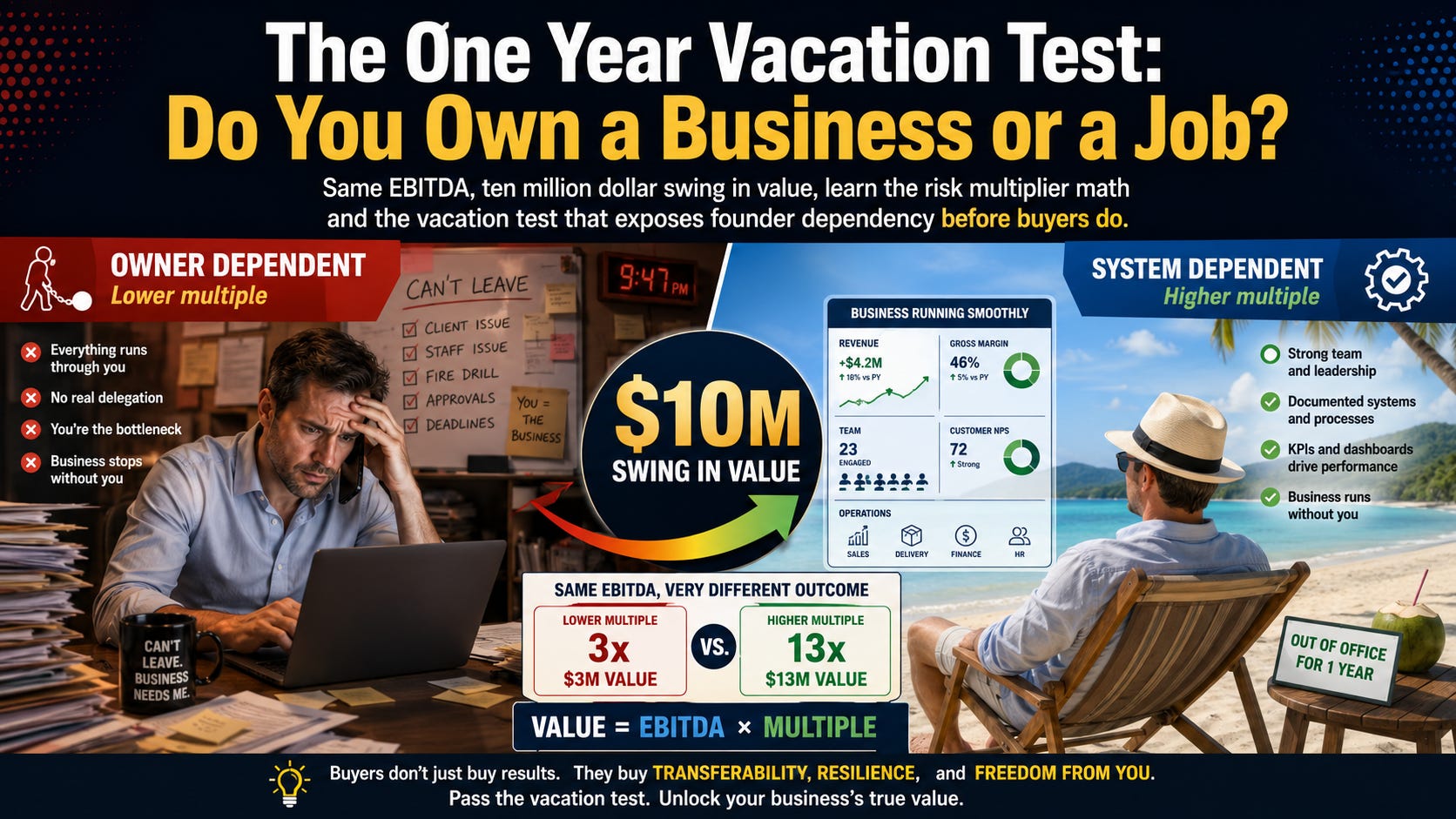
Same two million EBITDA. A ten million dollar difference in value. The gap is risk, and founder dependency is the number one destroyer. Ask yourself one question: if you took a one year vacation tomorrow, would your business run perfectly, or collapse? Your honest answer reveals whether you own a business or a job.
10 KEY TAKEAWAYS, THE VACATION TEST
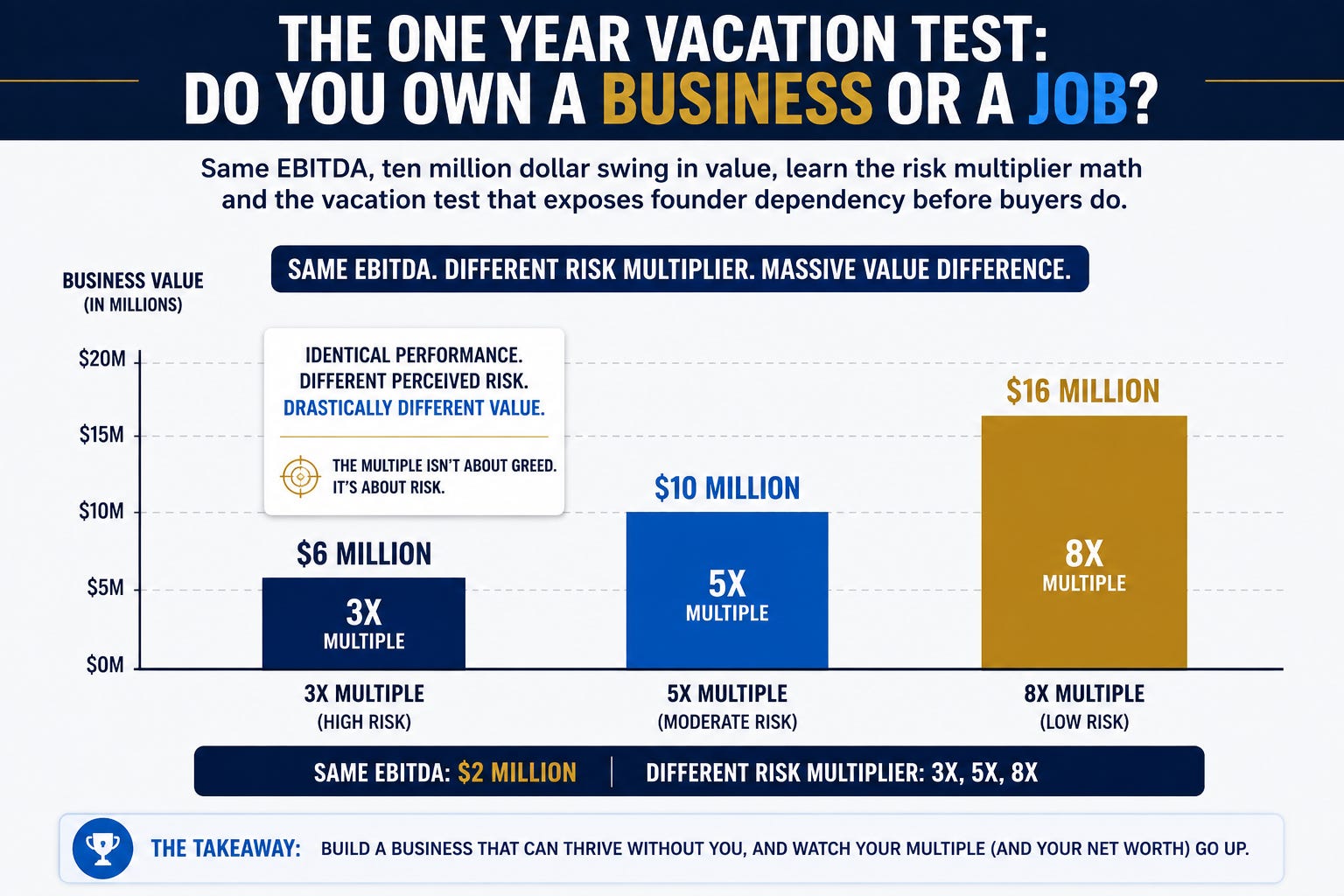
Same EBITDA, different value: A $2 million EBITDA can be worth $6 million or $16 million on risk alone.
The multiplier measures risk: A 3x multiple means a 33% required return, pure risk pricing.
Lower risk multiplies value: Cut the required return and your multiple, and value, climb.
The vacation test is brutal: If it cannot run without you, you own a job, not a business.
Founder dependency kills value: It is the number one destroyer, and the most fixable.
Be the vision, not the ego: Great founders own the vision and let others run operations.
Systems earn premiums: Buyers pay up for businesses that work without the owner.
You can be a liability: If you hold everything together, you are a risk, not an asset.
Value without more earnings: Reducing risk raises value without growing income.
Legacy beats micromanagement: Vision endures, micromanagement nearly destroyed even Apple.
📚 READING PREREQUISITES
This post applies the valuation formula and the multiplier logic from earlier chapters to founder dependency. You should already understand that your multiple is the inverse of your required rate of return.
Recommended Prior Reading:
The Mathematics of Risk, This Gets Expensive Fast
Let us do some math, because too many owners believe valuation is determined by wishful thinking and retirement needs rather than financial analysis. Your company has $2 million EBITDA. Congratulations. Now, what is your risk multiplier worth?
High risk business: $2 million multiplied by 3 equals $6 million value
Medium risk business: $2 million multiplied by 5 equals $10 million value
Low risk business: $2 million multiplied by 8 equals $16 million value
Same earnings, same industry, same market conditions, and a $10 million difference in enterprise value based purely on risk profile. The multiplier is a measure of the risk in your business. A 3x represents a required rate of return of 33%, meaning an investor needs 33% annually to compensate for the risk of owning your business.
The multiplier and the risk it prices:
2x equals 1 divided by 50%, a disaster waiting to happen
3x equals 1 divided by 33%, risky but might survive
5x equals 1 divided by 20%, getting serious about business
10x equals 1 divided by 10%, building something special
20x equals 1 divided by 5%, operating like a professional
Decrease your risk, and you decrease the required return, which increases your multiplier, which multiplies your value. That is simple arithmetic with profound implications, and it means you can raise value without raising earnings. For the foundation, the Corporate Finance Institute EBITDA multiple guide and Investopedia on the EV to EBITDA multiple map the mechanics.
The One Year Vacation Test
Here is my favorite question for owners: what would happen to your business if you took a one year vacation starting tomorrow? If your honest answer is anything other than “it would operate perfectly without me,” then you do not own a business. You own a job with inventory and receivables.
Does Richard Branson run Virgin day to day? No. Did Microsoft collapse when Bill Gates stepped back? No. Did Apple fail when Steve Jobs died? No. These are not businesses that depend on their founders, they are systems that operate independently. That is what buyers pay premiums for, businesses that work without the owner.
Why founder dependency destroys value:
The owner becomes a single point of failure buyers cannot insure against
Knowledge and relationships do not transfer in a sale
The multiplier collapses the moment a buyer sees the dependency
The owner has built a liability disguised as an asset
Founder dependency is the number one value destroyer in small businesses. It is also the most fixable, if you have the discipline to do the work. Finerva on key person dependency and Calder Capital on owner dependence both quantify exactly how buyers discount for it.
Be the Vision, Not the Ego
Handing over operations lets you own the vision, and that is where enduring value lives. Consider Apple, founded in 1976 by three men. You know Steve Jobs the visionary. You likely do not know Steve Wozniak, the engineer who designed the first Apple computer, or Ronald Wayne, who drafted the original agreement and logo and sold his 10% stake twelve days later for $800.
Vision is where fame and legacy come from. Jobs is gone, yet his legacy endures as an icon of innovation, while few recall the operational details. Even so, Jobs’s micromanagement nearly destroyed Apple the first time, exactly what YBAWS! warns against. The lesson is to be the vision, not the ego, and you can have both.
The takeaway on knowing your value:
Know when you hold value, and step away when you do not
Keep your eye on value and do not stray from your expertise
Keep some skin in the game, because you never know what will happen
💡 KEY TAKEAWAYS
Remember These Core Principles:
Risk sets the multiple: The same EBITDA is worth wildly different amounts based on risk.
Take the vacation test: If the business cannot run without you, fix that first.
Founder dependency is fixable: It is the top value destroyer and the most correctable.
Own the vision: Hand over operations and lead from strategy, not daily control.
Raise value without earnings: Cutting risk multiplies value on the same profit.
❓ FREQUENTLY ASKED QUESTIONS
Q: How can the same EBITDA be worth so differently?
A: Because value equals EBITDA multiplied by a risk based multiple. A $2 million EBITDA is worth $6 million at 3x but $16 million at 8x. The multiple is the inverse of the required return, so lowering risk raises value without changing earnings.
Q: What is the one year vacation test?
A: It asks what would happen to your business if you left for a year starting tomorrow. If the honest answer is anything other than “it runs perfectly,” you own a job rather than a business, and buyers will price that founder dependency as a heavy discount.
Q: Why is founder dependency the number one value destroyer?
A: Because the owner becomes a single point of failure whose knowledge and relationships do not transfer in a sale. When buyers detect it, the multiple collapses. It is also the most fixable risk through management depth and documentation.
Q: How do I reduce founder dependency?
A: Build a capable management team, document processes and relationships, remove yourself from routine decisions, and shift your role to vision and strategy. The goal is a system that operates and grows without your daily involvement.
🎯 READY TO PASS THE VACATION TEST?
Understanding founder dependency is just one piece of building a valuable, marketable business.
Subscribe to YBAWS! for weekly insights on business valuation, M&A strategy, and maximizing your company’s worth. Join business owners building more valuable, marketable businesses through unvarnished truth about exits.
Have questions about your specific situation? Drop a comment below or reach out directly, I respond to every message.
📖 RELATED READING
Finerva, Key Person Dependency and Exit Valuation: How founder reliance suppresses exit multiples.
Calder Capital, Effects of Owner Dependence: A practitioner view of owner dependency and value.
Investopedia, EV to EBITDA Multiple: The mechanics behind the multiple that prices your risk.
CONNECT WITH SAFERWEALTH
Web: SaferWealth.com, Alternative Startup Funding Structures
YouTube: @CapitalToolKit, Business valuation and M&A education
LinkedIn: LinkedIn @SaferWealth, Startup Finance Innovation
Rumble: @saferwealth, Educational video content
Instagram: @saferwealth, Quick insights and updates
👤 ABOUT THE AUTHOR
Sean Cavanagh, BAS, CPA, CA, CF, CBV
With over three decades negotiating business sales and conducting valuations, Sean delivers unvarnished truth about business exits. Starting at Deloitte and Canada Revenue Agency, he now advises business owners through his M&A practice. YBAWS! reflects his frustration with owners who consistently overvalue their companies.
Connect with Sean:
📚 DO YOUR OWN RESEARCH
Professional Standards & Organizations:
Key Person Risk & Founder Dependency:
Key Terms & Definitions:
This section empowers readers to verify information, explore topics deeper, and develop their own informed perspectives on business valuation principles.
⚖️ EDUCATIONAL DISCLAIMER
This guide provides information only, not professional advice. Consult qualified advisors for your specific situation. All cases are fictional, created for educational purposes from collective industry experience. Neither the author nor YBAWS! accepts liability for actions based on this content. This material supplements but never replaces proper professional consultation and judgment.
YBAWS! (Your Business Ain’t Worth Sh*t!) is a trademark and educational platform dedicated to helping business owners understand corporate value and marketability.
© 2026 YBAWS! All rights reserved.