

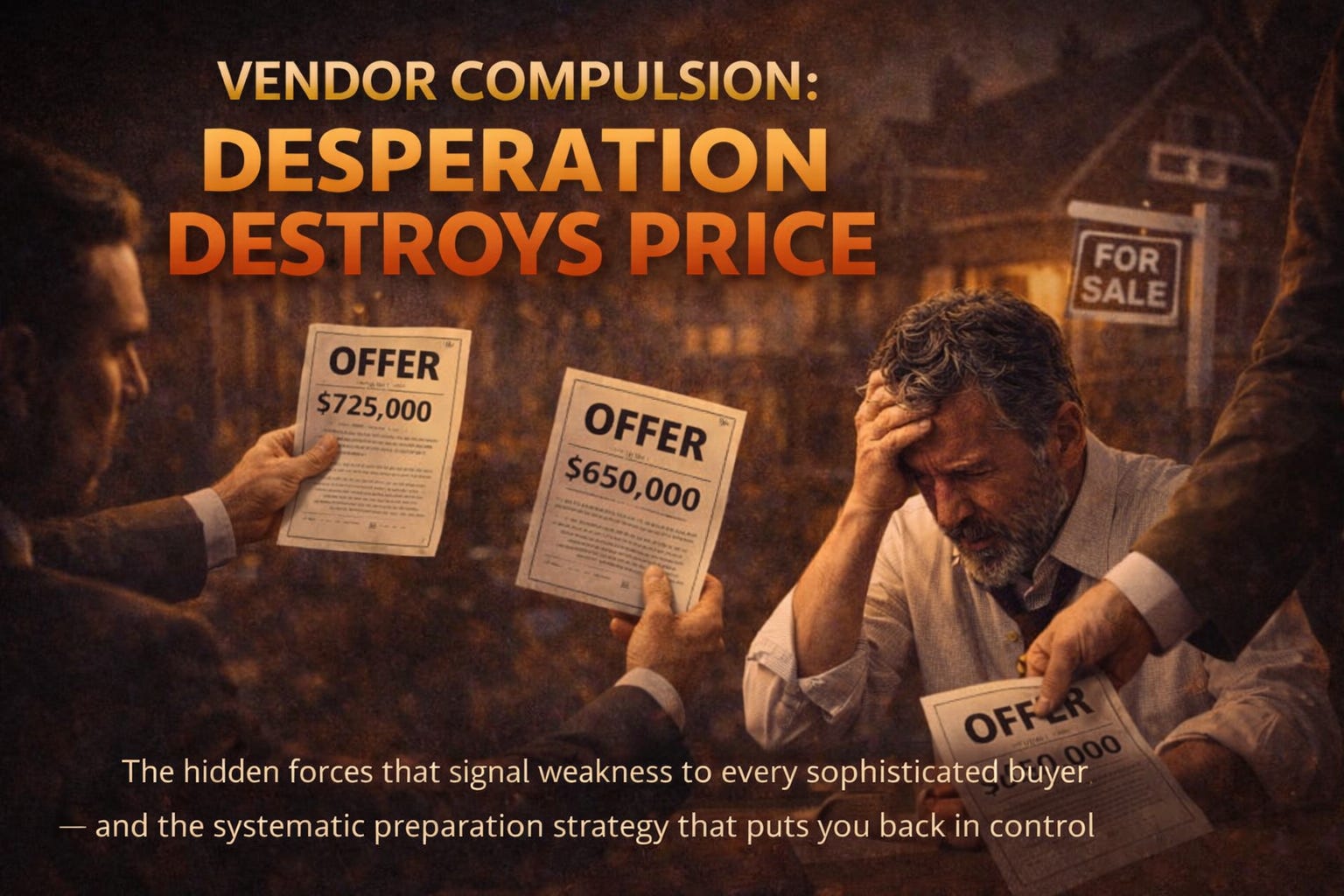
Most business owners spend years building a company, then hand millions of dollars back to the buyer in the final weeks of a sale. Not because of bad financials. Not because of a weak product. Because the buyer figured out they needed to sell.
Vendor compulsion is the single most expensive mistake in any business exit, and almost no one talks about it.
10 Key Takeaways
Compulsion is universal — every seller has some form of it; the question is whether you manage it or let it manage you.
The compulsion paradox — a truly compulsion-free seller rarely sells at all, because there is no motivating pressure to transact.
Three pillars define sale readiness — Financial Independence, Operational Independence, and Strategic Independence work together to build genuine freedom.
Buyers read pressure signals — timeline constraints, cash flow cracks, and owner dependency are visible to sophisticated acquirers long before you realize it.
Preparation must precede need — building readiness when you don’t need to sell is the only way to maintain pricing power.
The Freedom Formula is mathematical — seller compulsion raises perceived risk in the denominator of Value = Income ÷ Required Rate of Return, directly cutting your multiple.
Buyers have compulsion too — fund deployment deadlines, activist investor pressure, and quarterly reporting constraints create urgency you can exploit.
Personal financial independence removes the gun from your head — if you don’t need the proceeds, every negotiation shifts from need to choice.
Operational systemization protects you personally — a business that runs without you isn’t just more valuable, it eliminates the health or burnout scenario that forces a distressed sale.
Premium exits are engineered, not stumbled into — the sellers who extract the highest prices spend years building the conditions before they list.
Reading Prerequisites
This post builds on foundational YBAWS! concepts introduced in earlier chapters. Readers will find this material most valuable after reviewing the risk framework from Chapter 2 (the four categories of business risk that quietly become compulsion triggers), the systemization principle from Chapter 1 (founder dependency as a forced-sale vulnerability), and the core valuation formula from Chapter 6 (Value = Income ÷ Required Rate of Return). Each of those concepts reappears here with new consequence. The YBAWS! series is designed so that each chapter increases in analytical complexity, and this post reflects that progression.
The Vendor’s Compulsion Paradox
The Fair Market Value definition that governs most business transactions requires parties to act “under no compulsion.” That sounds straightforward. In practice, it creates one of the most misunderstood dynamics in any exit.
A seller with zero compulsion almost never sells. If there is no pressure at all, financial, personal, strategic, or circumstantial, what motivates the transaction? The truly compulsion-free seller is building their business and accumulating wealth. They are not in the market.
This is the paradox: some motivating force always exists. The question is not whether compulsion is present. The question is how visible it is, and who controls the narrative around it.
Sophisticated buyers, whether private equity firms or strategic acquirers, are trained to find compulsion. They are not evaluating only your business. They are evaluating your pressure level. They look for timeline constraints, cash flow weakness, key person dependency, and any signal that you need this deal more than they do.
When they find it, they use it.
The Three Pillars of Sale Readiness
Building genuine freedom to reject inadequate offers requires systematic preparation across three distinct dimensions:
Financial Independence means your personal financial situation never forces a business sale. If your lifestyle depends entirely on business distributions, experienced buyers will sense it. Building personal liquid reserves, diversified investments, and income sources outside the business removes the gun from your head in any negotiation.
Operational Independence means your business runs profitably without your daily involvement. Founder-dependent businesses are doubly dangerous: they carry a valuation discount because transferability is uncertain, and they trap owners in unsustainable situations that eventually create burnout pressure or health-related forced sales. Every system you build, every process you document, every layer of management you develop, reduces this risk on both fronts.
Strategic Independence means your business has multiple growth paths and multiple potential exit options. Single-buyer dependence is a single point of failure. When you have only one interested party, they know it, and they price accordingly.

Why the Formula Punishes Compulsion Mathematically
Chapter 6 established the foundational valuation equation: Value = Income ÷ Required Rate of Return.
Seller compulsion does not affect your income. It affects the denominator.
When a buyer perceives you are under pressure, they assign higher risk to the transaction. That elevated risk increases their required rate of return. A higher required rate of return produces a lower multiple. Lower multiple applied to the same income produces a lower price. The compelled seller loses value not because the business deteriorated, but because the buyer perceived instability and priced it in.
The CBV Institute, which governs Chartered Business Valuator standards in Canada, recognizes this dynamic explicitly in its valuation guidance: risk perception directly shapes the discount rates applied in any income-based approach.
This is why preparation is not a soft concept. It is a mathematical lever.
