

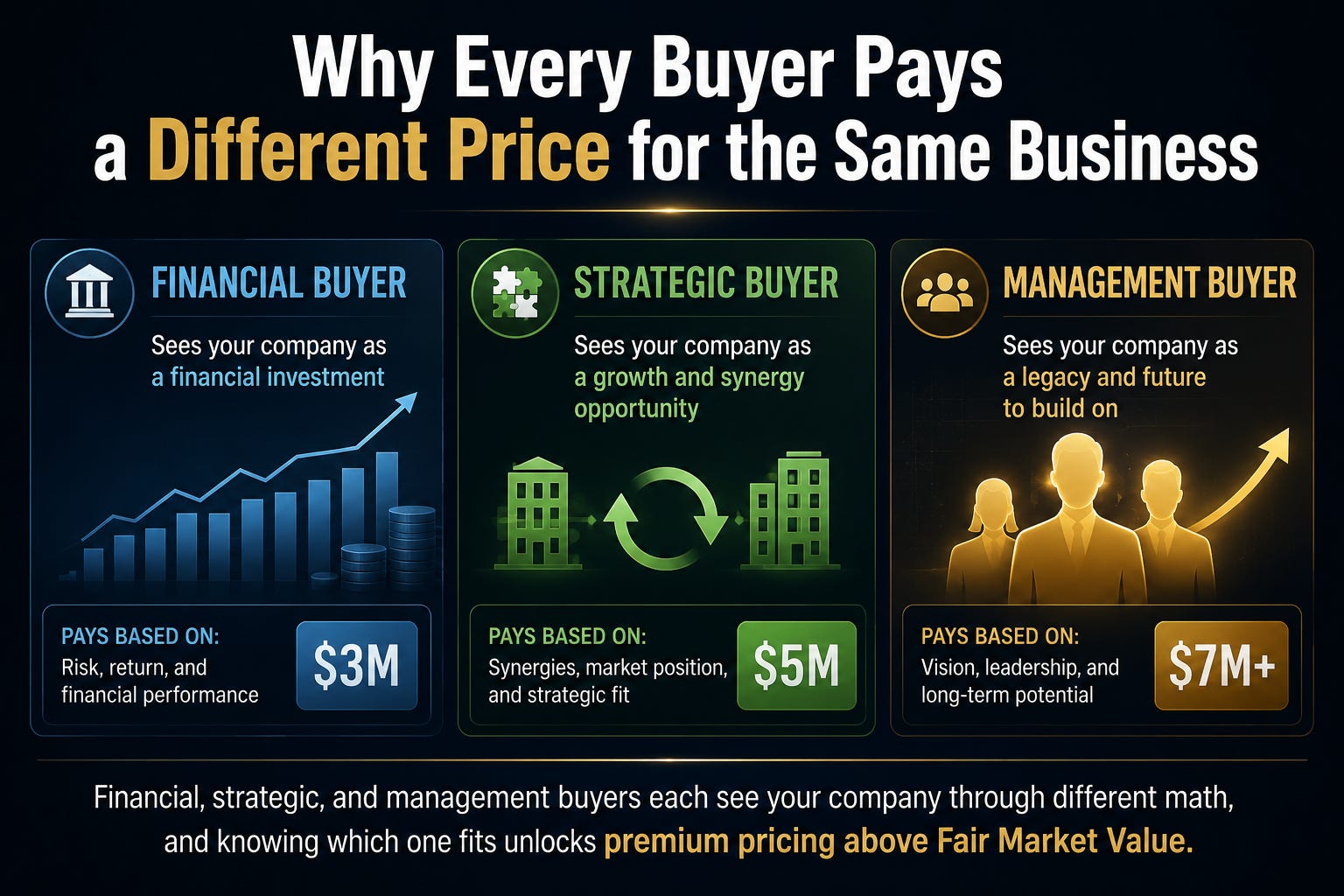
Two buyers walk into your conference room. One offers $48M, the other offers $55M for the same business. Same financials, same operations, same EBITDA. So why the $7M gap? Because buyer type drives valuation, not just your numbers. Understanding this gap is where amateurs stop and professionals begin.
10 KEY TAKEAWAYS — BUYER TYPES AND PREMIUM PRICING
FMV is your floor, not your ceiling: Fair Market Value is where negotiation begins, not where it ends.
Financial buyers buy the multiple: They increase price by reducing perceived risk, not by paying more for income.
Strategic buyers buy positioning: Empire builders pay premiums for synergies, defensive moats, and market access.
Management buyers buy continuity: MBO deals offer lower headline numbers but faster closes and insider trust.
ESOPs buy stability: Employee Stock Ownership Plans prioritize jobs and prosperity, not aggressive growth.
Deal structure beats headline price: A $45M deal that closes outperforms a $55M deal that collapses.
Premium triggers are buyer-specific: Each buyer category has unique levers that move them off base offers.
The right buyer wants your business most: Match your business profile to the buyer most compelled to pay up.
Seller financing creates leverage: Management buyers will pay premium for favorable note terms.
Your numbers don’t sell businesses, your story does: Buyer psychology determines whether premiums get paid.
📚 READING PREREQUISITES
Each post in this series builds upon the technical groundwork laid in earlier entries. The content progresses in depth and complexity, making prior understanding essential for full comprehension. Key valuation concepts, models, and metrics are intentionally revisited and reinforced across multiple posts to ensure retention and clarity.
Recommended Prior Reading:
Chapter 7: Why Fair Market Value Is the Beginning, Not the End
Chapter 11: Compulsion, Leverage, and the Psychology of the Sale
The $50M Problem Nobody Talks About
Every business owner I have met over thirty years walks into a sale believing one critical fallacy, that all offers at the same dollar amount are equivalent. They are not. A $50M offer from a private equity firm looks identical on paper to a $50M offer from a strategic acquirer, yet the cash you actually receive, the timeline to closing, and the probability of execution can differ by millions.
This is the central insight of Chapter 13, understanding buyer types is the difference between accepting Fair Market Value and capturing FMV plus premium. The buyer who values your business correctly is rarely the buyer who values it most.
[IMAGE: A balance scale with stacks of cash on one side and a calendar with red circled dates on the other, alt text: “Cash versus deal terms in business valuation negotiations”]
Financial Buyers: The Multiple Hunters
Financial buyers, including private equity firms, family offices, and search funds, do not increase their offer by paying more for your income. They increase their offer by reducing the perceived risk in your business, which lowers their required rate of return, which expands the multiple they apply to your EBITDA.
How financial buyers structure deals:
Base offer: 4.5x to 5x normalized EBITDA
Payment: Roughly 70% cash at closing, 30% earnout over three years
Earnout triggers: EBITDA improvements at underperforming units
Timeline: 45 to 60 days due diligence, 30 days to close
Premium triggers that move financial buyers higher:
Proven turnaround playbook: Detailed roadmap with comparable success stories
Scalable systems: Technology and processes ready for bolt-on acquisitions
Clean financials: Audited statements with no restatements or quality-of-earnings flags
Management depth: Strong #2 and #3 leaders who can run the business without you
Financial buyers will ask one question repeatedly during due diligence, “Prove to me the cash flow can handle the leverage without choking.” They are not asking about your story, they are testing whether the debt capacity supports their model.
Strategic Buyers: The Empire Builders
Strategic buyers are completely different animals. They buy strategic positioning, not financial performance. A regional competitor acquiring your business is not buying your EBITDA, they are buying your customer list, your geographic footprint, your supplier relationships, or in some cases, the simple satisfaction of removing you from their market.
How strategic buyers structure deals:
Base offer: Higher multiple than financial buyers due to synergies
Payment: Roughly 85% cash at closing, 15% earnout tied to integration milestones
Integration budget: $2M to $3M for rebranding and system integration
Timeline: 60 to 90 days, longer due to regulatory review
Premium triggers for strategic buyers:
Geographic expansion that fills gaps in their existing footprint
Customer base synergy where your demographics align with their other holdings
Supply chain integration that delivers 15% to 20% immediate cost savings
Defensive value that blocks a competitor from entering key markets
This is the synergy premium, and according to Deloitte M&A research, it can drive deal values 25% to 40% above what a financial buyer would pay for the same business.
Management Buyers: The Continuity Play
Management Buyouts (MBOs) are the most underrated path to a satisfactory exit. Your existing team knows the business, eliminates due diligence friction, and protects the legacy you spent decades building. The trade-off, they cannot pay all cash because they do not have it.
How MBO deals typically structure:
Base offer: Lower than financial or strategic buyers due to financing constraints
Payment: Roughly 30% cash, 50% seller note, 20% earnout over five years
Seller note: Often 5% to 6% interest with a seven-year term
Timeline: 30 to 45 days, faster because the buyers already know the business
Premium triggers for management buyers:
Attractive seller financing with below-market rate terms
Extensive transition support from the owner during handover
Strong employee retention programs to maintain morale
Clear operational roadmap for fixing underperforming areas
The honest reality, MBOs work when you trust your team and you are willing to be the bank. ESOP transitions work similarly but layer in significant tax advantages for sellers.
💡 KEY TAKEAWAYS
Remember These Core Principles:
Buyer type drives valuation methodology, not just dollar amounts
Financial buyers compete on the multiple, strategic buyers compete on synergy
Deal structure determines real proceeds, not the headline number
Management buyers offer speed and trust, not maximum cash
Premium triggers vary by buyer category, position your business accordingly
