

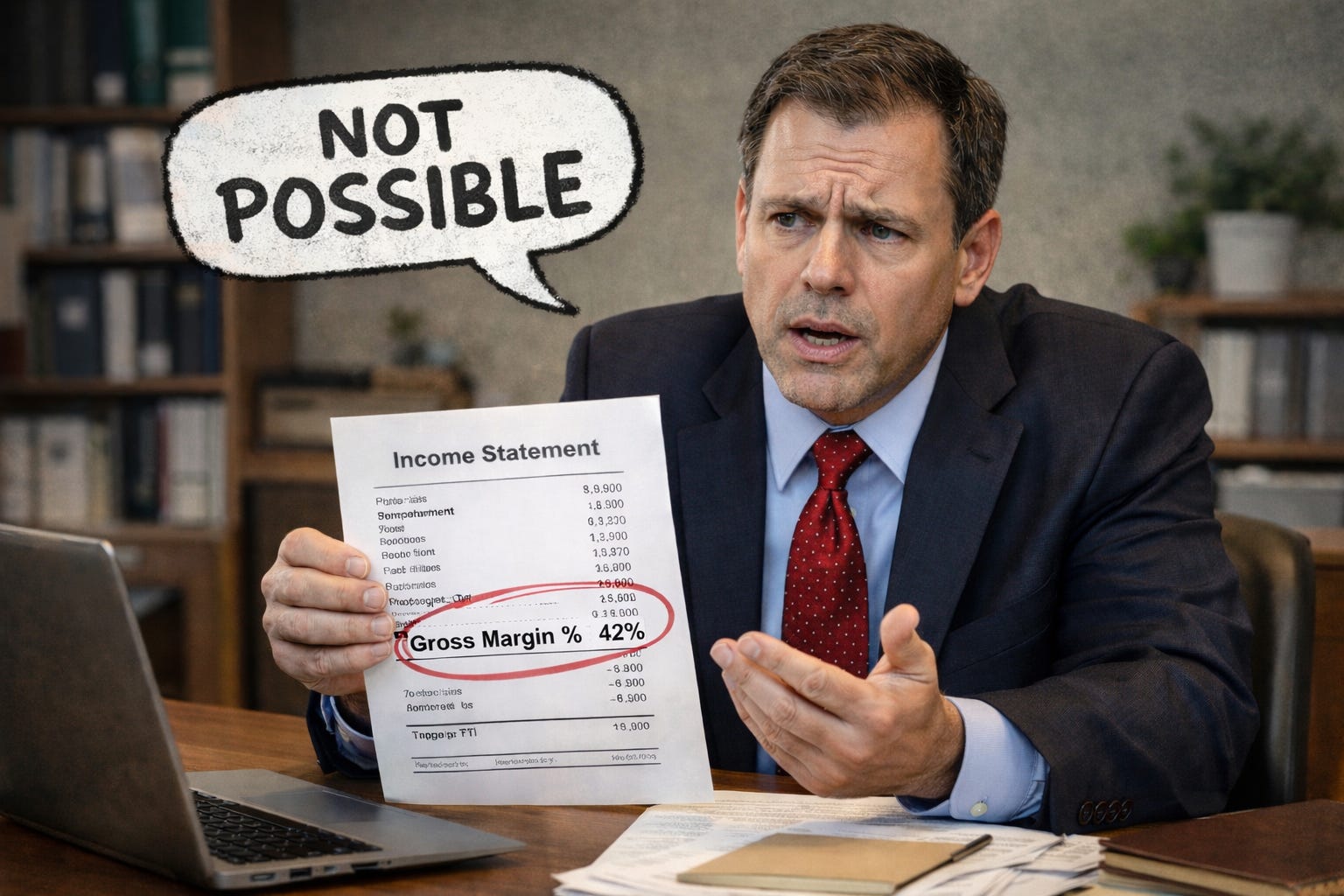
Your shop is running full tilt. Sales are up. You hired a CPA. The financial statements look clean. Yet your bank hesitates on financing. The problem isn’t your business, it’s presentation. Lenders underwrite gross profit economics, not operating expense management. Understanding this distinction separates “busy” from “bankable.
10 KEY TAKEAWAYS - PRODUCTION COST ALLOCATION
CPA-format statements serve compliance: Traditional multi-step income statements are built for tax filing and general reporting, not capital underwriting or equity valuation decisions.
Gross margin drives financing approval: Banks and investors anchor on gross profit percentage because it answers whether you make money on the actual work before office overhead and debt service.
Production costs hide below gross profit: Rent, utilities, insurance, machine maintenance, subcontractors, and working-owner time often sit in Operating Expenses despite being production-driven.
Inflated margins mislead lenders: When production overhead stays below the gross profit line, you show strong margins while job economics remain thin, creating unfinanceable businesses.
Allocation reveals true unit economics: Moving shop rent, production utilities, job-delivery subcontractors, and machine-related costs into Cost of Sales shows what revenue actually costs to produce.
Net income doesn’t change: Proper allocation is reclassification, not revision. Bottom-line profit remains identical, but the story changes from “managing overhead” to “strong production margins.”
Working-owner compensation splits matter: The percentage of founder time spent on production versus administration determines allocation ratios, directly impacting perceived gross margin quality.
Bank underwriting requires proof: Lenders want schedules showing square footage splits, utility consumption patterns, insurance exposure drivers, and subcontractor linkage to specific jobs for validation.
Valuation multiples follow margins: Professional buyers use gross profit quality to determine risk premiums. Thin adjusted margins trigger higher required rates of return and lower enterprise values.
Capital-ready packages convert rejections: Presenting both CPA-format statements and management-adjusted versions with allocation schedules removes lender guesswork and accelerates approvals with higher limits.
📚 READING PREREQUISITES
This post introduces fundamental concepts in financial presentation for capital underwriting. While CPA-prepared statements serve important compliance functions, they often require adjustment schedules to communicate production economics effectively to lenders and equity investors. Understanding the difference between accounting format and underwriting analysis creates the foundation for successful capital raises and higher business valuations.
Recommended Prior Reading:
Understanding gross margin versus operating margin fundamentals
How lenders underwrite debt service coverage ratios
The role of job costing in production business valuation
The Disconnect Between Accounting and Underwriting
Most business owners believe their CPA-prepared financial statements tell the complete story. Revenue minus cost of sales equals gross profit. Operating expenses get subtracted. Net income appears at the bottom. Everything balances. The format follows Generally Accepted Accounting Principles. The presentation looks professional.
Yet the bank still declines financing or offers far less than requested. The confusion is understandable. You followed the rules, hired professionals, maintained proper records. What went wrong?
Nothing went wrong with accounting. The issue is underwriting perspective. CPAs prepare statements for compliance, tax filing, and general financial reporting. Banks and equity investors analyze statements for cash flow resilience and production economics. These are fundamentally different lenses examining the same numbers.
The Capital Tool Machining Example
Consider Capital Tool Machining for the period ending December 31, 2025. Here’s the traditional CPA presentation:
BEFORE - Traditional CPA Presentation
Capital Tool Machining
Income Statement
Period Ending December 31, 2025

Revenue                                           CAD 10,000,000

Cost of Sales
  Materials and direct shop labour                   (6,000,000)
Total Cost of Sales                                  (6,000,000)

Gross Profit                                          4,000,000

Operating Expenses
  Rent                                                 (500,000)
  Utilities                                            (400,000)
  Insurance                                            (100,000)
  Machine maintenance                                  (150,000)
  Salaries and wages (admin)                           (700,000)
  Subcontractors (specialized jobs)                    (900,000)
  Owner compensation (management)                      (600,000)
  Legal and accounting                                  (40,000)
  Telephone                                             (25,000)
  Meals and entertainment                               (20,000)
  Marketing                                             (50,000)
  Other operating expenses                              (65,000)
Total Operating Expenses                             (3,550,000)

Operating Income                                        450,000

Finance Costs
  Bank fees                                            (150,000)

Income Before Amortization                              300,000

Amortization                                           (200,000)

Net Income                                              100,000
This statement shows 40% gross margin (CAD 4,000,000 ÷ CAD 10,000,000). That appears healthy. Most of the expenses sit below gross profit in Operating Expenses. The business looks profitable with strong production margins.
AFTER - Bank Underwriting View
Now consider the same business with production-driven costs properly allocated into Cost of Sales based on management schedules:
Capital Tool Machining
Income Statement
Period Ending December 31, 2025

Revenue                                           CAD 10,000,000

Cost of Sales
  Materials and direct shop labour                   (6,000,000)
  Subcontractors (job delivery)                        (900,000)
  Rent allocated to shop (90%)                         (450,000)
  Utilities allocated to shop (97%)                    (388,000)
  Insurance allocated to shop (90%)                     (90,000)
  Owner compensation allocated to production (80%)     (480,000)
  Machine maintenance                                  (150,000)
Total Cost of Sales                                  (8,458,000)

Gross Profit                                          1,542,000

Operating Expenses
  Rent (office portion)                                 (50,000)
  Utilities (office portion)                            (12,000)
  Insurance (office portion)                            (10,000)
  Salaries and wages (admin)                           (700,000)
  Owner compensation (admin portion)                   (120,000)
  Legal and accounting                                  (40,000)
  Telephone                                             (25,000)
  Meals and entertainment                               (20,000)
  Marketing                                             (50,000)
  Other operating expenses                              (65,000)
Total Operating Expenses                             (1,092,000)

Operating Income                                        450,000

Finance Costs
  Bank fees                                            (150,000)

Income Before Amortization                              300,000

Amortization                                           (200,000)

Net Income                                              100,000
Notice net income remains identical at CAD 100,000. You didn’t change reality, only classification. But gross margin compressed from 40% to 15.4% (CAD 1,542,000 ÷ CAD 10,000,000).
Why This Matters for Financing
Banks evaluate debt service coverage capacity. When gross margin appears inflated because production costs sit below the line, lenders face uncertainty. Is pricing adequate? Can the business absorb cost increases? What happens if revenue growth requires more facility, equipment, or capacity?
The adjusted presentation answers these questions directly. It shows the business generates CAD 1,542,000 in true contribution margin after all production-related costs. That’s what’s available for office overhead, debt service, and profit.
When a bank sees 40% gross margin in the traditional presentation, they must reverse-engineer actual production economics. This takes time, creates friction, and often results in declined applications because the lender can’t confidently underwrite what they can’t clearly see.
The adjusted presentation removes guesswork. The business produces revenue at 15.4% gross margin. Operating expenses consume CAD 1,092,000. Operating income is CAD 450,000. These numbers support specific debt service coverage ratio calculations without requiring the lender to build allocation assumptions.
Common Production Cost Allocation Categories
Production businesses should consider allocating these costs into Cost of Sales based on reasonable business logic:
Facility costs: Rent and utilities consumed by shop floor operations, manufacturing areas, and production equipment rather than office administration
Insurance: Coverage driven by shop activity, equipment operation, and production liability exposure
Subcontractors: Third parties hired specifically to complete or support revenue-generating jobs
Owner compensation: Founder time spent on production supervision, machine operation, quality control, or direct customer job delivery
Equipment maintenance: Costs required to maintain production capacity and prevent downtime affecting revenue generation
Each allocation requires supporting schedules. Square footage analysis for rent. Metered consumption or engineering estimates for utilities. Policy-by-policy review for insurance. Job-by-job tracking for subcontractors. Time tracking for working owners.
Moving From Busy to Bankable
Being “busy” and being “financeable” are different states. Activity doesn’t guarantee margin quality. Revenue growth without gross profit resilience can actually increase business risk under leverage.
A capital-ready financial package typically includes:
CPA-format multi-step income statement for compliance and professional presentation
Management-adjusted income statement showing production cost allocation into Cost of Sales
Allocation schedule documenting the logic, percentages, and methodology for each adjustment
Narrative bridge explaining what changed, why it changed, and what the adjusted numbers reveal about production economics
Supporting documentation including square footage analysis, utility bills, insurance policies, subcontractor agreements, and owner time tracking
This package removes lender uncertainty. When banks can clearly see job economics, gross margin quality, and cash flow resilience, approvals get faster, limits get higher, and pricing gets more competitive.
💡 KEY TAKEAWAYS
Remember These Core Principles:
CPA statements serve compliance: They’re built for tax filing and reporting, not capital underwriting or valuation analysis
Banks underwrite gross profit: Lenders evaluate whether you make money on the actual work before office overhead and debt service
Allocation is reclassification: Proper cost allocation doesn’t change net income, it reveals true production economics hidden below gross profit
Support your adjustments: Every allocation requires documented business logic through schedules, analysis, and reasonable methodology
Capital-ready packages win: Presenting both traditional and adjusted statements removes lender guesswork and accelerates financing approval
❓ FREQUENTLY ASKED QUESTIONS
Q: Will proper cost allocation reduce my gross profit?
A: Yes, adjusted gross profit will typically be lower than traditionally presented gross profit because production-driven costs move from Operating Expenses into Cost of Sales. However, this reveals your true unit economics, which builds lender confidence rather than creating concern about inflated margins.
Q: Does reclassifying costs change my taxes or net income?
A: No. Allocation adjustments are presentation changes, not accounting revisions. Net income remains identical. Tax liability doesn’t change. You’re simply organizing costs by function (production versus administration) rather than by type (rent, utilities, insurance).
Q: How do I know which percentage to use for allocations?
A: Allocation percentages should reflect actual business operations. Use square footage analysis for rent, metered usage for utilities, policy review for insurance, and time tracking for owner compensation. Document your methodology with objective evidence.
Q: Can’t the bank just do this analysis themselves?
A: Banks can perform their own analysis, but it takes time, creates uncertainty, and often results in conservative assumptions that work against your approval. Providing the analysis yourself with proper documentation removes friction and demonstrates financial sophistication.
Q: Will this help with business valuation in addition to financing?
A: Absolutely. Professional buyers use gross profit quality to assess operational risk and determine valuation multiples. Businesses with strong adjusted gross margins command premium valuations while thin-margin operations face higher required rates of return and lower enterprise values.
🎯 READY TO TRANSFORM YOUR FINANCIAL PRESENTATION?
Understanding production cost allocation is essential for accessing growth capital and maximizing business value.
Subscribe to YBAWS! for weekly insights on business valuation, M&A strategy, and maximizing your company’s worth. Join business owners who are building more valuable, marketable businesses through unvarnished truth about business exits.
Have questions about your specific situation? Drop a comment below or reach out directly at riskswap@saferwealth.com.
📖 RELATED READING
Continue Your Learning:
Understanding Gross Margin - Corporate Finance Institute: Comprehensive guide to calculating and interpreting gross profit margins across different industries and business models.
Debt Service Coverage Ratio - Investopedia: How lenders use DSCR to evaluate financing capacity and determine appropriate loan structures for businesses.
Financial Statement Analysis - CPA Canada: Professional guidance on financial statement preparation, presentation, and analysis for business financing decisions.
CONNECT WITH SAFERWEALTH
Expand Your Learning Beyond This Post:
Web: SaferWealth.com - Alternative Startup Funding Structures
Video: SaferWealth Posts - VC Risk Swap Educational Content
LinkedIn: LinkedIn @SaferWealth - Startup Finance Innovation
Rumble: @saferwealth - Educational video content on business valuation
Instagram: @saferwealth - Quick insights and updates
👤 ABOUT THE AUTHOR
Sean Cavanagh, BAS, CPA, CA, CF, CBV
With over three decades negotiating business sales and conducting valuations, Sean delivers unvarnished truth about business exits. Starting at Deloitte and Canada Revenue Agency, he now advises business owners through his M&A practice. YBAWS! reflects his commitment to helping owners understand what actually creates enterprise value.
Connect with Sean:
📚 DO YOUR OWN RESEARCH
The concepts discussed in this article are grounded in professional accounting standards and commercial lending practices. For comprehensive understanding of financial statement preparation and analysis, consult the following authoritative sources:
CPA Canada. (2025). Financial reporting and analysis standards. CPA Canada.
https://www.cpacanada.ca/
Corporate Finance Institute. (2025). Gross margin analysis and interpretation. CFI Education.
https://corporatefinanceinstitute.com/
Investopedia. (2025). Debt service coverage ratio explained. Investopedia.
https://www.investopedia.com/
Canadian Bankers Association. (2025). Commercial lending underwriting standards. CBA.
https://cba.ca/
CBV Institute. (2025). Business valuation standards and practices. CBV Institute.
https://www.cbvinstitute.com/
EDUCATIONAL DISCLAIMER
This content is for educational purposes only and does not constitute financial, legal, accounting, or investment advice. The scenarios presented are fictional and created for instructional purposes from collective industry experience. Neither the author nor YBAWS! accepts liability for actions based on this content. This material supplements but never replaces proper professional consultation and judgment.
YBAWS! (Your Business Ain’t Worth Sh*t!) is a trademark and educational platform dedicated to helping business owners understand corporate value and marketability.
© 2026 YBAWS! All rights reserved.