


There is a source of capital with no dilution, no interest, no covenants, no board seat, and no valuation fight, and most founders walk right past it. It is your customers. When a customer pays you a year in advance, you have raised a round without a single investor meeting, and proven your product in the same breath.
The Round You Can Raise Without Investors
The cheapest round of funding you will ever raise does not come from a venture fund, a bank, or a lender. It comes from the people already paying you: your customers. When a customer agrees to pay for twelve months upfront in exchange for a modest discount, you have effectively raised a round of funding with zero dilution, and you did it without a single investor meeting, pitch deck, or term sheet. Twenty customers prepaying a thousand dollars a year is twenty thousand dollars of working capital in your account today, no board seat attached.
The forms are everywhere once you start looking. Annual upfront subscriptions, deposits, retainers, setup fees, paid pilots, pre orders, and even ordinary vendor terms, since negotiating net ninety with a supplier is simply borrowing from them interest free for three months. Each of these converts future revenue into immediate working capital with zero equity implications and no debt. It is the oldest form of financing in commerce, older than venture capital by several thousand years, and in 2026 it is quietly one of the most powerful, and most underused, tools a founder has.
The economics are gentler than they first look, too. A twenty percent discount for an annual prepayment sounds expensive until you compare it to the alternatives. Twenty percent once, paid to your own customer, is a rounding error next to the twenty five to fifty percent a year that revenue based financing charges, or the quarter of your company a seed round takes forever. And unlike every one of those, this capital arrives with a customer attached to it, someone who has now committed to you for a year and has every reason to stick around. You are not just cheaper by the numbers. You are buying loyalty and cash in the same transaction, and paying for it with a discount you fully control.
The Cheapest Capital There Is
Line customer cash up against every other option and it wins on price outright. Its cost of capital is effectively zero, and it keeps the cap table completely clean. There is no interest to service the way debt demands, no equity surrendered the way a priced round demands, no covenant to trip the way venture debt demands, and no relentless revenue skim the way revenue based financing demands. It is, in the most literal sense, free money that you earned.
And it carries a second benefit that speaks directly to everything this series has argued about valuation. Every share you do not sell today is a share you can sell later, at a higher valuation, in a more competitive process, or never at all if you would rather hold it. Customer cash is the ultimate way to delay, or skip entirely, the valuation fight, because you never have to argue a number with anyone. The customer has already priced your product in the most honest way possible, by buying it.
This is not a toy strategy for tiny businesses, either. Companies like Basecamp and Mailchimp scaled to nine figure valuations without selling equity, funded largely by their own customers, and kept nearly all of the upside their founders created. There is an honest limit, of course. Customer funding caps how fast you can grow, it requires enough trust and leverage to ask a customer to pay ahead, and it can leave you exposed if a large opportunity needs more capital than your revenue can generate. It is powerful, and like the grant stack before it, it is bounded.
The Proof That Beats Any Pitch
Here is the part that matters most, and it is not about the money at all. Customer cash is not just cheap, it is proof. When a customer pays you before you have fully delivered, they are validating your product with their own wallet, giving you the first real indicator of demand and the first real cash inflow at the same time. No survey, focus group, or investor’s gut feeling comes close to the signal of someone actually paying you.

That proof is worth more than any valuation, and it travels. Market funded growth is the cleanest proof you can carry into any later fundraise. While AI startups raise fortunes on a thesis and a famous founder, a company outside AI can raise on receipts, and in a market that has stopped trusting soft valuations and started demanding evidence, receipts are exactly what wins. The founder who shows up with a book of prepaid contracts is not asking to be believed. They are showing what is already true.
The mindset shift is the whole game. The common mistake is treating customer first, non dilutive capital as a fallback, something you settle for once investors say no. It is the opposite. Validate first, scale second, always. Prove the product with customer money before you ever discuss a valuation with a soul, and you walk into every later conversation from a position of strength instead of need. Which leaves one question. Customer cash proves the demand and funds the early climb, but what funds the scale up once the demand is proven?
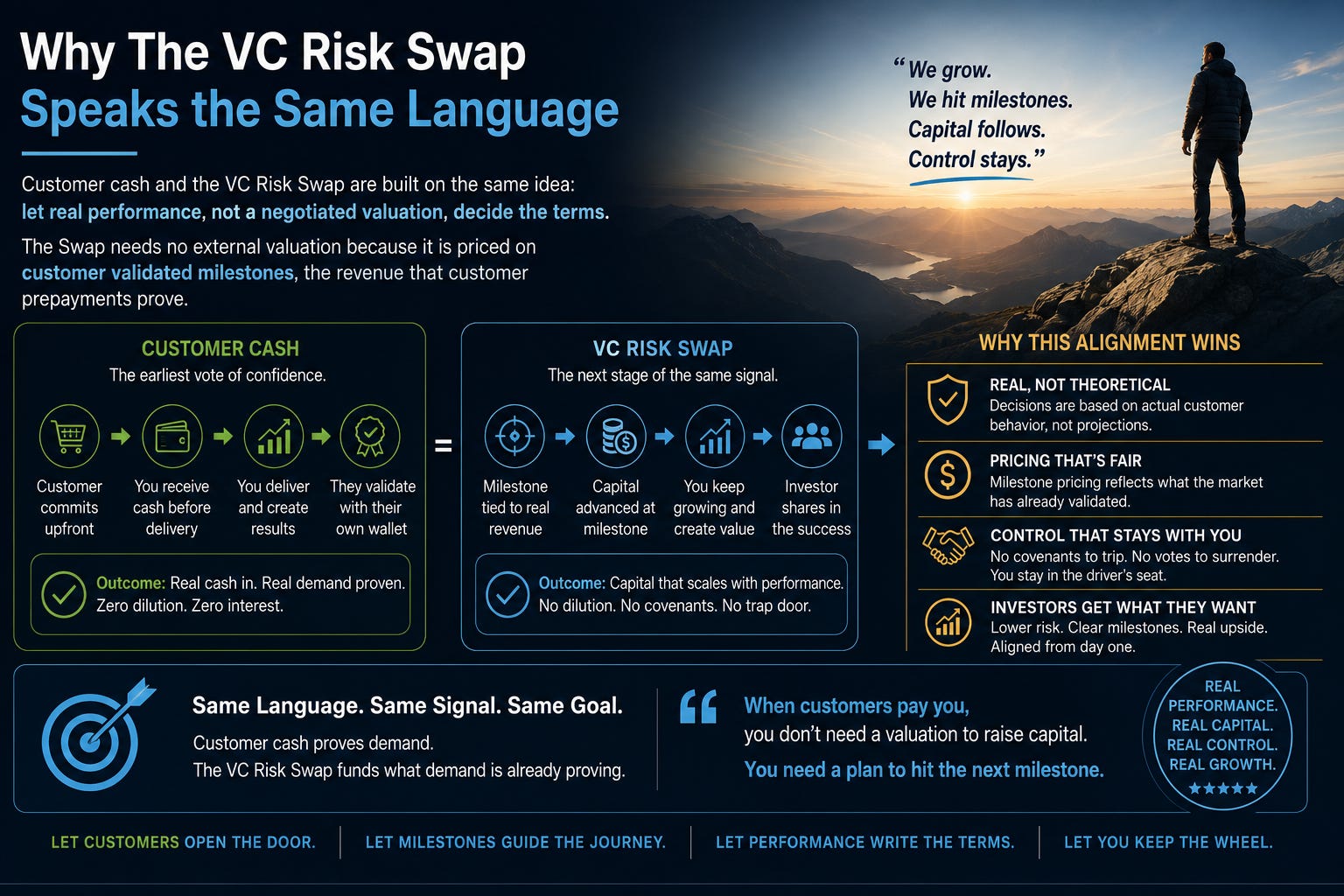
Why The VC Risk Swap Speaks the Same Language
Customer cash and the VC Risk Swap are built on the same idea: let real performance, not a negotiated valuation, decide the terms. The Swap needs no external valuation because it is priced on customer validated milestones, the revenue that customer prepayments prove. For the founder, that means funding the scale up on the strength of demand, never arguing a number with an investor. For the funder, it means a defined, downside protected return backed by proven customer traction, not a speculative comp. Customer cash proves the demand. The Swap funds the growth that demand deserves, without a valuation fight.
Subscribe to SaferWealth for more field notes from the part of the funding world the venture market overlooks, plus the structures that fund good companies on their own terms.
Questions about your specific situation? Reach out directly at riskswap@saferwealth.com.
CONNECT WITH SAFERWEALTH
Expand your learning beyond this post:
1. Web: SaferWealth.com, alternative startup funding structures.
2. YouTube: The Capital ToolKit, funding strategy and structure breakdowns.
3. Rumble: @SaferWealth.
4. Contact: riskswap@saferwealth.com.
