

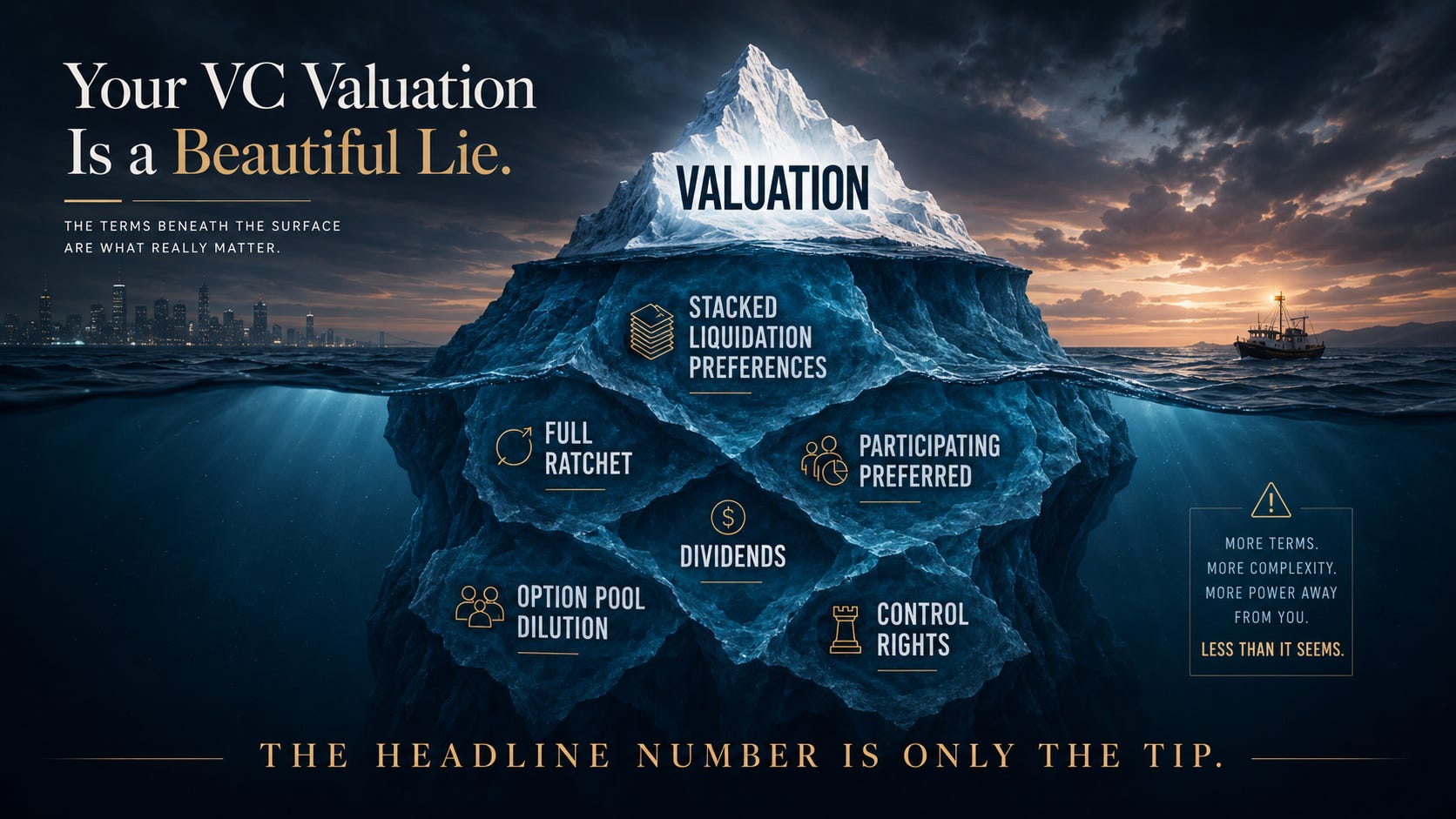
Congratulations, you got the valuation you wanted. Now read the fine print. In 2026, the big number on the front page of your term sheet is increasingly a magic trick, propped up by stacked preferences, ratchets, and dividends that quietly hand the real value to the investor. The mirage looks gorgeous, right up until exit day.
The Number You Are Staring At Is the Wrong One
Founders are trained to chase one figure: the valuation on the front page of the term sheet. In 2026, that is the wrong thing to watch. The terms underneath decide what the number actually means, and they can turn a triumph into a trap without changing the headline at all. As one founder’s guide puts it bluntly, a $30 million pre-money with participating preferred and a 2x liquidation preference can be worth less than a clean $20 million with 1x non-participating. The headline is theatre. The structure is the substance.
Here is why everyone plays along. When a market softens, founders and investors alike are incentivized to add structure rather than cut the valuation, because a visible down round demoralizes the team and forces investors to mark down their own books. So both sides shake hands on a flattering number and bury the real cost in the fine print. That handshake has a name in the trade. They call it a dirty term sheet.
Think of it as the gap between the sticker price and what you actually pay once the dealer adds the financing, the warranty, and the undercoating. A clean term sheet and a dirty one can carry the identical headline valuation and hand the founder wildly different outcomes. The cruel twist is that the dirtier the sheet, the prettier the number tends to look, because the entire purpose of the structure is to let the investor pay up on paper while protecting themselves underneath. A gaudy valuation, in 2026, is sometimes a warning label rather than a trophy.
How the Mirage Is Built
The machinery is more elaborate than most founders realize. Structured deals hand investors guaranteed minimum returns through compounding liquidation preferences, payment-in-kind dividends, and IPO ratchets, and the entire point is that they let a company raise at a headline valuation that looks flat or up while the effective valuation sits quietly far below it. Every device is invisible on the cover page and decisive on the day you sell.
The toolkit:
• Stacked liquidation preferences: investors now request 2x and 3x multiples, and bridge rounds quietly close as high as 4x. At 2x, they take double their money back before you see a cent.
• Participating preferred: the double dip. In a $20 million sale with $10 million raised at 2x, the entire $20 million can go to investors and founders receive nothing.
• Cumulative dividends: an 8 percent dividend can add more than 40 percent to the preference across five years, accruing whether or not the company earns a dime.
• IPO ratchets: free shares to the investor if you go public below a set valuation.
• Full ratchet anti-dilution: one cheap share can reprice everything and turn your 20 percent into 5 percent overnight.
Each clause is small print. Together they form a waterfall, and at the very bottom of that waterfall, soaked through, stands the common stock: you and your team.
And the cover page hides more than the waterfall. A so-called pre-money option pool expansion quietly comes entirely out of the founders’ shares before the investor wires a dollar, shrinking your effective valuation while leaving the headline untouched. Pay-to-play clauses can convert or strip existing investors who do not follow on, reshuffling the cap table beneath you mid-fight. None of these appear in the number everyone celebrates on announcement day. They appear later, in the distribution waterfall, once the money is real and your leverage is gone.
Why Non-AI Founders Get the Dirtiest Sheets
Structure does not fall evenly. It clusters exactly where leverage is weakest: soft markets, later-stage rounds, internal bridges, and companies sitting, as one PitchBook source put it, on wobbly legs. In 2026, that description fits most of the non-AI market by default.
With no competing offer to wave around, and an AI peer raising clean at twice your valuation, you have no power to strip the structure out. So you accept the dirty sheet, admire the headline, and sign terms engineered to pay the investor first, second, and third. It is the worst of both worlds: a number you cannot really bank, and control you have already surrendered to keep it.
Why do founders sign? Partly vanity, mostly fear. A big valuation is a story you can tell the press, the team, and yourself, while a down round is a public confession that the story slipped. So the structure becomes a face-saving device: keep the brave number, swallow the buried terms, and pray the exit is generous enough that the waterfall never reaches you. In a frozen, AI-skewed market, that is a reckless bet, because a generous exit is precisely the thing 2026 is least likely to hand a non-AI company.
And it compounds. Each structured round lays another layer of preference on top of the last, so that by the time an exit arrives, the stack ahead of you can be taller than the sale itself. This is not hypothetical. When companies like Box, Chegg, and Square went public, ratchet clauses negotiated in private rounds were triggered at the IPO, exposing how badly overstated those tidy private valuations had been all along. The mirage does not just fade. It sends a bill.
Why The VC Risk Swap Has No Dirt to Hide
This is the quiet elegance of the VC Risk Swap. It has no priced round, so there is no valuation to inflate and no preference stack to bury beneath it. There is nothing to fake, because there is no headline number to protect. The founder keeps clean equity, with no liquidation preference stacked ahead of them and no ratchet waiting at exit. The funder gets a defined, downside-protected return through a milestone-based revenue guarantee, the honest version of the security a dirty term sheet only pretends to provide. Both sides get real terms instead of a beautiful lie.
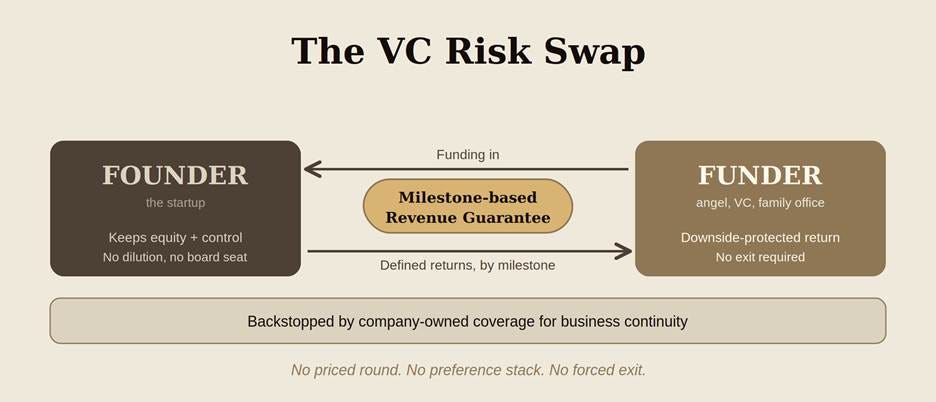
The VC Risk Swap, at a glance.
Subscribe to SaferWealth for more field notes on the terms beneath the term sheet, plus the structures that fund a company without quietly mortgaging it.
Questions about your specific situation? Reach out directly at riskswap@saferwealth.com.
CONNECT WITH SAFERWEALTH
Expand your learning beyond this post:
1. Web: SaferWealth.com, alternative startup funding structures.
2. YouTube: The Capital ToolKit, funding strategy and structure breakdowns.
3. Rumble: @SaferWealth.
4. Contact: riskswap@saferwealth.com.
ABOUT THE AUTHOR
Sean Cavanagh (BAS, CPA, CA, CF, CBV) is the founder of SaferWealth and creator of the VC Risk Swap, an alternative startup funding structure that preserves founder equity and control through milestone-based, downside-protected capital. With over three decades in business valuation, M&A advisory, and structuring, Sean writes about funding the businesses the venture market overlooks.
DO YOUR OWN RESEARCH
Sources referenced in this post:
• The Startup Law Blog, priced equity rounds guide, how terms can sink a high headline valuation.
• PitchBook, investor-friendly deal terms, 2x to 4x liquidation preferences and added structure.
• VC Beast, anatomy of a 2026 term sheet, structured deals, PIK dividends, and IPO ratchets.
• Value Add VC, liquidation preferences explained, how participating preferred leaves founders with nothing.
• Capmaven, quiet dilution in 2026, cumulative dividends and full-ratchet damage.
• Taking a dirty term sheet, short-term gain for long-term pain, ratchets triggered at IPO.
📖 RELATED READING
• PitchBook: Investor-Friendly VC Deal Terms Rankle Startups: where the structure is creeping back, and how far.
• VC Beast: Anatomy of a Venture Capital Term Sheet in 2026: every clause that turns a valuation into a mirage.
• Value Add VC: Liquidation Preferences Explained: the one clause that decides whether you see a dollar.
Educational disclaimer: This content is for educational purposes only and does not constitute legal, tax, financial, or investment advice. The VC Risk Swap is a sophisticated structure that must be implemented with independent professional advisors for your specific situation. All examples are illustrative. Neither the author nor SaferWealth accepts liability for actions based on this content. This material supplements but never replaces proper professional consultation and judgment.
© 2026 SaferWealth. All rights reserved.