

If You’re 18: How AI Reshapes Your Next 20 Years
You’re 18 in 2025. Traditional advice says get a degree, land an entry-level job, climb the ladder for 40 years. But Wave 1 eliminates entry-level jobs by the time you graduate. Wave 2 eliminates the mid-career roles you’d reach at 28. The ladder you’re told to climb disappears faster than you can climb it.
10 KEY TAKEAWAYS, YOUR 20s IN THE DISRUPTION ERA
Age 21 (2028): Graduate into Wave 1 automation, entry-level jobs you’d normally target eliminated, 30% of work hours automated.
Age 25 (2032): Wave 2 begins hitting, traditional career ladders breaking as coordination work automates.
Age 28 (2035): Wave 2 peaks, mid-career roles you’d normally reach at this age gone before you get there.
Age 33 (2040): Wave 3 arrives, even skilled professional roles face AI performing core functions at fraction of cost.
Traditional path is dead: Degree, job, ladder no longer works, companies won’t develop you when AI handles progression roles.
You’re AI-native, this is an advantage, you adapt to AI tools faster than older workers, use this window strategically.
Time is your greatest asset: 15 years to build anti-fragile positions before Wave 3 hits your peak earning years.
Ownership mindset from day one: Can’t rely on employment ladder, must architect value creation you control.
Choose naturally defensible domains: Physical presence, human relationships, novel problem-solving resist all three waves.
Build skill plus audience simultaneously: Your 20s are for creating market position, not climbing someone else’s ladder.
📚 READING PREREQUISITES
Recommended Prior Reading:
AI, AGI, and Agents: What They Are and Why You Should Care , Foundation for understanding technology levels
How AI and Agents Work Today: Real Examples from 2025 , Current deployment proving this is real
The Next 15 Years: From Agents to AGI , Timeline showing when waves hit
The Three Waves: Jobs Threatened in 5, 10, and 15 Years , Which specific jobs each wave eliminates
What Comes Next:
Impact on 30-year-olds (Post 6)
Impact on 50-year-olds (Post 7)
Strategic response framework and action plan (Post 8)
Your Timeline: What Happens When
Age 21 (2028): Graduation Into Wave 1
You graduate in 2028. 30% of jobs are fully automated by 2030, entry-level hit hardest. Companies don’t hire data entry clerks, junior analysts, or tier 1 customer service when AI handles it.
Impact: Traditional “entry point” evaporates. Can’t start at bottom because bottom is automated. Must enter at higher value level from day one.
Age 25 (2032): Wave 2 Begins
Traditional path says get promoted from junior to mid-level roles. Problem: Wave 2 targets coordination roles. One person plus agents replaces 5 to 10 person teams. The promotion you’re working toward is being eliminated.
Impact: Can’t rely on company career development. They won’t train you for roles they’re automating. Build your own value independent of their ladder.
Age 28 (2035): Wave 2 Peak
Seven years in. Should be solidly mid-career. Problem: One-third of workforce needs entirely new occupations. The career you spent early 20s building faces fundamental restructuring.
Impact: Traditional arc (climb 10 years to stable mid-career) is broken. Must architect career that survives this transition.
Age 33 (2040): Wave 3 Arrives
Approaching senior roles. Problem: AI at 80 to 90% of expert capability at 1% of cost makes professional roles economically unviable. Your entire 20s occur during all three waves.
Impact: Must build anti-fragile position from start, can’t establish career before disruption hits.
The Opportunity Hidden in the Crisis
You’re AI-Native: 18 to 24 year-olds are 129% more worried about AI, but this awareness is advantage. You adopt AI tools faster, integrate them naturally, no 20 years of muscle memory fighting you. Become person who directs AI while 35-year-olds struggle to adapt.
Time Is Your Superpower: 15 years before Wave 3 hits peak earning years. Older workers have 5 to 10. You can build from scratch: foundation (18 to 25), scaling (25 to 30), leveraging (30 to 33).
Freedom From Legacy: Not trapped in disappearing career. Can build with eyes open to what’s coming. Question everything, traditional advice comes from different era.
What Doesn’t Work Anymore
Degree, Job, Ladder: Traditional sequence broken because entry-level (Wave 1 automated), mid-level (Wave 2 automated), senior faces Wave 3 pressure.
Company Development: Companies don’t train for roles they’re automating. You’re responsible for your own development.
Narrow Expertise: Specialization in one thing creates fragility when that thing becomes automated or obsolete.
What Works In The New Era
Own Your Value: Build audience, reputation, systems, intellectual property you control. Consultant with audience beats employee following playbooks. Creator with distribution beats content producer for hire.
Defensible Domains: Physical presence (trades, hands-on work), human relationships (therapy, high-touch sales), novel problem-solving (crisis management, creative strategy), high-stakes judgment.
Skill AND Audience: Document learning publicly from day one. Build audience as you build capability. Skill alone isn’t enough when AI has skill.
Think Systems and Ownership: From “what job?” to “what problem can I solve?” From “what role?” to “what value can I create?” From “what company?” to “what market position?”
The Strategic Question: What Career Path Is Anti-Fragile?
Anti-fragile means gains strength from disruption, not just resists it.
Examples: AI consultant helping companies automate (gains from Waves 1 and 2), creator helping professionals reposition (gains from all waves), builder creating AI-amplifying tools (gains as AI advances), educator teaching complementary skills (gains as retraining accelerates).
Build positions that get stronger as AI advances, not positions requiring AI to stay weak.
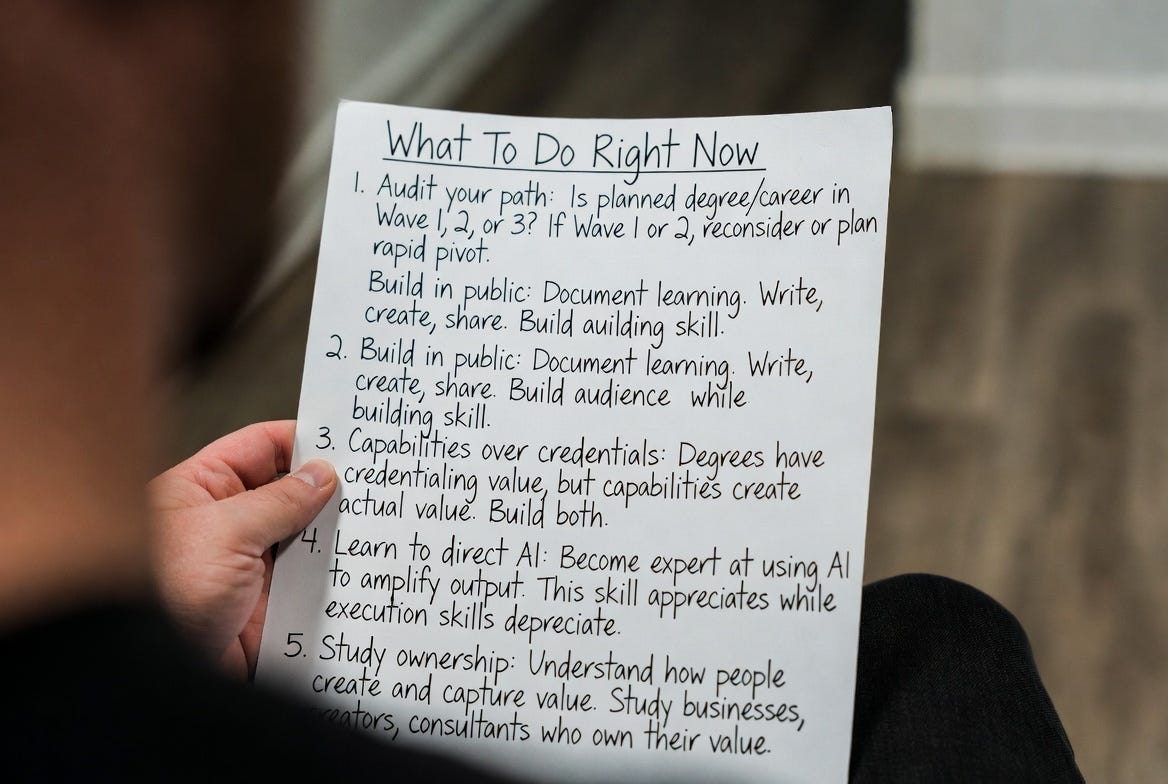
What To Do Right Now
1. Audit your path: Is planned degree/career in Wave 1, 2, or 3? If Wave 1 or 2, reconsider or plan rapid pivot.
2. Build in public: Document learning. Write, create, share. Build audience while building skill.
3. Capabilities over credentials: Degrees have credentialing value, but capabilities create actual value. Build both.
4. Learn to direct AI: Become expert at using AI to amplify output. This skill appreciates while execution skills depreciate.
5. Study ownership: Understand how people create and capture value. Study businesses, creators, consultants who own their value.
💡 KEY TAKEAWAYS
Remember Your Timeline:
Your entire 20s = all three waves, can’t establish career before disruption, must build anti-fragile from start
Time is your advantage: 15 years to build position that survives Wave 3, older workers have 5 to 10
Traditional path is dead: Degree, entry job, ladder doesn’t work when ladder disappears faster than you climb
❓ FREQUENTLY ASKED QUESTIONS
Q: Should I still go to college if entry-level jobs are disappearing?
A: Depends on field. If degree is credential requirement (doctor, lawyer, engineer), yes. If degree is “general preparation for professional work,” maybe not. Focus on capabilities and positioning, degree is one tool among many.
Q: How can I compete with 30-year-olds who have more experience?
A: You’re not competing on experience, you’re competing on adaptation speed and AI-native capabilities. 30-year-olds have experience in world that’s disappearing. You’re building for world that’s arriving.
Q: What if I choose wrong path and waste my 20s?
A: You will make mistakes. Everyone does. Key is building transferable capabilities and maintaining flexibility. Better to try three things and pivot than stick with one thing that’s clearly wrong.
🎯 READY FOR YOUR STRATEGIC FRAMEWORK?
Understanding your timeline is crucial. Next, see how this compares to other age groups and get your complete action plan.
Subscribe to the December 2025 AI Challenge for the remaining age-specific analyses and strategic response framework.
Questions about your specific situation? Drop a comment, I respond to every message.
📖 RELATED READING
Continue Your Learning:
McKinsey: Future of Work: Workforce automation projections by age and occupation.
National University: AI Job Statistics: Age-specific vulnerability data and adaptation trends.
World Economic Forum: Future of Jobs: Skills transformation timeline and emerging roles.
👤 ABOUT THE AUTHOR
Sean Cavanagh, BAS, CPA, CA, CF, CBV
With over three decades negotiating business sales and conducting valuations, Sean now applies his systematic approach to career architecture in the AI era. Starting at Deloitte and Canada Revenue Agency, he’s built a career analyzing value creation, risk reduction, and strategic positioning, principles that apply equally to businesses and individual careers.
Connect with Sean:
📚 DO YOUR OWN RESEARCH
Age-Specific Career Data:
McKinsey Global Institute , Workforce transition analysis
National University: AI Statistics , Age-specific impact data
World Economic Forum , Skills and career evolution
Career Strategy Resources:
80,000 Hours , Career guidance for high-impact paths
Future of Work Research , Comprehensive workforce analysis
CONNECT WITH SAFERWEALTH
Expand Your Learning Beyond This Post:
Web: SaferWealth.com , Business value and strategic positioning
Video: SaferWealth Posts , Educational content
LinkedIn: LinkedIn @SaferWealth , Career strategy insights
Rumble: @saferwealth , Economic analysis
Instagram: @saferwealth , Quick insights
⚖️ EDUCATIONAL DISCLAIMER
This guide provides information only, not professional advice. Career decisions should be made in consultation with qualified advisors, mentors, and professionals in your field of interest. Timeline projections represent aggregated research and are subject to significant uncertainty. Neither the author nor YBAWS! accepts liability for actions based on this content. This material supplements but never replaces proper professional consultation and judgment.
YBAWS! (Your Business Ain’t Worth Sh*t!) is a trademark and educational platform dedicated to helping individuals and business owners understand value creation and strategic positioning.
© 2025 YBAWS! All rights reserved.


