

You’re 50 in 2025. You’ve built 25 to 30 years of expertise, seniority, relationships. Traditional plan says work until 65 to 67, maximize retirement savings, exit on your terms. But Wave 1 hits at 55, Wave 2 at 60, Wave 3 at 65. Your role category faces automation exactly when you planned to coast to finish. Exit timeline just accelerated.
10 KEY TAKEAWAYS, YOUR 50s AND 60s IN THE DISRUPTION ERA
Age 55 (2030): Wave 1 complete, 30% jobs automated, junior support eliminated, your team shrinks dramatically, more work with fewer resources.
Age 60 (2035): Wave 2 hitting, mid-level coordination automated, even senior roles face pressure as organizations restructure around AI, traditional “hold on until retirement” becomes impossible.
Age 65 (2040): Wave 3 arriving, cognitive professional work automated, exact age you planned to retire, but role may not exist anymore or compensation cut dramatically.
Timeline conflict is the crisis: Traditional retirement planning assumes working until 65 to 67, but automation waves hit at 55, 60, 65, can’t assume role lasts.
Expensive experience becomes liability: Senior salary justified by coordination and oversight, but AI does coordination for fraction of cost, makes you vulnerable.
Can’t afford career restart: Unlike younger cohorts, don’t have 20 to 30 years to rebuild, need strategies that work with 10 to 15 year horizon.
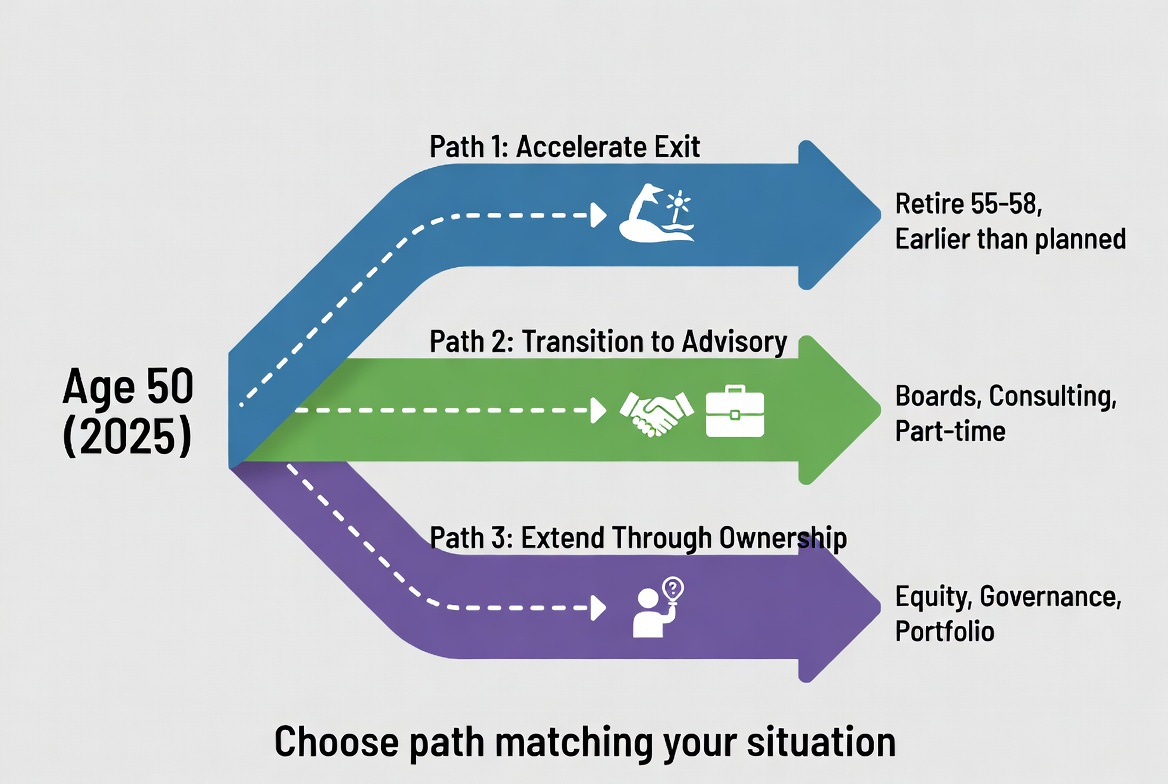
Three strategic paths forward: Accelerate exit (earlier retirement), transition to advisory (leverage experience differently), or extend through ownership (equity participation beyond employment).
Seniority is asset IF extracted: 30 years of relationships, industry knowledge, pattern recognition valuable, but only if captured and deployed strategically.
Portfolio approach works best: Multiple smaller income streams (advising, board seats, consulting, part-time) safer than single full-time role dependency.
Time to extract is NOW: Don’t wait until 60 or 62 to start transition, begin building alternative income and positioning immediately while employed.
📚 READING PREREQUISITES
Recommended Prior Reading:
AI, AGI, and Agents: What They Are and Why You Should Care , Foundation for technology levels
How AI and Agents Work Today: Real Examples from 2025 , Current deployment reality
The Next 15 Years: From Agents to AGI , Timeline context
The Three Waves: Jobs Threatened in 5, 10, and 15 Years , Which jobs each wave eliminates
If You’re 18: How AI Reshapes Your Next 20 Years , Comparison to younger cohort
If You’re 30: The Mid-Career Squeeze Is Coming , Mid-career dynamics
What Comes Next:
Strategic response framework and complete action plan (Post 8)
Your Timeline: What Happens When
Age 55 (2030): Wave 1 Complete
30% of jobs fully automated. Entry-level and junior eliminated. Your team of 8 becomes 3. Support structure relied on for 30 years? Gone.
Impact: More work, fewer resources, higher stress. “Coast to retirement” fails. Working harder at 55 than at 45, learning unexpected AI tools, managing restructured operations.
Age 60 (2035): Wave 2 Hitting
Wave 2 automates coordination, your exact function. One-third of workforce needs new occupations. Senior project director, operations VP, HR executive, finance controller, multi-agent systems replace these.
Impact: Entire organizational redesign, 60% fewer senior coordinators. Early retirement packages (worse terms than planned) or significant pay cuts.
Age 65 (2040): Wave 3 Arrives
Wave 3 pressures cognitive work. Even if you navigated to 65 in advisory role, now facing AI at high quality for minimal cost. Traditional retirement age arrives exactly when role faces peak automation.
Impact: Role and compensation transformed. Retirement timing forced by automation, not chosen by you.
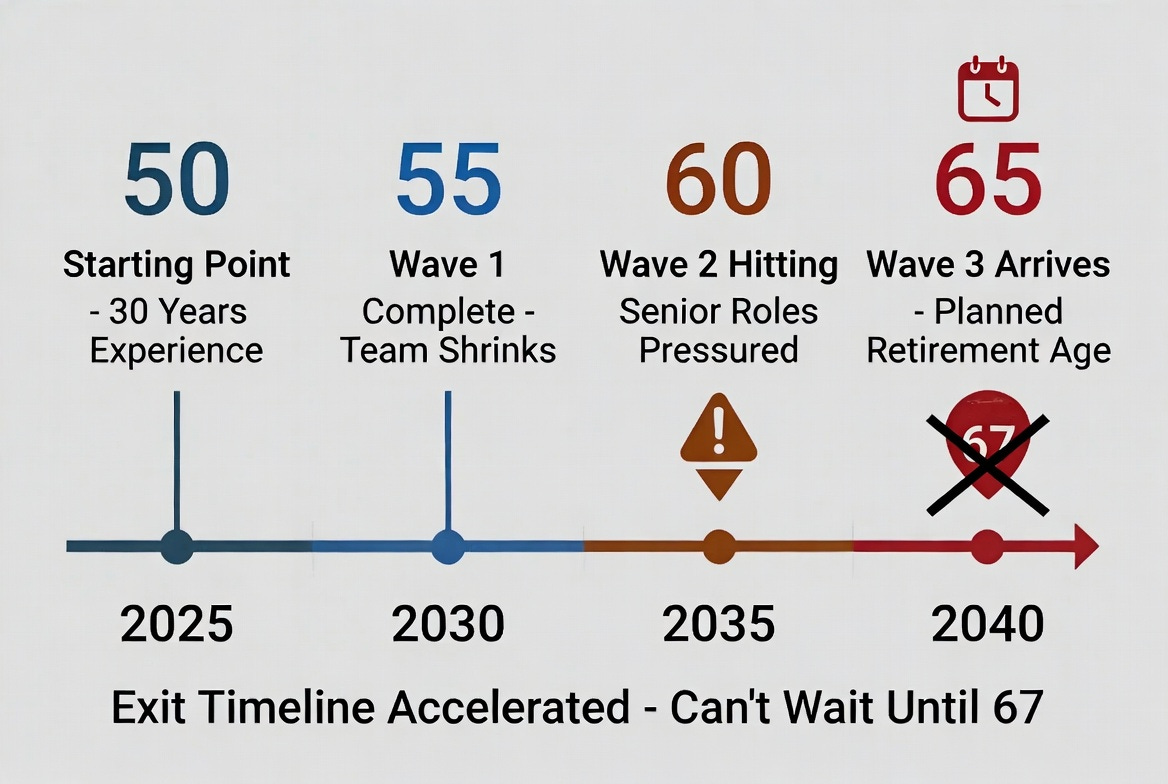
The Timeline Conflict
Traditional planning assumes: Work to 65-67, consistent income through final decade, build maximum savings in high-earning 50s/60s, exit on your terms.
Automation reality: Wave 1 (age 55) collapses teams, Wave 2 (age 60) pressures your role, Wave 3 (age 65) automates cognitive work at planned exit. Can’t assume role lasts.
Financial squeeze: Need 10-15 more years income to fund retirement. Automation threatens exactly when you need it most. Unlike younger workers, can’t afford 5-10 year rebuild.
Why “Hold On” Fails
You’re expensive: Senior salary, benefits, pension obligations. Junior plus AI costs fraction.
Coordination-heavy: Oversight, judgment on recurring situations. Exactly what agents automate.
Companies restructure: Economic pressure plus AI capability eliminates expensive senior roles.
Packages decline: Early offers (2028-2030) reasonable. Later offers (2033-2035) worse as leverage shifts.
Your Advantages
Deep relationships: 30 years building network, trust, reputation.
Pattern recognition: Multiple cycles, understand what works and why.
Industry knowledge: Know players, dynamics, hidden factors.
Credibility: Track record established, don’t need to prove competence.
Financial foundation: Home equity, retirement savings, lower debt, more options.
Three Strategic Paths
Path 1: Accelerate Exit
Retire earlier, accept smaller income, reduce expenses, exit before automation forces worse terms.
Works if: Sufficient savings, can downsize lifestyle, health supports early retirement, want to avoid restructuring stress.
Timeline: Exit by 2030-2033 (age 55-58), before Wave 2 pressures senior roles. Early packages still available.
Path 2: Transition to Advisory
Shift from employee to advisor, consultant, board member. Leverage relationships without full organizational role.
Works if: Strong network, expertise translates to advisory, comfortable with variable income, can package knowledge.
Timeline: Begin now (2025-2027) while employed. Build practice alongside job, transition fully by 2030-2032.
Path 3: Extend Through Ownership
Move to equity participant. Board seats, profit-sharing, small business ownership, partnerships. Own outcomes, not execute tasks.
Works if: Have capital or reputation to contribute, network includes opportunities, can add governance value, want continued engagement.
Timeline: Identify opportunities now, transition 2027-2030 into ownership roles, maintain through 60s-70s.
Portfolio Career Approach
Don’t replace one job with another. Build multiple engagements:
Board positions: 2-3 seats at $25K-$75K each
Advisory retainers: 3-5 clients at $3K-$10K monthly
Consulting projects: Selective high-value engagements
Part-time roles: 20 hours weekly, senior advisor
Total: $150K-$250K from diversified sources, more security than single $200K at-risk job.
What To Do Right Now
1. Audit exit timeline: When did you plan to retire? Account for waves? Adjust expectations.
2. Assess financial flexibility: Retire at 58 vs 67? What income needed? Run scenarios.
3. Extract knowledge: Document everything, build frameworks, capture insights. Advisory IP.
4. Activate network: Open to advisory, boards, consulting. Plant seeds now.
5. Build positioning: Write, speak, share. Thought leadership separate from employer.
6. Explore ownership: Who needs experienced director? Governance roles? Partnerships?
7. Reduce dependency: Diversify income. Test advisory, consulting, join board.
Starting Now Advantage
At 50, you have 5 years before Wave 1. Use window:
2025-2027: Build foundation - Document knowledge, activate network, test positioning, identify opportunities.
2027-2029: Create alternatives - Launch advisory, secure boards, develop streams, reduce employer dependency.
2030 (Age 55): Strong position - Portfolio income established, not employer-dependent, advisory reputation built, options available.
Risk of Waiting
Wait until 58-60: Wave 1 complete, market flooded, Wave 2 approaching, packages gone/reduced, advisory saturated, network contacts pressured.
Starting now creates 5-10 year advantage over peers waiting until forced.
💡 KEY TAKEAWAYS
Remember Your Timeline:
Wave 1 at 55, Wave 2 at 60, Wave 3 at 65, can’t assume role lasts until planned retirement
Three paths: accelerate exit, transition to advisory, extend through ownership, choose strategy matching your situation
Portfolio approach beats single role, multiple income streams create security automation can’t eliminate
❓ FREQUENTLY ASKED QUESTIONS
Q: I’m in senior leadership, aren’t I safe?
A: Senior roles face Wave 2 coordination automation and restructuring. Seniority provides buffer but doesn’t guarantee survival to 65-67. Many senior roles are coordination-heavy, exactly what agents automate.
Q: Should I just hold on 10 more years?
A: Risky. “Hold on” assumes role exists with same compensation. Wave 2 hits at 60. Better to transition proactively while employed than reactively after displacement.
Q: Can I build advisory practice at 50?
A: Yes, with strong network and transferable expertise. Advantage: 30 years of relationships and credibility. Start now while employed, build gradually, transition over 3-5 years.
🎯 READY FOR YOUR STRATEGIC FRAMEWORK?
Understanding your accelerated timeline is crucial. Next, Post 8 provides complete action framework for all age groups.
Subscribe to the December 2025 AI Challenge for the final strategic response and ownership ladder.
Questions about your transition? Drop a comment, I respond to every message.
📖 RELATED READING
McKinsey: Workforce Transitions: Late-career disruption
AARP: Late Career Planning: Workers 50+ transitions
CONNECT WITH SAFERWEALTH
Web: SaferWealth.com
LinkedIn: LinkedIn @SaferWealth
Rumble: @saferwealth
👤 ABOUT THE AUTHOR
Sean Cavanagh, BAS, CPA, CA, CF, CBV
With over three decades negotiating business sales and conducting valuations, Sean now applies his systematic approach to career architecture in the AI era.
📚 DO YOUR OWN RESEARCH
CONNECT WITH SAFERWEALTH
Web: SaferWealth.com
LinkedIn: LinkedIn @SaferWealth
Rumble: @saferwealth
⚖️ EDUCATIONAL DISCLAIMER
Information only, not professional advice. Consult qualified advisors. Timeline projections subject to uncertainty. Neither author nor YBAWS! accepts liability.
YBAWS! (Your Business Ain’t Worth Sh*t!) © 2025 All rights reserved.


