

Timeline predictions for AGI have collapsed from 50 years to 5 years in just four years. Whether optimistic estimates (2027) or conservative projections (2040) prove correct doesn’t matter, the disruption waves hit decades before AGI arrives. Here’s the specific timeline affecting your career, with dates that determine your strategic response window.
10 KEY TAKEAWAYS - THE 15-YEAR TIMELINE
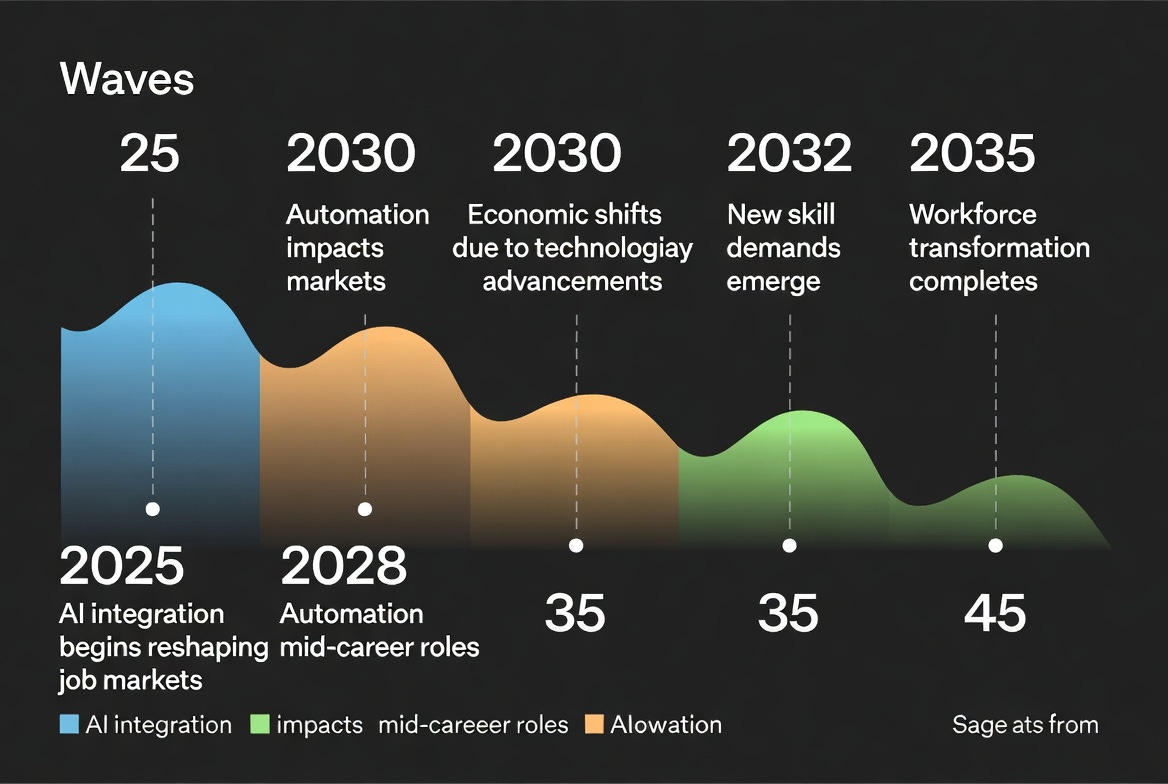
5 years (2030): 30% automation: Entry-level white-collar work largely eliminated, 40% of enterprise apps embed agents.
10 years (2035): Missing middle collapses: 1 person + AI replaces small teams, 60% of jobs see major changes.
15 years (2040): Near-AGI capabilities: 60-70% of knowledge work economically automated.
AGI forecasts shortened dramatically: 25% chance by 2027, 50% by 2031 per Metaculus.
300 million jobs globally at risk: 14% of workers worldwide will change careers by 2030.
Entry-level disappears first: 50 million U.S. entry jobs at risk, 18-24 year-olds 129% more worried.
Age determines timeline: 18-year-olds face all three waves in their 20s.
Career ladders break: Automation eliminates rungs faster than you can climb.
Daily life accelerates: AI teams, smaller companies, autonomous everything.
Markets move on anticipation: Companies restructure based on expectations, not perfect systems.
📚 READING PREREQUISITES
Recommended Prior Reading:
AI, AGI, and Agents: What They Are and Why You Should Care - Foundation for understanding the three technology levels
How AI and Agents Work Today: Real Examples from 2025 - Current deployment reality showing this isn’t speculation
What Comes Next:
The Three Waves: Execution, Coordination, Cognition (Post 4)
Age-specific impact analysis and timelines (Posts 5-7)
Strategic response frameworks (Post 8)
5 Years (2030): The Agent-AI Takeover
McKinsey projects 30% of U.S. jobs fully automated by 2030, with 60% seeing significant task changes. Entry-level white-collar work faces near-total elimination: data entry, basic bookkeeping, customer service tier 1, junior content writers, entry-level paralegals. Nearly 50 million U.S. entry-level jobs at risk.
40% of enterprise applications embed AI agents by end of 2026, per Gartner. By 2030, integration is ubiquitous. Companies don’t hire coordinators when agents coordinate better.
Your 2030 workplace: Agents draft documents, manage calendars, generate reports, handle inquiries, process invoices. The junior analyst position you’d get promoted to? Doesn’t exist. Remote work becomes remote AI teams—companies operate with 70% fewer employees doing 200% more work.
10 Years (2035): The Missing Middle Collapses
McKinsey research indicates one-third of the U.S. workforce may need entirely new occupations by mid-2030s. Multi-agent systems mature: one person directing AI agents replaces 5-10 professionals from 2025.
The mid-level coordination layer faces systematic elimination, project managers, mid-tier analysts, recruiting coordinators, financial advisors, property managers, medical billing specialists. This is the “missing middle”: entry-level automated by 2030, senior strategy remains, everything between disappears.
Healthcare shifts: AI handles diagnostic support, treatment planning, medical records. Autonomous vehicles deploy widely, affecting 3.5 million transportation jobs. Education transforms: AI tutors provide PhD-level personalized learning; teachers become coordinators.
15 Years (2040): The Near-AGI Reality
Whether “true” AGI exists becomes irrelevant. Expert consensus varies wildly, Metaculus gives 50% AGI probability by 2031, conservatives push to 2040-2050. But markets don’t wait for perfect AGI.
Systems with 80-90% of human cognitive capability at 1% of cost eliminate 60-70% of knowledge work economically. Not because AI is better at everything, because it’s good enough at enough things at low enough cost.
Generalist software developers, mid-tier consultants, routine lawyers, financial advisors, many radiologists, substantial middle management, all facing AI performing core functions at acceptable quality for drastically lower cost.
Work restructures: 40-hour workweek collapses for many, Universal Basic Income becomes policy reality in regions, “career” as 40-year ladder becomes historical. Personalized AI everything: entertainment, education, healthcare, financial planning. Virtual/augmented reality mature into primary social spaces.
The Age-Specific Timelines That Actually Matter
Age 18 in 2025: Age 23 (2030) = Wave 1 hits, Age 28 (2035) = Wave 2 hits, Age 33 (2040) = Wave 3 hits. Your entire 20s occur during all three disruption waves.
Age 30 in 2025: Age 35 (2030) = Wave 1 complete, Age 40 (2035) = Wave 2 hitting YOU, Age 45 (2040) = Wave 3 arriving. Peak earning years = peak disruption years.
Age 50 in 2025: Age 55 (2030) = Wave 1 complete, Age 60 (2035) = Wave 2 complete, Age 65 (2040) = Wave 3 arrives. Planned exit timeline conflicts with automation timeline.
Why Timeline Uncertainty Doesn’t Matter
Optimistic forecasts: AGI by 2027-2031
Conservative forecasts: AGI by 2040-2050
The range: 2-25 years
But here’s what’s identical across all scenarios: The disruption waves hit in the same sequence at roughly the same times regardless of when “true” AGI arrives.
Execution layer automation (Wave 1) happens with current AI, not AGI. Coordination layer automation (Wave 2) happens with multi-agent systems, not AGI. Even substantial cognitive work automation (Wave 3) happens with near-AGI capabilities, not perfect human-level AGI.
Markets restructure based on anticipation. Companies eliminate roles when they expect automation, not when automation is perfect. Students avoid careers they expect to disappear. Investors fund businesses built for AI-native operations.
Your strategic response depends on which wave threatens your specific work, and all three waves hit within 15 years regardless of AGI arrival date.
The Psychological Trap
Most people processing this timeline make one of two mistakes:
Mistake 1: “AGI is decades away, so I have time”
Wrong. Agent-AI automation hitting in 5 years doesn’t require AGI. If you’re in an execution or coordination role, your clock runs out long before AGI arrives.
Mistake 2: “AGI could arrive in 2 years, so nothing matters”
Wrong. If you position strategically for the 5-year timeline, you’re protected even if AGI comes faster. If you panic and do nothing, you’re exposed to the 5-year wave regardless.
The rational response: Position for the earliest threat to YOUR specific work, which creates resilience against all later waves.
💡 KEY TAKEAWAYS
Remember These Timeline Realities:
30% of jobs automated by 2030: First wave hits in 5 years with current technology, no AGI required
Age determines your specific timeline: 18-year-olds face all three waves during their 20s; 50-year-olds face disruption at planned retirement
Markets move on anticipation: Companies restructure NOW based on expected automation, not perfect systems
❓ FREQUENTLY ASKED QUESTIONS
Q: If experts disagree on AGI timelines, how can these predictions be reliable?
A: All three automation waves occur with pre-AGI technology. Wave 1 uses current AI, Wave 2 uses multi-agent systems deploying now, Wave 3 uses near-AGI capabilities. Whether “true” AGI arrives in 2027 or 2045 doesn’t change these waves’ timing.
Q: Won’t new jobs be created to replace automated ones?
A: Yes, but not in the same quantities, locations, or requiring the same skills. History shows technology creates jobs, but the transition period crushes individuals who can’t adapt. Saying “new jobs will emerge” doesn’t help the 35-year-old mid-level analyst whose role disappears in 2035.
Q: Why should I trust these timeline predictions when experts have been wrong before?
A: You shouldn’t trust precise dates. But you should trust the sequence and the range. Whether Wave 2 hits in 2032 or 2038 doesn’t change your strategic response if you’re 30 today, you need to reposition before mid-career roles disappear.
🎯 READY TO UNDERSTAND YOUR SPECIFIC WAVE?
Understanding the 15-year timeline is step three. Next, you’ll see exactly which jobs each wave threatens and why.
Subscribe to the December 2025 AI Challenge for the specific job categories at risk in each wave, and age-specific strategic responses.
Questions about your specific timeline? Drop a comment—I respond to every message.
📖 RELATED READING
Continue Your Learning:
80,000 Hours: When Do Experts Expect AGI?: Comprehensive analysis of expert AGI forecasts and timeline compression.
McKinsey: Generative AI and the Future of Work: Detailed projections of automation impact through 2030.
Metaculus: AGI Forecasting: Live prediction markets showing real-time expert consensus on AI timelines.
CONNECT WITH SAFERWEALTH
Expand Your Learning Beyond This Post:
Web: SaferWealth.com - Business value and strategic positioning
Video: SaferWealth Posts - Educational video content
LinkedIn: LinkedIn @SaferWealth - Career and business strategy insights
Rumble: @saferwealth - Video analysis of economic trends
Instagram: @saferwealth - Quick insights and updates
👤 ABOUT THE AUTHOR
Sean Cavanagh, BAS, CPA, CA, CF, CBV
With over three decades negotiating business sales and conducting valuations, Sean now applies his systematic approach to career architecture in the AI era. Starting at Deloitte and Canada Revenue Agency, he’s built a career analyzing value creation, risk reduction, and strategic positioning—principles that apply equally to businesses and individual careers.
Connect with Sean:
📚 DO YOUR OWN RESEARCH
AGI Timeline Research:
80,000 Hours: AGI Expert Forecasts - Comprehensive timeline analysis
Metaculus - Prediction market aggregating expert forecasts
AI Multiple: AGI Timeline Analysis - 8,590 predictions analyzed
Automation Impact Research:
McKinsey: Future of Work - Workforce transition projections
National University: AI Job Statistics - Current automation impact data
Bain: Labor 2030 - Comprehensive workforce analysis
⚖️ EDUCATIONAL DISCLAIMER
This guide provides information only, not professional advice. Timeline projections represent aggregated expert forecasts and are subject to significant uncertainty. Career planning should be made in consultation with qualified advisors for your specific situation. Neither the author nor YBAWS! accepts liability for actions based on this content. This material supplements but never replaces proper professional consultation and judgment.
YBAWS! (Your Business Ain’t Worth Sh*t!) is a trademark and educational platform dedicated to helping individuals and business owners understand value creation and strategic positioning.
© 2025 YBAWS! All rights reserved.


